
How Batom Is Reimagining the EV Gearbox
Electric vehicles have reshaped what a transmission needs to do. The internal combustion engine required complex multi-gear systems to keep its narrow power band useful across driving speeds. Electric motors deliver maximum torque from near-zero RPM (or from stall), so the industry has converged on a simpler answer: a single-speed reduction gearbox, where typical fixed ratios often fall between 7:1 and 10:1 depending on motor characteristics, vehicle mass, and target wheel speed. By most industry estimates, this architecture is used in a vast majority of passenger EVs in production today.
The simplicity is elegant, but it masks a harder engineering problem. Without engine noise to cover it, minute manufacturing variations in the gear mesh can become audible inside the cabin. Noise frequencies previously masked by internal combustion engines now present critical NVH challenges across the EV drivetrain. For gear manufacturers, electrification raised the precision bar to a level the automotive industry had not previously demanded at volume.
Batom Co., Ltd., a Taiwan-based precision gear manufacturer with over 40 years of experience, has been leveraging its high-precision capabilities to address this exact challenge. The company produces EV gears, Dual-Clutch Transmission (DCT) components, and planetary (hybrid) assemblies for the automotive sector, alongside engine and wing-control gears for aerospace, and custom solutions for various industrial applications worldwide.
Why EV Gears Are Harder to Make Than They Look
The core issue is transmission error (TE) — the deviation between the theoretical and actual position of the driven gear during mesh. In a combustion vehicle, TE produces vibrations that get drowned out by the engine. In an EV, those same vibrations propagate through shafts and bearings into the housing, creating the characteristic whine that passengers can hear at almost any speed.
The contributors to EV drivetrain NVH are well understood at this point: gear macro- and micro-geometry errors, stiffness variations during mesh engagement, assembly misalignments, and manufacturing tolerances. Each factor compounds the others, and a gear that passes individual tooth inspection on a static gear-tester can still generate unacceptable noise when it runs in its actual housing under load. This is why downstream validation matters as much as upstream measurement.
There is more on gear noise and NVH in electric drivetrains in the EV gear noise guide.
Surface waviness adds another layer of complexity. Waviness patterns on gear tooth surfaces — often invisible to conventional quality checks — create tonal noise components that are particularly irritating to the human ear. Controlling waviness requires tight integration between the grinding process, machine-tool condition, and real-time measurement feedback, exactly the kind of process discipline that distinguishes an EV-grade gear supplier from a general-precision machine shop.
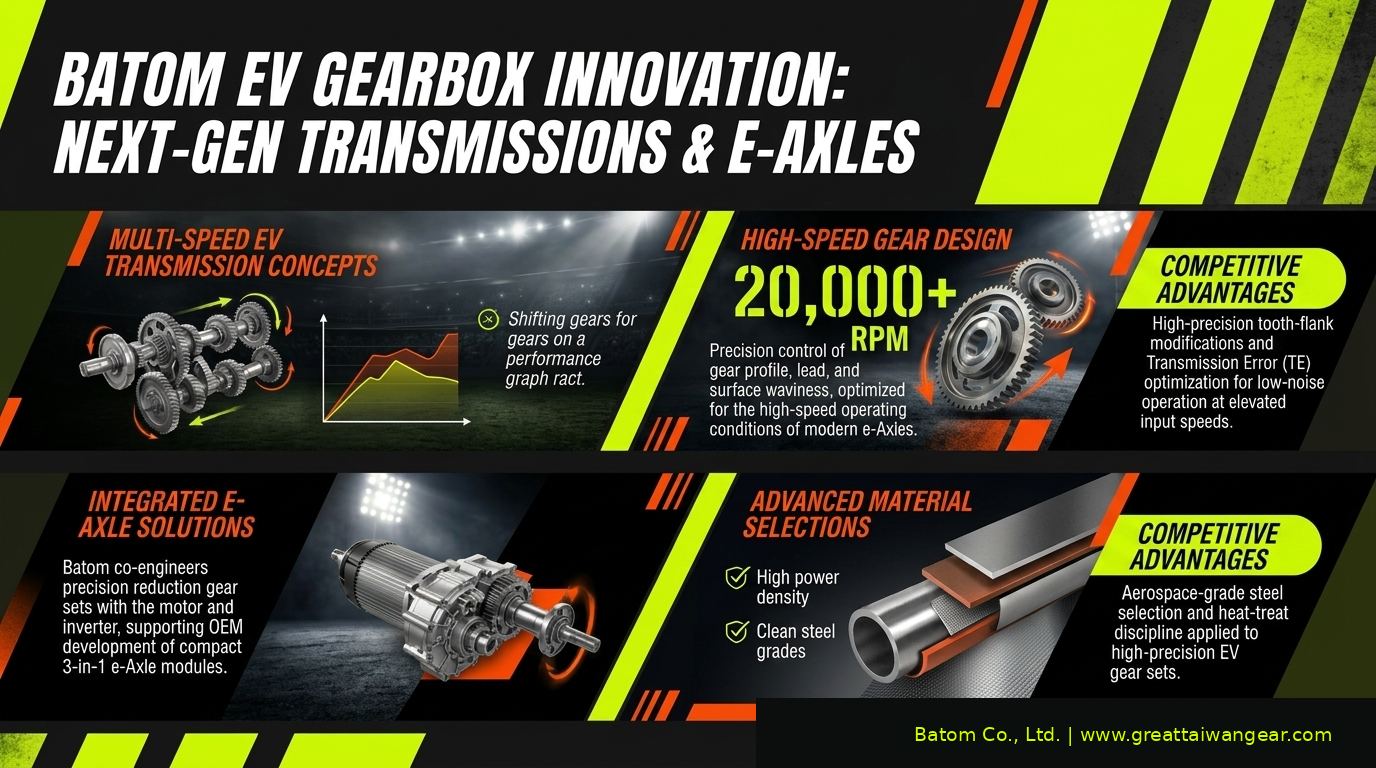
Batom's manufacturing system addresses these challenges through specialized processing capabilities: gear profile modification, lead modification, twist correction, and surface waviness control. The company holds IATF 16949 (automotive quality management), AS9100 (aerospace), and Nadcap certifications — standards that enforce the kind of process discipline EV gear manufacturing now demands.
Single-Speed vs. Multi-Speed: Solving NVH and Shift Shock With Batom's 2-Speed eAD Transmission
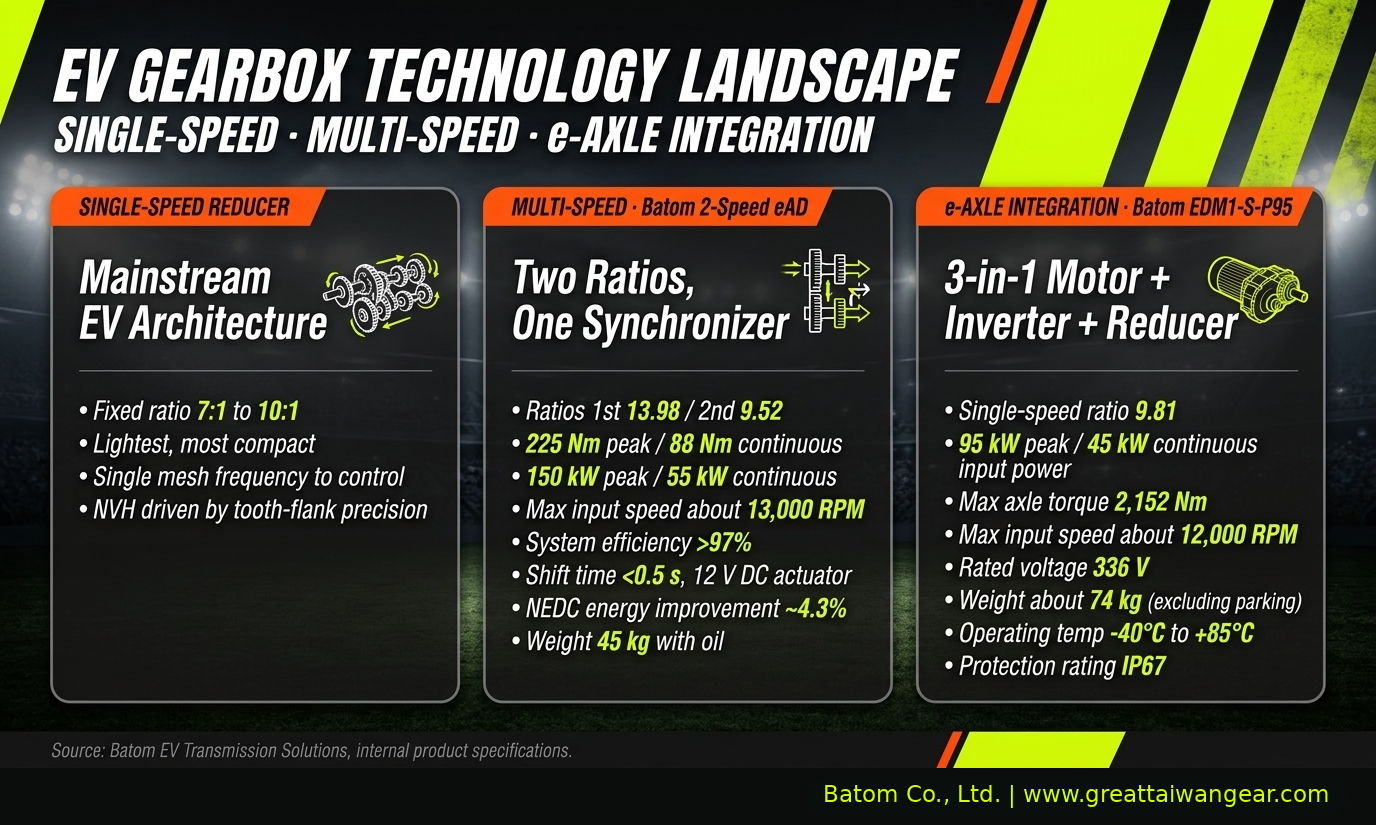
Single-speed reducers remain dominant for mainstream passenger EVs, but a second gear becomes attractive once a program prioritizes launch torque, top-end efficiency, or sustained grade performance. The trade-off is well known: adding a synchronizer and a second mesh path introduces two new failure modes that didn't exist in a one-speed reducer — shift shock at the moment of ratio change, and an additional NVH signature from the engaged but idling gear set. Batom's 2-Speed electric Axle Drive (eAD) Transmission is engineered around exactly those two problems.
The 2-Speed eAD couples a 13.98:1 launch ratio with a 9.52:1 cruise ratio, rated for 225 Nm peak / 88 Nm continuous input torque and 150 kW peak / 55 kW continuous input power. Maximum input speed is approximately 13,000 RPM, system efficiency exceeds 97%, the actuator shifts ratios in under 0.5 s on a 12 V DC drive, and the integrated splash-lubricated housing weighs 45 kg with oil at a 200 mm center distance. Under NEDC simulation, Batom's two-speed configuration shows roughly 4.3% better energy consumption than a comparable single-speed reducer — a real, internally measured number rather than a marketing extrapolation.
Two engineering disciplines do the heavy lifting:
- Gear micro-geometry modification. Profile crowning, lead crowning, tip relief, and root relief are tuned together so each tooth pair carries load smoothly across the meshing cycle, suppressing the transmission-error harmonics that turn into audible whine. Batom validates the modification set with gear-tester measurements and TE simulation before tooling is cut, then closes the loop with rolling-test data from finished hardware.
- Synchronizer engagement geometry. Shift shock in an EV two-speed is harder to mask than in an ICE manual transmission — there is no engine torque interrupt to hide behind. The 2-Speed eAD uses a cone-and-spline synchronizer matched to the actuator timing so the speed-matching phase completes within the sub-0.5 s shift window, keeping driveline jerk low enough that the passenger does not feel a step in tractive force.
The result is a two-speed architecture whose NVH and shift-quality profile is built around the gear set, not bolted on afterward. For Tier-1 integrators evaluating multi-speed concepts, the eAD shows that the precision-machining playbook Batom has refined on single-speed reducers scales cleanly into multi-speed territory.
| Parameter | Single-Speed Reducer (mainstream EV) | Batom 2-Speed eAD Transmission |
|---|---|---|
| Gear Ratio | Fixed, typically 7:1 – 10:1 | 1st 13.98 / 2nd 9.52 (switchable) |
| Input Torque (peak / continuous) | Motor-defined | 225 Nm / 88 Nm |
| Input Power (peak / continuous) | Motor-defined | 150 kW / 55 kW |
| Max Input Speed | Motor-defined | ≈13,000 RPM |
| System Efficiency | ~95–97% | >97% |
| Energy Consumption vs. 1-Speed (NEDC) | Baseline | ≈4.3% improvement (Batom internal simulation) |
| Shift Time | n/a | <0.5 s (12 V DC actuator) |
| Weight (with oil) | ~30 kg class | 45 kg |
| NVH / Shift-Shock Risk | Single mesh frequency to control | Managed via micro-geometry tuning + synchronizer geometry |
The e-Axle Integration Wave: Batom's EDM1-S-P95 3-in-1 System as Proof Point
The biggest structural change in EV drivetrains is the move to e-Axle architecture — packaging the electric motor, power electronics, and reduction gearbox into a single integrated module so the OEM no longer mounts three subsystems and tunes the interfaces between them. Once the three subsystems share a housing, gears can no longer be designed in isolation; their mesh harmonics, bearing loads, and thermal behavior become part of the inverter and motor calibration too.
Batom's EDM1-S-P95 3-in-1 System is the in-house proof point for that integration discipline. It packages motor, inverter, and a 9.81:1 single-speed reduction gearbox into a 465 × 450 × 375 mm housing weighing ≈74 kg (without the optional parking system), delivering 95 kW peak / 45 kW continuous input power, 2,152 Nm peak axle torque, and a maximum input speed of ≈12,000 RPM at 336 V — high-RPM operating conditions characteristic of, with the industry trajectory pushing toward 16,000–20,000+ RPM in next-generation programs. The unit is rated IP67 and qualified for –40 to +85 °C, with splash lubrication and electronic control as standard.
What is genuinely difficult about a 3-in-1 unit is not any single subsystem but the system-level transmission error budget. As motor speed climbs, the spectral content of TE shifts into frequency bands where the inverter switching, motor stator excitation, and gearbox mesh excitation can interact constructively and amplify cabin noise. Batom approaches this on three fronts inside the EDM1-S-P95:
- System-level low transmission error. The reduction stage is designed to a TE budget set against the integrated motor and inverter behavior — not against the gear alone — using profile/lead corrections and waviness control on the ground tooth flanks.
- Lightweight design at the housing level. An aluminum-alloy die-cast housing replaces the traditional grey cast iron, holding case-stiffness and NVH performance while shaving mass that previously came along for the ride.
- Thermal and lubrication co-design. Splash lubrication is tuned so that oil film, bearing temperatures, and gear-flank temperature stay within a window that preserves micro-geometry under continuous high-speed operation, validated on Batom's own automatic test equipment.
Empowering Next-Gen EV Gearboxes Through Precision Manufacturing
Batom co-develops and manufactures high-precision gear components for electric drive systems across multiple applications, spanning e-bikes, electric trucks, buses, and off-highway vehicles. As a Tier-2/Tier-3 precision component manufacturer, Batom focuses on the gear sets, shafts, and sub-assemblies that go into our customers' drive units — and that breadth of experience across torque levels and speed ranges gives the company a practical component-level knowledge base that pure-play automotive suppliers often lack.
Quality and Sustainability Infrastructure Built for the EV Transition
The manufacturing quality bar for EV gears is measurably higher than for conventional automotive gears. Quality Magazine reports that the electrification shift demands tighter manufacturing tolerances, particularly in lead and profile characteristics. Spline clearances that were traditionally masked by engine noise or absorbed by mechanical dampers — such as dual-mass flywheels and clutch-hub interfaces — in ICE drivetrains now directly contribute to audible clunking or droning in EVs, driven by the instantaneous torque delivery of the electric motor and the absence of engine sound to cover it.
Batom's quality infrastructure reflects this reality. The company's quality certifications (AS9100, IATF 16949, ISO 9001, and Nadcap) ensure full traceability from raw material through finished product, while its sustainability stack (ISO 14001, ISO 14064-1, ISO 14067, ISO 45001) guarantees responsible and safe manufacturing practices. Furthermore, Batom's application of aerospace-grade Nadcap accreditation to its special processes (including heat treatment) provides a level of metallurgical discipline and residual stress control that exceeds standard automotive requirements, ensuring exceptional long-term gear noise behavior.
End-to-End EV Gearbox Engineering Services
What separates a precision machining house from a full EV gearbox development partner is the breadth of the engineering loop. Batom's EV gearbox development capability is built to span the entire flow, from blank-sheet concept through the gearbox the OEM finally bolts onto the vehicle:
- Concept design. Ratio architecture, motor matching, packaging envelope, and target NVH / efficiency budgets are set against the customer's vehicle duty cycle.
- Design for Manufacturability (DFM). Tooth geometry, material grade, heat-treatment route, and housing manufacturability are reviewed before tooling is cut, so the design that ships matches the design that was simulated.
- Transmission Error (TE) simulation. Micro-geometry sets — profile crowning, lead crowning, tip and root relief — are iterated in simulation against the integrated motor / inverter behavior, then locked in as a manufacturing target.
- Prototype build and rolling test. Hardware is instrumented for speed, torque, vibration, and bearing / gear-flank temperature, then run on Batom's automatic test equipment under representative duty conditions rather than only static gear-tester checks.
- End-of-Line (EOL) testing. Every production unit is verified against the same dynamic envelope used in development — speed, torque, vibration, and temperature signatures — so what leaves the line matches what was qualified.
The Gearbox Development cell instruments the input shaft, intermediate shaft, and output shaft with X/Y/Z accelerometers and a tacho on the output, plus bearing-temperature sensors on each shaft and dedicated gear-flank temperature probes. Forward-speed runs capture speed/torque, temperature, vibration, and durability data simultaneously, with a high-loading test rig stressing the gear set toward end-of-life behavior. This dynamic running-condition validation is, in practice, a stronger predictor of in-vehicle NVH and reliability than static measurement alone — gears that pass tooth-tester inspection can still fail under load, and Batom catches those failures on the rig, not at the OEM.
For OEMs and Tier-1 integrators, the practical upshot is that the same supplier who grinds the tooth flanks also owns the simulation model, the prototype rig, and the EOL fixture. The feedback loop closes inside one building, which compresses the iteration cycle and reduces the number of program risks that have to be carried into the customer's own validation campaign.
References:
- Batom — 2-Speed eAD Transmission product specifications
- Batom — EDM1-S-P95 3-in-1 System product specifications
- Batom — EV Gearbox Development & Automatic Test Equipment
- Quality Magazine — Noise, Vibration, Harshness (NVH) Quality Inspection
- Batom — Gear Design and Analysis capability overview
About the Author
This article was produced by the marketing team at Batom Co., Ltd., founded in 1981 in Taichung, Taiwan. With over 40 years of precision gear manufacturing expertise and certifications including IATF 16949, AS9100, and Nadcap, Batom serves leading automotive, aerospace, and industrial OEMs. The company's EV-related capability covers single-speed reducer gear sets and growing engineering and machining capability for future multi-speed transmissions and integrated e-drive unit gear sets, supporting OEM and Tier-1 system development from prototype through volume.
Ready to explore how precision EV gear solutions can work for your next drivetrain project? Schedule a consultation with Batom's engineering team to discuss tailored solutions.
Frequently Asked Questions
Q1: Do electric cars have gearboxes? A: Yes. The vast majority of production passenger EVs use at least one gear — typically a single-speed reduction gearbox that converts high motor RPM into usable wheel torque. The fixed ratio usually falls between 7:1 and 10:1, eliminating the need for gear shifting while still providing the mechanical advantage required for acceleration and cruising.
Q2: Why are EV gearboxes so noisy? A: Electric motors are nearly silent, which removes the engine noise that traditionally masked gear mesh vibrations. Transmission error, surface waviness, and assembly misalignments that were inaudible in combustion vehicles now become the dominant sound sources in an EV cabin, making precision manufacturing critical.
Q3: What is a multi-speed EV transmission, and why is it gaining traction? A: A multi-speed EV transmission utilizes two or more selectable gear ratios instead of a single fixed one. While single-speed reducers dominate the current mainstream market due to their simplicity, multi-speed architectures (such as 2-Speed eAD systems) are increasingly adopted for high-performance and heavy-duty applications. By switching gears, the system allows the electric motor to operate within its peak efficiency window across a wider range of vehicle speeds. This provides massive torque for launch and acceleration in the lower gear, while significantly reducing battery energy consumption during high-speed highway cruising in the higher gear. For gear manufacturers, this introduces new NVH and shift-quality challenges, requiring extreme precision in micro-geometry design and synchronization.
Q4: What is an e-Axle in electric vehicles? A: An e-Axle integrates the electric motor, power electronics, and reduction gearbox into a single compact module. This architecture reduces weight, simplifies assembly, and improves packaging efficiency. It requires gears to be co-engineered with the motor and inverter for optimal NVH performance.
Q5: How does gear quality affect EV range? A: Gear manufacturing precision directly impacts drivetrain efficiency. Optimized gear tooth profiles minimize transmission error for superior NVH performance, while precision grinding for geometric accuracy, combined with superfinishing processes to significantly reduce sliding friction losses, directly translating to improved drivetrain efficiency and range. In multi-speed transmissions, gear quality also affects shift smoothness, which influences regenerative braking efficiency and overall energy recovery.