

Sourcing Precision Gears From Taiwan: Cost, Quality & Supply Chain Advantages
Taiwan has emerged as a precision gear sourcing destination that offers an optimal balance of cost, quality, and supply chain reliability. For OEMs and supply chain professionals evaluating gear suppliers, Taiwan presents a compelling alternative to Western premium suppliers, Chinese commodity producers, and Japanese specialists. This practical buyer's guide explores the strategic advantages of sourcing precision gears from Taiwan, from initial RFQ through production and delivery.
Why Taiwan for Precision Gears: The Strategic Case
Sourcing decisions are rarely simple. Engineers want the best quality; procurement wants the lowest cost; operations wants reliability and speed. Taiwan delivers across all three dimensions and is becoming a strong sourcing option for global precision gear programs — particularly for OEMs that value engineering collaboration alongside competitive pricing.
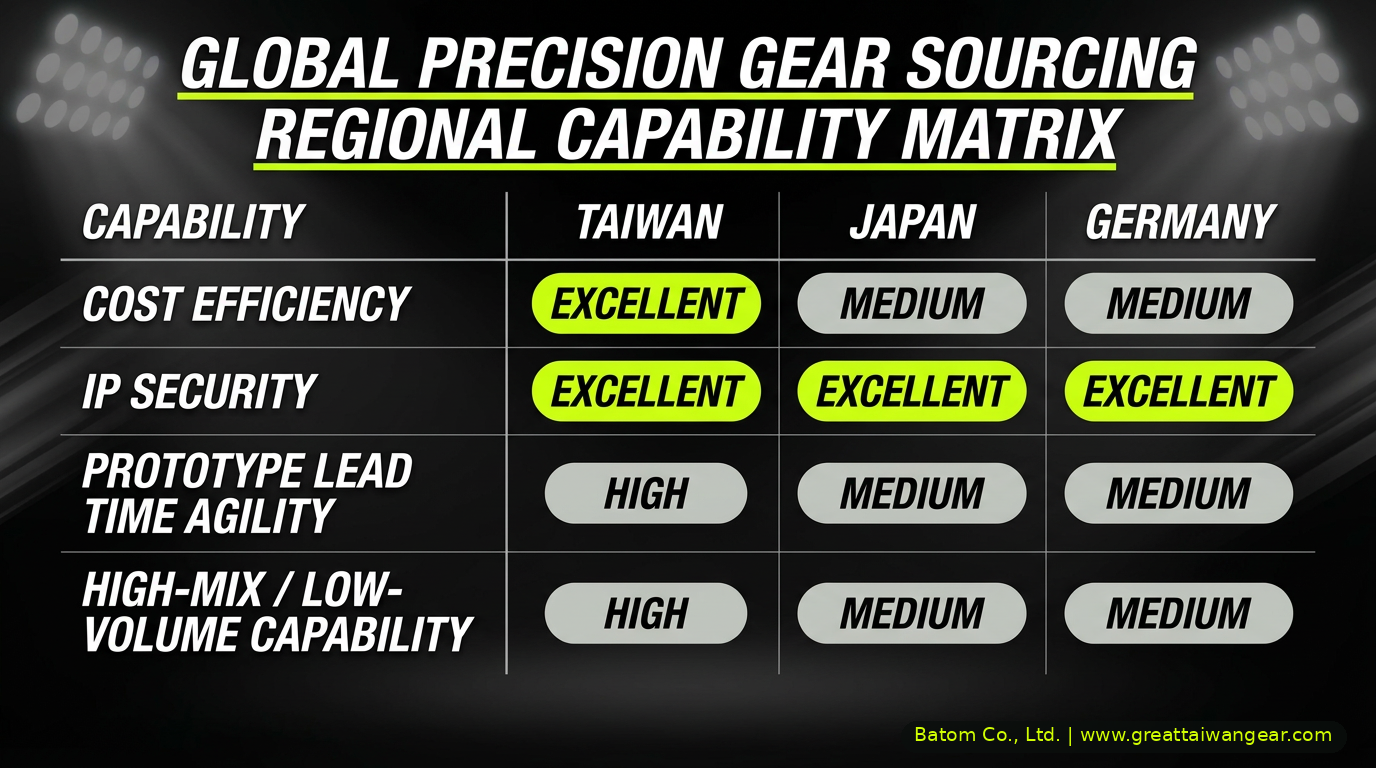
Cost Analysis: 10-30% Savings vs Western, 15-25% vs Japan
The most visible advantage of Taiwan sourcing is cost. But the cost advantage is nuanced and depends on application, volume, and technical specifications.
Taiwan vs Western Suppliers (US, Germany, Switzerland)
- Price advantage: 10-30% cost savings
- Quality parity: Equivalent to superior
- Lead time: 2-4 weeks faster
- Volume flexibility: Better for prototypes and low-volume runs
Indicative relative-cost comparison for DIN 6 (AGMA A5) spur gears versus comparable Western quotations. Figures express the typical unit-cost reduction range observed on a like-for-like specification basis; the TCO column captures the qualitative landed-cost picture once defect rates, IP security, and lot-over-lot consistency are factored in. Actual savings depend on material, certification scope, batch size, and current market conditions.
| Specification | Estimated unit-cost reduction vs. Western | Total Cost of Ownership (TCO) — qualitative |
|---|---|---|
| Small spur gear (10-50mm) | 15-25% | Strong — predictable lot quality lowers rework |
| Medium spur gear (50-150mm) | 20-30% | Strong — tighter Cpk on critical features |
| Large spur gear (150-300mm) | 20-30% | Strong — vertically integrated heat treat and grinding |
| Helical gear assembly | 15-25% | Strong — assembly-level inspection capability |
| Bevel gear pair | 20-30% | Strong — specialized bevel cutting and grinding systems |
Taiwan vs Japanese Suppliers
- Price advantage: 15-25% cost savings
- Quality comparison: Taiwan delivers highly competitive precision and consistency, successfully meeting the stringent ISO/DIN tolerances traditionally dominated by Japanese suppliers
- Lead time: Comparable (10-14 weeks)
- Specialization: Japan strong in ultra-niche applications; Taiwan broader capability
Japan maintains pricing premium due to:
- Established brand reputation
- Higher labor costs
- Historical brand equity and proprietary metallurgical heritage
Taiwan competes effectively because:
- Government-subsidized training programs reduce labor costs
- Modern manufacturing equipment amortized across larger volumes
- Economies of scale in material sourcing
- Competitive talent pool attracted by growing aerospace/medical sectors
Taiwan vs Chinese Suppliers
- Cost dynamics: While Chinese suppliers often aggressively target high-volume, standard commodity markets on initial piece-price, Taiwan consistently demonstrates superior Total Cost of Ownership (TCO) when factoring in defect rates, IP security, and lot-over-lot consistency for precision applications
- Quality trade-off: In quality-sensitive segments, Taiwanese suppliers often demonstrate lower defect rates and stronger lot-over-lot consistency, particularly on certified medical, aerospace, and EV-grade work
- Supply chain risk: Taiwan operates a separate legal and IP framework with stronger enforcement track record for design-rights and trade-secret cases relative to many alternatives
- Regulatory compliance: Taiwan-based suppliers are generally well represented in medical, aerospace, and automotive certification ecosystems, supporting the documentation work required by Western OEMs
Quality System Maturity: Certifications and Standards
Taiwan's competitive advantage extends far beyond cost. The quality system maturity of Taiwanese manufacturers represents years of accumulated investment in certifications, processes, and continuous improvement.
ISO 9001 Certification (Quality Management)
Most established Taiwanese precision gear manufacturers serving export markets maintain ISO 9001 certification. In practice, that means:
- Design control: Customer requirements translated to specifications with formal reviews
- Production control: Statistical process control (SPC) charts, in-process inspections
- Inspection and testing: Incoming, in-process, and final inspection protocols
- Document control: Revision control, engineering change management, and documented information retention
- Corrective action: Root cause analysis and preventive actions
- Record retention: Documented procedures aligned with OEM requirements (often scaling to 10+ years for critical aerospace/medical applications)
ISO 13485 (Medical Devices)
For medical device suppliers, ISO 13485 is increasingly expected. Among larger, medical-oriented Taiwanese manufacturers, an estimated meaningful share holds active ISO 13485 certification — sufficient to support a robust shortlist for most medical-device gear programs. Certification scope and validity vary by supplier, so it should always be verified directly with the issuing body. ISO 13485 itself supports:
- Risk management: FMEA (failure mode and effects analysis) mandatory
- Biocompatibility management: Material sourcing controls and lot traceability
- Material sterilization compatibility: For components used in sterilizable instruments
- Traceability: Complete chain from raw material to finished device
- Complaint investigation support: Assisting OEMs with root cause analysis and CAPA execution for field performance inquiries.
IATF 16949 (Automotive)
For automotive-grade gears, IATF 16949 certification is the working standard. A meaningful share of larger, export-focused Taiwanese gear manufacturers — by our estimate among the larger suppliers — hold active IATF 16949 certification; exact figures vary by year and reporting source and should be verified during qualification. The framework drives:
- Appearance and minor defects: Zero-defects mindset
- Advanced product quality planning (APQP): Structured approach to new product development
- Production part approval process (PPAP): Formal sign-off before production
- Control plans: Documented process control strategy
- Poka-yoke: Error prevention at source
AS9100 (Aerospace)
For aerospace applications, AS9100 certification is the baseline expectation. A select group of established, aerospace-focused Taiwanese manufacturers hold active AS9100 certification, reflecting the stringent quality and traceability requirements of aerospace and defense supply chains. Certification scope and validity should always be confirmed directly with the certifying registrar. AS9100 supports:
For the full treatment of lot traceability and material records, see the aerospace traceability guide.
- Configuration management: Engineering change control
- Foreign object debris (FOD): Cleanroom protocols and controls
- Counterfeit parts prevention: Supplier authentication and material verification
- Product safety: Traceability for critical components
- Counterfeit and suspect counterfeit (COSC) reporting
Nadcap Accreditation (Special Processes)
Among larger, aerospace-oriented Taiwanese suppliers, Nadcap special-process accreditations have become an estimated meaningful presence — covering capabilities such as:
- Heat treatment (carburizing, hardening, tempering)
- Surface treatments (plating, coating, nitriding)
- Non-destructive testing (NDT, X-ray, ultrasonic)
IP Protection Framework: Your Designs Are Safe
One of the most significant concerns for Western OEMs sourcing from Asia is intellectual property protection. Taiwan offers stronger legal protections than most Asian competitors.
Taiwan's IP Legal Framework
International IP Alignment
- Taiwan operates a modern IP regime that is broadly aligned with major international standards
- Taiwan is bound by the TRIPS agreement (Trade-Related Aspects of Intellectual Property Rights) through that membership
- Enforcement runs through Taiwan's specialized IP court system rather than ad-hoc administrative processes
Design Patent Protection
- Up to 15 years of protection from the filing date under Taiwan's current Patent Act
- Reasonable enforcement track record through the IP and Commercial Court
- Application and prosecution cost varies with claim scope and prosecution complexity
Invention Patent Protection
- Up to 20 years of protection from the filing date for invention patents
- Strong enforcement through the Intellectual Property and Commercial Court (established 2008, restructured 2021)
- Application and prosecution cost varies with technical complexity and translation needs
Trade Secret Protection
- Civil code protects trade secrets
- Strict criminal penalties for misappropriation (up to 5 years imprisonment for domestic infringement, and up to 10 years for intent to use in foreign jurisdictions under Taiwan's Trade Secrets Act)
- Reasonable steps required (NDA, access controls, security measures)
Copyright Protection
- Automatic protection (no registration required)
- Infringement remedies available
- International alignment via WTO/TRIPS membership and bilateral intellectual property agreements
Practical IP Safeguards When Sourcing from Taiwan
Contractual Protections
- Comprehensive NDA covering all technical data
- Explicit prohibition on disclosure to third parties
- Specifications for data storage and access controls
- Indemnification for unauthorized disclosure
- Remedies for breach (liquidated damages, injunctive relief)
Supplier Audit Program
- Initial audit of security measures and quality systems
- Review of access controls and personnel clearance procedures
- Verification of document control and data encryption
- Annual re-audit to ensure continued compliance
Design Protection Strategies
- Execute comprehensive NDAs before supplier collaboration, and file patents before any public or third-party disclosure
- Use design patents to create legal barriers for competitors
- Maintain separate supplier relationships for critical subsystems
Illustrative scenario: Designing IP Leakage Out of the Program The following is an anonymized, representative scenario based on typical engagements we see in this space. A medical-device OEM partnered with a Taiwanese precision-gear manufacturer to develop a specialized wrist gear assembly. Before any technical disclosure, the parties executed a stringent NDA covering tooth geometry, process steps, and downstream manufacturing know-how. The supplier's plant operates internal information-isolation and access-control protocols — including segregated project rooms, role-based document permissions, and audit logs on drawing access — so that only the cleared engineering team could view the OEM's controlled drawings. Over the multi-year development cycle, the design never left that controlled environment, and the OEM secured its global patent portfolio without any leakage event. The combination of pre-filed patents, contractually enforced confidentiality, and supplier-side access control turned IP protection from a reactive enforcement question into a prevention-by-design outcome. Specific contractual terms and control structures should always be tailored with qualified IP counsel.
Manufacturing Lead Times by Application
Manufacturing lead time and logistics transit time should be planned as two separate buckets. This section covers in-plant manufacturing lead time — from PO release through final lot release at the factory. Ocean and air-freight transit times are addressed separately under "Logistics and Shipping" below.
Standard Manufacturing Lead Times by Application
Typical ranges only. Actual schedules and pricing vary substantially with gear geometry, material, certification scope, tooling availability, and current shop loading at the chosen supplier. *Lead times below are highly dependent on specialty raw material availability and heat-treatment batch processing, and are intended as planning benchmarks rather than commitments.
Prototype / Low-Volume (1-50 units)
- Raw material procurement (highly dependent on alloy specialty): 2-4 weeks
- Specification review, DFM, and custom tooling (if required): 4-8 weeks
- First article production: 4-6 weeks
- Inspection and approval: 2-3 weeks
- Total timeline: 12-18 weeks
- Cost: Custom tooling investment required (if applicable); per-unit pricing reflects NRE and setup amortization
Small-Volume Production (50-500 units)
- Raw material procurement (highly dependent on alloy specialty): 2-4 weeks
- NRE and tooling: 4 weeks
- Production: 6-8 weeks
- Quality assurance: continuous in-process SPC with final lot-release inspection — 2 weeks
- Total timeline: 14-18 weeks
- Cost: Tooling amortized, per-unit cost approaching production rate
Medium-Volume Production (500-5,000 units)
- Raw material procurement (highly dependent on alloy specialty): 3-5 weeks
- Setup and preparation: 2 weeks
- Production: 8-10 weeks
- Quality assurance: continuous in-process SPC with final lot-release inspection — 3 weeks
- Total timeline: 16-20 weeks
- Cost: Optimal per-unit pricing
High-Volume Production (5,000+ units)
- Raw material procurement (highly dependent on alloy specialty): 4-6 weeks
- Setup: 2 weeks
- Production: 10-14 weeks (scheduled in batches)
- Quality assurance: continuous in-process SPC with final lot-release inspection — 2-3 weeks
- Total timeline: 18-24+ weeks
- Cost: Maximum discount, volume pricing
*Lead times are highly dependent on specialty raw material availability and heat-treatment batch processing.
Logistics and Shipping
Taiwan's geographic position creates both advantages and considerations for logistics planning. Once the manufacturing lead times above are complete, the shipment moves into the logistics phase below.
Shipping Methods and Costs
Freight rates are highly volatile and route-dependent. The transit-time ranges below are typical-condition benchmarks for planning only. Actual rates and schedules should always be confirmed with a freight forwarder at the time of shipment.
Air Freight
- Transit time: typically 5-7 days to US West Coast, 7-9 days to US East Coast, and 6-9 days to Europe
- Best for: urgent prototype delivery, high-value components, FAI samples, and time-sensitive program milestones where landed-cost premium is acceptable
Ocean Freight (LCL — Less than Container Load)
- Transit time: typically 14-18 days to US West Coast, 21-28 days to US East Coast, and 28-35 days to Northern Europe
- Best for: shipments that are physically small in volume but mechanically dense — exactly the profile of precision metal gear components, which occupy little cubic space but carry significant weight. LCL allows OEMs to consolidate these heavy, low-volume gear lots without paying for a full container, optimizing total transportation cost
Ocean Freight (FCL — Full Container Load)
- Transit time: typically 14-18 days to US West Coast, 21-28 days to US East Coast, and 28-35 days to Northern Europe
- Best for: large production runs of high-volume gear families, where total cubic and weight justify a dedicated container
- Example: a full container of heavy-duty transmission assemblies or high-volume automotive gearsets
Incoterms and Responsibility
Most Taiwanese suppliers quote on one of the following Incoterms 2020 bases. The right term depends on the chosen transport mode (sea, air, or multimodal) and on which party is best positioned to manage carriage, insurance, and customs:
- EXW (Ex Works) — buyer takes responsibility at the supplier's loading dock; gives sophisticated buyers full control of carrier choice, consolidation, and export customs handling. Suitable for any mode of transport.
- FCA (Free Carrier) — seller delivers cleared-for-export goods to a carrier nominated by the buyer at a named place. This is the correct Incoterm for air freight and multimodal shipments (including LCL and consolidated cargo); it has largely replaced FOB for non-bulk container traffic in modern practice.
- FOB (Free On Board) — seller pays freight to the loading port and bears risk until the goods are loaded on board the vessel; buyer takes over ocean freight and insurance. FOB applies only to sea freight (and inland waterway) shipments; for air freight or container shipments handed over at an inland terminal, FCA is the correct equivalent.
- CIF (Cost, Insurance, Freight) — seller arranges and pays for freight and minimum insurance to the destination port. Sea-freight only.
- CIP (Carriage and Insurance Paid To) — seller arranges carriage and insurance to a named destination. Suitable for air, multimodal, and combined transport where CIF is not applicable.
- DAP / DDP — seller handles freight to the buyer's destination (DAP), or to the buyer's destination cleared through import customs (DDP). Suitable for any mode of transport.
Incoterms selection is best matched to each customer's logistics setup, transport mode, and risk preference. CIF/CIP or DAP/DDP can simplify logistics and place freight responsibility on the seller; FCA or EXW gives sophisticated buyers tighter control of carrier choice, consolidation, and customs handling. Either model is commonly supported by Taiwanese suppliers; the right choice depends on the customer's freight contracts, customs broker, and internal landed-cost objectives.
Communication and Time Zone Advantages
Taiwan's geographic position and English-speaking workforce create surprising advantages for Western OEMs.
Time Zone Efficiency
Taiwan (UTC+8) vs Key Markets (time-zone offsets shown for US standard time; the overlap windows shrink slightly during US daylight saving):
| Market | Time difference vs Taiwan | Useful business-hour overlap | Operational implication |
|---|---|---|---|
| US West Coast (PST, UTC-8) | 16 hours | Roughly 1 hour: Taiwan 9-10 AM ≈ US West Coast 5-6 PM (prior day) | Tight same-day overlap; most exchanges rely on end-of-day handoff |
| US East Coast (EST, UTC-5) | 13 hours | Roughly 1 hour: Taiwan 9-10 AM ≈ US East Coast 8-9 PM (prior day) — narrow direct overlap; most teams work an overnight handoff cadence | Practically a "follow-the-sun" workflow rather than a live overlap |
| Continental Europe (CET, UTC+1) | 7 hours | Roughly 2-3 hours: Taiwan 3-6 PM ≈ Europe 8-11 AM | Comfortable mid-day window for engineering reviews |
| Japan (UTC+9) | 1 hour | Effectively full business-day overlap | Same-day, real-time collaboration |
| India (IST, UTC+5:30) | 2.5 hours | Roughly 4-5 hours: Taiwan 11:30 AM-5 PM ≈ India 9 AM-2:30 PM | Strong same-day overlap for engineering review |
Practical Impact: A US OEM discovers a critical gear defect at the end of the workday Pacific time. The Taiwanese supplier is just starting the next business morning; the issue can be elevated to engineering and quality during the buyer's overnight, root-cause analysis is closed out within Taiwan's working hours, and a corrective-action plan is in the buyer's inbox before the next business day starts on the US West Coast. The advantage here is operational, not absolute — Japanese and European suppliers are equally capable, but the time-zone overlap between Asia-Pacific manufacturing partners and US teams typically gives North American programs a productive overnight cycle for fast-moving issues, while European programs gain a live mid-day window with Taiwan.
English Communication and Engineering-Documentation Capability
For cross-border gear programs, the bottleneck is rarely casual English ability — it is whether the supplier can faithfully read, interpret, and respond to engineering documentation in English. That is where Taiwanese suppliers serving export markets focus their investment, and it is where Batom puts deliberate emphasis:
- Dedicated, English-capable customer-facing team: a project-management and sales bench staffed with engineering-background members who carry the conversation directly with the OEM, removing translation layers and reducing time-zone-driven hand-offs.
- Engineering-drawing fluency: comfort with English engineering drawings, GD&T callouts, and international tolerance frameworks — including DIN, ISO, and AGMA — so specifications transfer cleanly from the OEM's release package onto the shop floor without re-interpretation.
- Quality-document literacy: ability to read, write, and respond to standard quality documentation in English, including First Article Inspection (FAI / AS9102) reports, PPAP packages, 8D problem-solving reports, and CAPA documentation.
- Reduced cross-border misalignment: by combining the linguistic bridge with engineering judgment, both sides spend less time clarifying and more time executing — which is a recurring pain-point in offshore sourcing programs that lack this internal capability.
Practical implication: OEM engineers can hold technical reviews directly with Taiwanese counterparts, exchange revised drawings without translation cycles, and keep specifications precise as they move from concept to first-article and into volume.
Business Culture Alignment
Taiwanese manufacturers align with Western business practices:
- Contract enforcement: Business agreements are legally binding and respected
- Transparency: Open sharing of quality data, cost breakdowns, and process information
- Professionalism: Formal project management, documented processes, scheduled meetings
- Long-term relationships: Suppliers view customers as partners, not transactions
This relationship-based approach significantly reduces supply chain friction and offers a clear contrast to purely transaction-based sourcing models, where each PO is treated as an isolated event rather than as part of an ongoing engineering partnership.
RFQ to Production Timeline: A Practical Example
Let's walk through a real-world sourcing scenario to illustrate the full timeline.
Scenario: Aerospace Helical Gear Sourcing
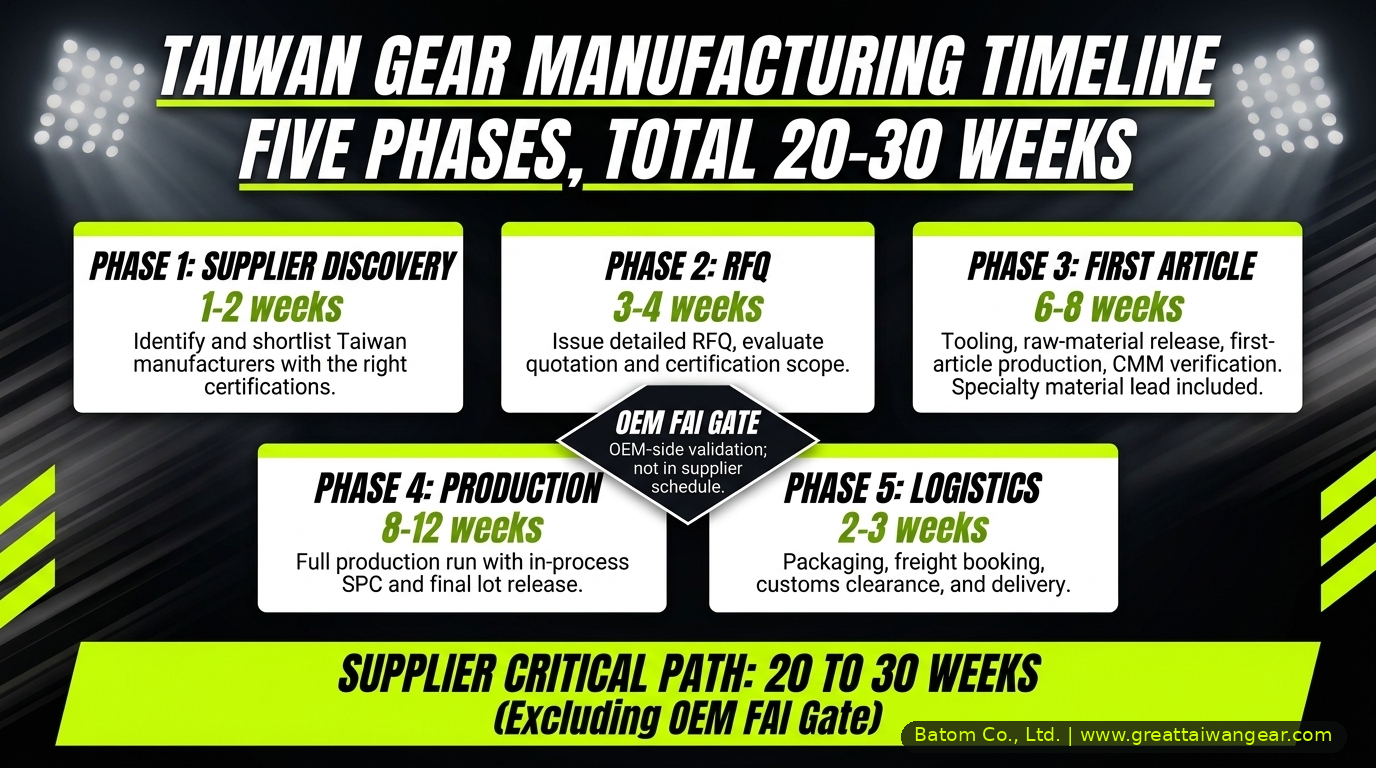
Week 1-2: RFQ Preparation and Transmission
- Prepare detailed specifications (drawing, material spec, AS9100 requirement)
- Contact Taiwanese supplier via email or trade show introduction
- Supply engineer provides preliminary quote within 24 hours
- Schedule technical call to review requirements
Week 3-4: Supplier Proposal
- Supplier conducts design analysis and feasibility study
- Provides detailed quotation with: - Unit price per quantity tier - Tooling cost (if required) - Lead time - Quality plan and test data requirements - AS9100 compliance statement - Delivery terms (FOB, CIF)
- Follow-up technical call to confirm details and address questions
Week 4: Purchase Order and Contract
- Negotiate final pricing and payment terms
- Execute purchase agreement with: - Technical specifications and drawings - Quality requirements and inspection plan - Delivery schedule - Intellectual property clause - Payment terms (commonly seen pattern: a deposit at PO, mid-stream tied to FAI or shipment, balance net 30 — actual percentages negotiated)
- Issue formal purchase order
Week 5-6: Design and Tooling
- Supplier's engineering team reviews drawings and specifications
- Conducts DFM (Design For Manufacturing) analysis
- Orders raw materials
- Designs custom fixtures and procures specialized cutting tools (if required)
- Submits First Article Inspection Plan (FAIP)
- Schedules production timeline
Week 7-14: Production and First Article Inspection (FAI)
- Manufacturing runs first batch
- Conducts dimensional inspection (CMM scanning)
- Performs material testing and hardness verification
- Completes FAI documentation and test data
- Ships sample to customer for approval
Week 15-16: FAI Approval
- Customer receives sample, visually inspects, performs functional testing
- Reviews inspection data and test reports
- OEM evaluation and FAI approval (typically 2-4 weeks, highly dependent on the OEM's internal material validation and functional testing protocols)
Week 17-25: Full Production
- Supplier begins full production run
- Conducts in-process inspections and SPC monitoring
- Completes final inspections and packaging
- Prepares for shipment (arranges freight, documentation)
Week 26-30: Shipment and Delivery (Ocean Freight)
- Ocean freight from Taiwan to destination — typically 14-18 days to US West Coast, 21-28 days to US East Coast or Europe, with additional buffer for port congestion and rolling sailings
- Customs clearance and document release at destination port
- Drayage / inland transport to OEM receiving dock
- Receiving inspection and lot acceptance
Alternative path: when the program requires faster turnaround, switching this final phase to Air Freight compresses the logistics window to roughly 1-2 weeks (typically 5-7 days transit plus customs clearance and inland delivery), at a higher per-kg landed cost.
Total Timeline: 20-30 weeks from RFQ to delivery for ocean-freight programs (approximately 4-5 months); roughly 12-16 weeks for air-freight programs (approximately 3-4 months).
Cost Breakdown — Illustrative Mix Only
For a representative aerospace helical-gear order, the typical landed-cost mix breaks roughly into the following buckets, ordered by their typical share of program cost. Manufacturing machine time (e.g., precision grinding) and QA/Inspection typically drive the core cost structure for high-precision, low-volume programs, with specialty raw materials forming a significant secondary component. Actual percentages and absolute amounts vary substantially with geometry, material grade, certification scope, batch size, and freight conditions, so the ranges below are illustrative rather than quotable:
- Manufacturing machine time: precision hobbing, grinding, honing, finishing, and heat-treat support — typically the largest single bucket on high-precision, low-volume aerospace programs
- Quality, inspection, and documentation: CMM and dedicated gear metrology (e.g., Klingelnberg P26/P40), FAI/PPAP, SPC reporting, traceability paperwork — frequently the second-largest bucket on certified work
- Specialty raw material: a significant secondary component, especially for aerospace alloys subject to AVL-controlled mill traceability
- Tooling and setup: a one-time NRE component, amortized across the program
- Logistics: freight, packaging, customs, insurance
- Supplier overhead and margin: scaled to certification scope and program complexity
The point of this view is to show that the economics of a Taiwan gear program are dominated by precision machine time and quality documentation — not by hidden margin layers — which is what allows the unit cost to land below typical Western quotations on a quality-adjusted basis.
For comparable specifications, Western suppliers commonly quote at a meaningful unit-cost premium versus Taiwan in our experience — the exact gap varies with geometry, material, certification scope, and program volume.
Supplier Audit Process: Vetting Taiwan Manufacturers
Before committing to a Taiwan supplier, conducting a thorough audit is essential.
Pre-Audit Due Diligence (Remote)
Document Review
- Verify ISO 9001/AS9100 certificates (check certification body, validity dates)
- Request quality manual and relevant procedures
- Review capability matrix (equipment, material certifications, process capabilities)
- Obtain references from existing customers
Financial Verification
- Request 3 years of financial statements
- Verify company registration with Taiwan Ministry of Economic Affairs
- Check for legal disputes or tax compliance issues
- Assess financial stability (debt-to-equity ratio, cash flow)
Supplier Assessment Questionnaire (SAQ)
- Quality system: training programs, management review frequency, continuous improvement
- Technical capability: equipment age and maintenance, personnel qualifications
- Production control: SPC implementation, yield rates, scrap/rework percentages
- Supply chain: material sourcing, supplier management, supply chain risk
- Compliance: regulatory experience, certificate maintenance, audit history
On-Site Audit (if necessary)
Recommended for:
- First-time supplier relationships with high-value products
- Aerospace or medical device applications
- Suppliers without third-party certification
- Strategic supplier relationships supporting multi-year program volume
Audit Scope (typical 1.5-2 day visit for a second-party / SQE-led audit of a precision-gear job shop; full multi-day third-party QMS certification audits are a separate scope and are not covered here):
Day 1: QMS, Documentation, and Facility Tour
- Tour facility (cleanliness, equipment condition, material storage)
- Meet quality manager and engineering team
- Review quality system documentation
- Inspect material receiving and testing area
- Evaluate document control and traceability systems
- Review supplier approval, material certificates of conformance (CoC), regulatory compliance and certification maintenance
- Review customer complaint and corrective action records
Day 2: Manufacturing Processes, Metrology (CMM), and Traceability Review
- Review CNC machine tool maintenance and calibration records
- Observe in-process inspection and SPC charting
- Evaluate heat treatment, grinding, and surface treatment capabilities
- Verify measurement system calibration traceability (ensuring external calibration is performed by ISO/IEC 17025 accredited laboratories)
- Examine statistical analysis of process capability (Cpk, Ppk) and historical SPC performance on similar tight-tolerance applications
- Verify lot-level traceability and batch documentation
- Confirm quality agreement, inspection plan, and escalation paths; document audit findings and corrective actions; schedule the follow-up audit cadence
Audit Cost: scales with travel, auditor seniority, and audit scope. ROI: Essential risk-mitigation investment for strategic supplier relationships and critical multi-million dollar precision programs.
Payment Terms and Trade Finance
Understanding payment and financing options is crucial for cash flow management.
Payment Structures Commonly Seen
The structures below are common patterns observed in relationship-based sourcing from Taiwan. They are starting points for negotiation rather than fixed terms — actual percentages, milestones, and net periods are settled between buyer and supplier based on order size, history, credit position, and the OEM's working-capital strategy.
New Supplier Relationship (commonly seen pattern):
- An initial advance deposit to cover NRE (Non-Recurring Engineering), custom tooling, and specialty raw material procurement upon purchase order placement
- Mid-stream payment tied to first-article inspection approval or shipment
- The balance paid net 30 from delivery
- Often settled in full within roughly 60 days of delivery, depending on terms
Established Supplier Relationship (after a successful initial program):
- Smaller advance deposit, with a larger share moved to shipment
- Extended net terms (for example, net 45) from delivery
- Specific milestones often anchored to FAI or in-process inspection sign-offs
High-Volume / Long-Run Relationship:
- Minimal or no advance deposit where credit history supports it
- Most of the payment shifted to shipment and post-delivery net periods (for example, net 60)
- Often combined with frame agreements, blanket POs with scheduled offshore releases, or safety-stock agreements
None of the above should be read as a fixed scale: actual payment terms are negotiated, are subject to local financing conditions, and should be confirmed in the executed purchase agreement for each order.
Trade Finance Options
Letter of Credit (LC)
- How it works: Your bank issues a letter guaranteeing payment upon supplier's presentation of shipping documents
- Advantages: Supplier confidence, payment security, faster shipment
- Cost: 0.5-2% of transaction value (paid by you or negotiated with supplier)
- Best for: Very large capital or blanket-order transactions, though milestone-based T/T (Wire Transfers) remain the dominant and more efficient standard for custom precision manufacturing in low-risk jurisdictions like Taiwan
Telegraphic Transfer (T/T) — Milestone Wire Transfers
- How it works: Buyer wires payment in defined milestone tranches — for example a deposit at PO, a mid-stream tranche tied to FAI or shipment, and a balance net 30 from delivery
- Advantages: Direct, low-friction, and the dominant standard for custom precision manufacturing in low-risk jurisdictions such as Taiwan
- Risk: Buyer manages milestone discipline; supplier carries production risk between milestones
- Best for: The majority of OEM-supplier programs, including aerospace, medical, and automotive precision work
Open Account
- How it works: Supplier ships goods, you pay per agreed terms (typically net 30-60)
- Advantages: Lower cost, faster payment processing, more flexible
- Risk: If dispute arises, payment has already cleared
- Best for: Established relationships, trusted suppliers
Illustrative Engagements: Where Taiwan Sourcing Adds Value
The following are anonymized, representative scenarios based on typical OEM engagements and supply chain optimizations we handle. Specific numbers, customer identities, and program details have been generalized; nothing in these scenarios should be treated as a guarantee of outcomes for any particular project.
Engagement 1: Aerospace OEM — Cost and Quality Improvement
Profile: Tier-1 aerospace supplier sourcing high-speed transmission gears from a Western incumbent.
Engineering challenge: Tight backlash and traceability requirements, with growing pressure on landed cost and field-quality escapes.
For a closer look at planetary gearbox architecture and backlash, see the planetary gearbox design guide.
Sourcing approach:
- Shortlisted a Taiwan manufacturer with AS9100 and applicable Nadcap special-process accreditation
- Ran an on-site audit covering quality systems, machine capability baseline, and historical SPC performance on similar tight-tolerance applications
- Established a structured FAI / quarterly business review cadence to track performance lot-over-lot
Engineering value delivered:
- Approximately mid-double-digit percent (estimated, in the ~20% range) unit-cost improvement versus the incumbent quote, on a quality-adjusted basis
- Demonstrated a significant reduction in non-conformance rates across the first year, attributable to disciplined SPC and tooling control rather than to a single intervention
- Dual-sourced capability that materially reduced single-supplier risk for that program
Outcome: Multi-year sourcing partnership with continuous-improvement targets and an established collaboration model between the OEM's engineering team and the Taiwan supplier.
Engagement 2: Medical-Device Program — Engineering Collaboration
Profile: Early-commercial-stage surgical robotics program needing Grade 4-5 precision wrist gears, sterilization-survivable materials, and ISO 13485-aligned documentation.
Engineering challenge: Long lead times and high low-volume pricing from Western incumbents were pushing the program off its launch window.
Sourcing approach:
- Selected a Taiwan supplier with active ISO 13485 certification and demonstrated micro-gear capability
- Ran an on-site capability audit and structured a joint development program with the supplier's engineering team
- Included the supplier in OEM design reviews so DFM feedback could be folded into the next revision early
Engineering value delivered:
- Reduced lead times by up to approximately 25% on the critical path through dedicated fast-track routing for early iterations
- Three concrete design-optimization suggestions contributed by the supplier's engineering team during DFM reviews, including a tooth-form refinement estimated to yield a 15% reduction in gear backlash on test articles
- Quality trajectory aligned with surgical-instrument requirements from initial production, supported by tightly controlled CMM and Cpk reporting
Outcome: The OEM stayed on its launch window, adopted the Taiwan supplier as a primary source for the wrist drivetrain, and rolled the same engineering relationship into subsequent product variants.
Engagement 3: Automotive Supply Chain — Resilience and Dual-Sourcing
Profile: Automotive transmission supplier carrying significant annual gear volume on a single offshore source.
Engineering challenge: A regional disruption to the incumbent forced an emergency review of single-supplier exposure, with downstream pressure on customer schedules.
Sourcing approach:
- Implemented a structured diversification strategy with a Taiwan manufacturer as a qualified secondary source
- Negotiated redundant tooling and inventory agreements so capacity could be shifted between sources without re-tooling delay
- Built supplier-KPI visibility into the OEM's S&OP process for ongoing performance monitoring
Engineering value delivered:
- Eliminated single-supplier exposure on that program family
- Approximately low-double-digit percent (estimated, in the ~20% range) unit-cost improvement on the volume routed through the Taiwan source, on a like-for-like specification basis
- Strict quality parity with the incumbent was fully validated and secured through a rigorous PPAP Level 3 approval prior to the launch of mass production
- Lead-time reductions of up to approximately 25% on selected SKUs through tooling-availability planning and capacity reservation
Outcome: A more resilient supply structure with two qualified sources, healthier negotiating leverage, and contingency capacity that proved useful through subsequent global disruptions.
Frequently Asked Questions
Q1: What is the typical payment structure for new Taiwan suppliers?
A: There is no single "standard." Payment terms are negotiated each time and depend on order size, history, credit standing, and the OEM's working-capital strategy. The patterns most commonly seen in relationship-based sourcing are: a deposit at PO, a mid-stream payment tied to first-article inspection or shipment, and the balance net 30 from delivery for new relationships; smaller deposits and longer net periods (for example, net 45 or net 60) for established relationships; and minimal-deposit, longer-net terms for high-volume frame agreements. Specific percentages should be settled in writing in each purchase agreement.
Q2: How do I verify that a Taiwan manufacturer is legitimate and financially stable?
A: Conduct verification through: (1) Taiwan Ministry of Economic Affairs company registration check, (2) Request 3 years of financial statements and verify through a Taiwan CPA firm if needed, (3) Check certification validity (e.g., ISO 9001 with issuing body, and AS9100 status via the IAQG OASIS global database), (4) Request customer references and conduct direct contact with current customers, (5) If possible, conduct on-site audit to verify equipment and operations match documentation.
Q3: What should I include in a supplier agreement to protect intellectual property?
A: Critical IP protections include: (1) Comprehensive NDA covering all technical data with non-disclosure obligations for employees and subcontractors, (2) Explicit prohibition on disclosure to third parties without written consent, (3) Specification that supplier retains no rights to designs or proprietary information, (4) Requirements for data storage security, encryption, and access controls, (5) Indemnification clause protecting you against unauthorized disclosure, (6) Liquidated damages for breach (scaled to fully cover the commercial value of the protected intellectual property and potential market loss), (7) Provisions explicitly acknowledging the OEM's right to seek immediate injunctive relief in the event of a breach, (8) Survival clause stating IP obligations continue after contract termination.
Q4: What certifications should I require from Taiwan precision gear manufacturers?
A: Minimum requirements depend on application: General industrial—ISO 9001. Automotive—IATF 16949 certification mandatory. Aerospace—AS9100 and Nadcap accreditation essential. Medical device components—ISO 13485 quality system, with material traceability and validated cleaning controls supporting the OEM's finished-device biocompatibility assessment. Food-grade applications—Material compliance with food-contact regulations and use of certified food-grade lubricants (e.g., NSF H1). Each certification comes with cost implications and should be balanced against application criticality.
Q5: How do I manage the transition from current supplier to a new Taiwan supplier to minimize production risk?
A: Supply chain transition is ultimately set by the OEM's own risk-management policy; suppliers should not prescribe a one-size-fits-all schedule. A common qualitative framework includes: (1) Parallel sourcing and buffer stock build-up during FAI/PPAP, (2) Pilot production runs to validate lot-over-lot consistency, (3) Phased volume ramp-up based on OEM risk management policies. The pace of each phase is calibrated by the OEM's quality and inventory thresholds rather than fixed months or percentages.
Work With Batom
Manufacturing precision gears in Taiwan demands deep engineering rigor and tightly controlled in-house processes. Batom Co., Ltd. is a direct precision-gear manufacturer with over 40 years of in-house production expertise. We operate our own plant covering hobbing, shaping, grinding, heat treatment, and full inspection, and partner with OEMs as a single accountable manufacturing source.
Our in-house capabilities include:
- In-house precision gear manufacturing: hobbing, shaping, grinding, honing, and finishing performed under one roof for tight schedule and quality control
- DFM & engineering co-development: direct collaboration with OEM design teams on tooth geometry, material selection, and tolerance allocation
- Aerospace-grade quality control: AS9100-aligned QMS, CNC gear metrology (e.g., Klingelnberg P26 / P40), FAI/PPAP, SPC, and full lot-to-mill traceability
- Specialty material & heat treatment management: AVL-controlled raw material procurement and qualified heat treatment for aerospace, medical, and high-performance automotive alloys
- Program qualification support: documentation packages ready to drop into the OEM's Device History Record (DHR), Design History File (DHF), or PPAP submission
- Multi-component program coordination: for non-gear sub-assemblies, Batom coordinates with complementary manufacturing partners (e.g., sheet metal, specialized electronics, or castings) so the OEM has a single accountable contact
Secure your precision-gear supply chain at the source. Start your Taiwan manufacturing partnership today: Contact us
Batom Co., Ltd. is an in-house precision-gear manufacturer serving aerospace, medical-device, automotive, EV, and industrial-equipment OEMs. With over 40 years of expertise, Batom controls every stage of production — from DFM engineering through hobbing, shaping, grinding, heat treatment, and final inspection — inside its own facilities, making us the direct manufacturing source rather than an intermediary. For complex multi-component assemblies, we coordinate with complementary manufacturing partners while retaining accountability for the precision-gear scope.