From ICE to EV: How Automotive Transmission Technology Is Evolving (2026 Outlook)
Global electric car sales cleared 17 million units in 2024, a year-on-year increase of over 25%. The IEA's Global EV Outlook 2025 projects sales will surpass 20 million in 2025, representing one in every four new cars sold worldwide. By 2030, more than two in five new cars are expected to be electric under current policy settings. That trajectory carries direct consequences for the transmission industry — an engineering discipline that spent the last century optimizing gear ratios for internal combustion engines and now faces a wholesale redefinition of its purpose.
This article traces the technical evolution from ICE to EV transmissions, identifies the developments shaping 2026, and assesses the practical implications for gear manufacturers in the global supply chain.
Why ICE Engines Needed Multi-Speed Gearboxes
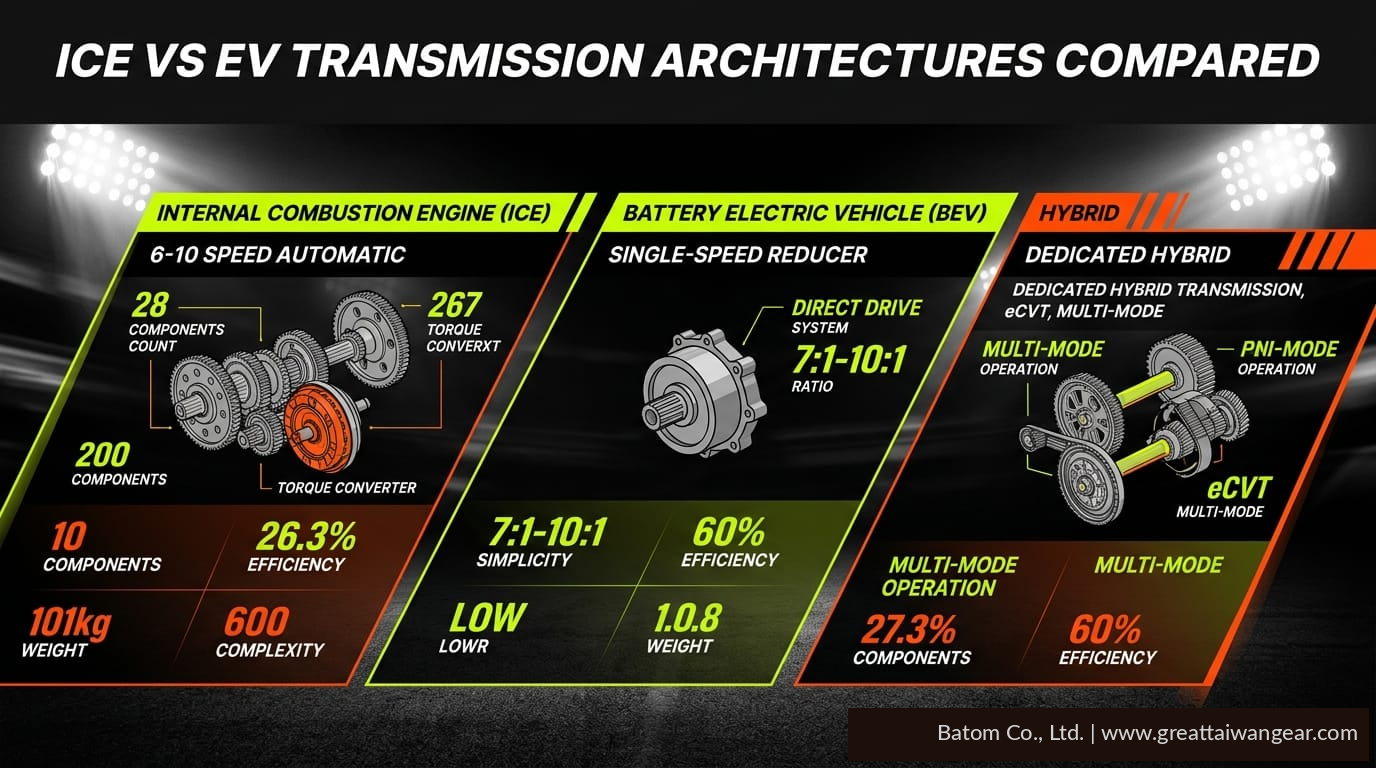
Internal combustion engines produce usable power across a narrow range of rotational speeds. A typical passenger car engine operates between 800 and 7,000 RPM, with peak efficiency confined to an even smaller band within that range. Connect an engine directly to the wheels, and it would either stall at low speeds or destroy itself at high speeds. Transmissions solve this problem by using gear ratios to decouple engine speed from wheel speed.
The technology evolved through several phases. Manual transmissions entered commercial use in 1894 with the Panhard et Levassor Type A. Automatics gradually overtook manuals and currently hold about 60% of the global transmission market. CVTs and dual-clutch transmissions (DCTs) introduced further refinements in fuel efficiency and shift speed. A modern 8-speed automatic — like the ZF 8HP used across dozens of premium vehicles — represents the mature endpoint of over a century of mechanical optimization.
According to Fortune Business Insights, ICE transmissions still account for roughly 71.73% of the global automotive transmission market in 2025. That share, however, is declining year over year as battery electric vehicles accelerate into mainstream adoption.
Engineers working through how an EV gearbox program is developed will find more detail in the EV gearbox development story.
How Electric Motors Changed the Equation
Electric motors produce peak torque from a standstill. Their effective operating range spans from near-zero RPM to well beyond 15,000 RPM, eliminating the narrow powerband constraint that made multi-speed gearboxes essential for ICE vehicles. This is why most production EVs use a single-speed reduction gear — typically a fixed ratio between 7:1 and 10:1 — paired directly with the motor.
The single-speed approach delivers clear advantages: fewer moving parts, lower cost, high reliability, and compact packaging. Every production EV on the road today, from mass-market models to luxury sedans, uses at least one gear for torque multiplication. The question is whether one gear is enough.
At city speeds, single-speed EVs are highly efficient. Regenerative braking recovers energy during deceleration, and the motor operates in its optimal efficiency zone. At highway speeds, the calculus shifts. The motor spins rapidly to maintain vehicle speed, drawing heavily on the battery while aerodynamic drag and tire resistance compound the energy loss. The result is reduced highway range — a measurable engineering compromise that multi-speed transmissions aim to address.
The Multi-Speed EV Transmission — From Niche to Necessity
The Porsche Taycan was the first volume-production EV to use a two-speed transmission, with a ZF-supplied unit on the rear axle. First gear provides strong low-speed acceleration; the shift to second occurs at 70 km/h, reducing motor RPM for improved cruising efficiency. ZF's data indicates that a two-speed configuration can extend range by approximately 5% compared to a single-speed setup.
Between 2024 and 2026, the competitive landscape around multi-speed EV transmissions has intensified significantly. Key developments include:
| Supplier | Product/Program | Key Specification | Target Application |
|---|---|---|---|
| ZF | Modular 2-speed eAxle | 140–250 kW, CAN-linked shift strategy | Passenger and commercial EVs |
| BorgWarner | Integrated eGearDrive | Motor + transmission unified housing | Medium-duty EVs |
| Eaton | HD 4-speed EV transmission | 2,600 Nm max torque, 5,000 rpm | Heavy-duty vehicles up to 43 tons |
| Mercedes-AMG | Performance 2-speed unit | Targeted for 2026 electric AMG lineup | High-performance passenger EVs |
| Allison | eGen Power 100S eAxle | Integrated 2-speed, 10.4-ton GAWR | Commercial vehicles |
| Inmotive | Ingear 2-speed | >99% efficiency, cost-comparable to single-speed | Mass market |
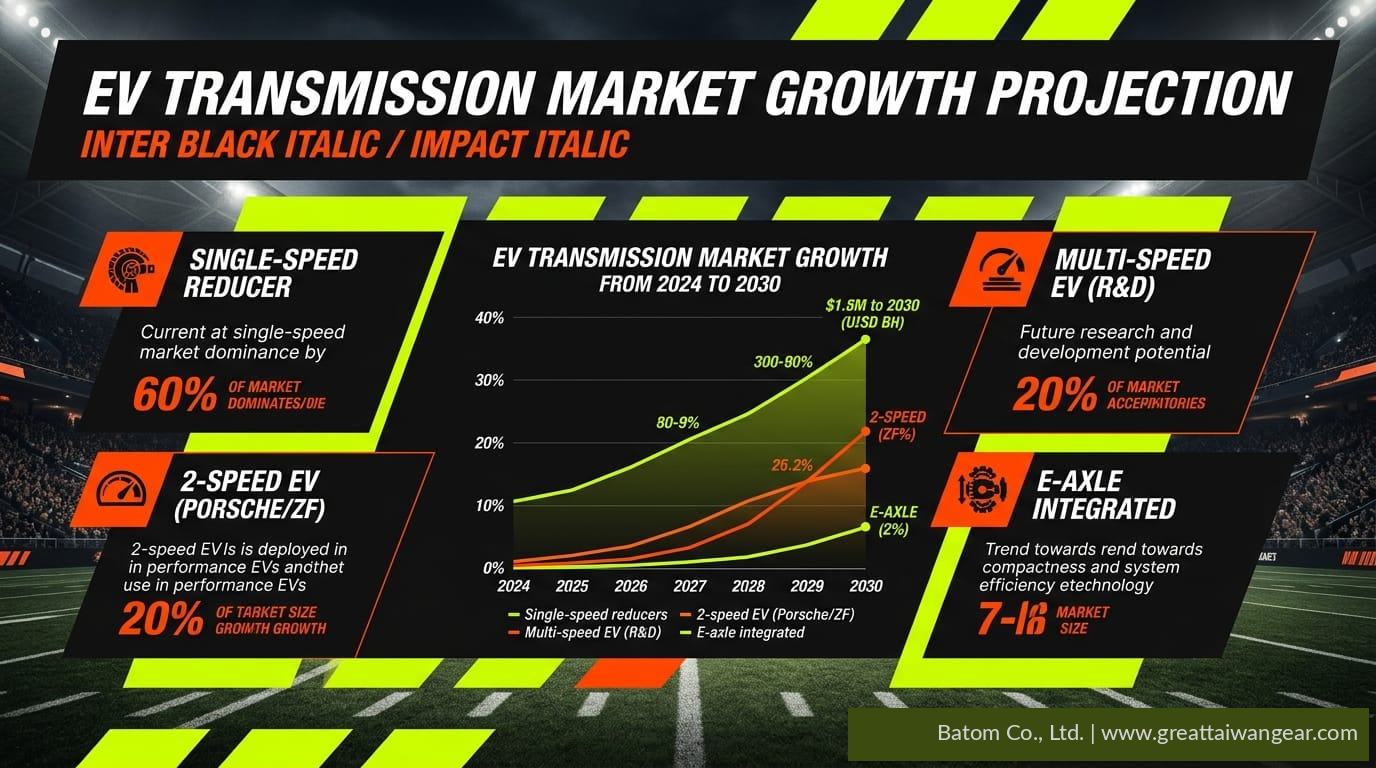
The e-Axle architecture is gaining rapid traction. These highly integrated units combine the motor, gearbox, and power electronics in a single housing, replacing the distributed powertrain layout that carried over from ICE designs. Allison's eGen Power system integrates a two-speed gearbox directly into the axle housing. Aisin and Subaru signed a joint development contract in March 2024 to co-produce eAxles for upcoming Subaru BEVs. Bosch is ramping volume production of 800V powertrain systems. More than ten major automotive suppliers are actively competing in this segment as of 2025.
What 2026 Looks Like for EV Transmissions
Several data points anchor the 2026 outlook.
The global EV transmission market is projected to reach USD 15.0–16.0 billion in 2026, according to Fortune Business Insights and Verified Market Reports. Growth from 2026 to 2033 is estimated at a compound annual rate between 6.2% and 10.5%, depending on the scope of analysis. Asia Pacific dominates with approximately 55% market share, driven by Chinese OEM demand and Japanese supplier investment.
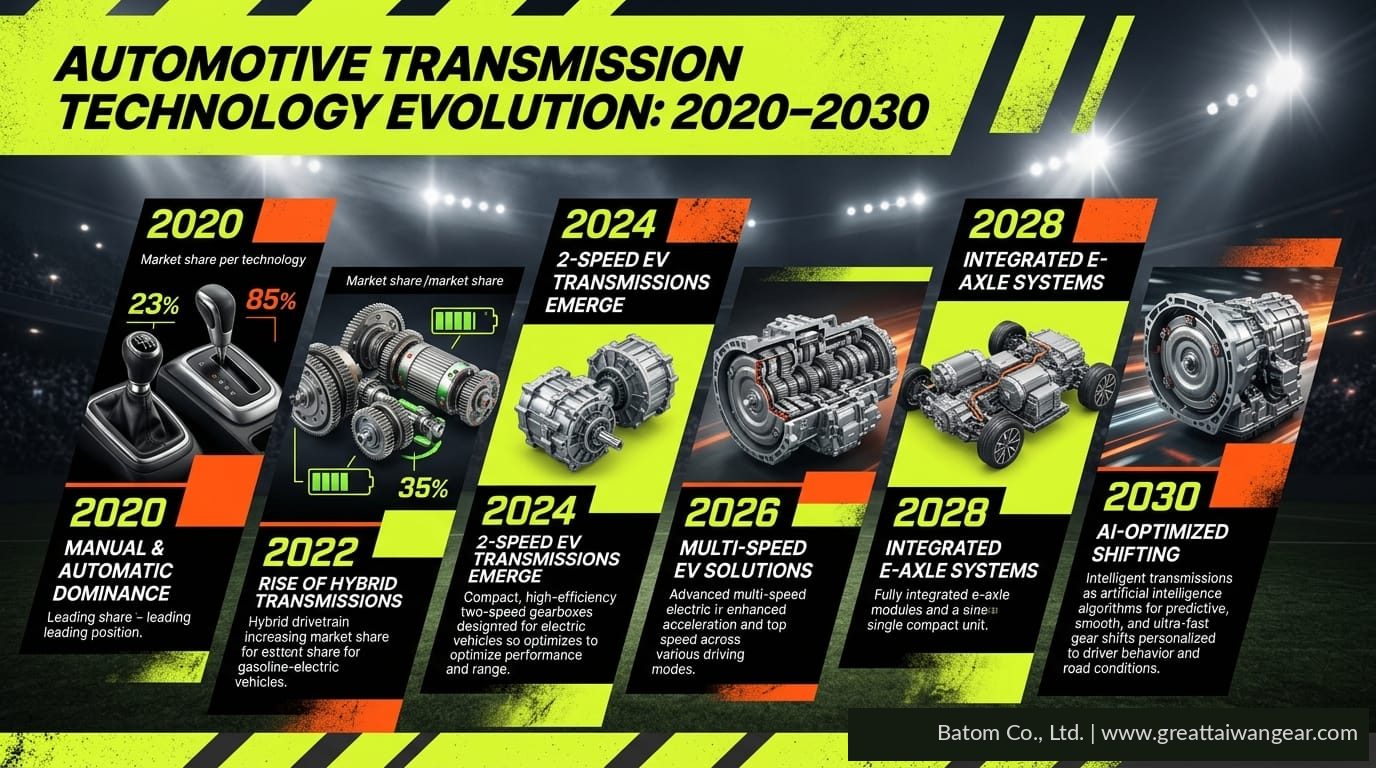
Software-defined transmission control is emerging as a differentiator. Valeo's Predict4Range software optimizes thermal management to improve EV range by up to 24%. This shifts the value proposition of a transmission system beyond mechanical gear design into integrated hardware-software performance. Tier 1 suppliers that combine gearbox engineering with embedded software capabilities will hold a competitive edge in OEM negotiations.
Modularization continues to accelerate. ZF's two-speed platform scales from 140 kW to 250 kW. Standardized motor-gearbox interfaces reduce integration time for automakers adopting multi-speed systems. This modular approach shortens development cycles and lowers per-unit costs — a critical factor as EV manufacturers compete on price in an increasingly crowded market.
What This Means for Gear Manufacturers
The shift from ICE to EV transmissions creates a structural change in gear demand, not a simple reduction. An ICE automatic transmission contains 6 to 10 gear pairs. A single-speed EV reducer needs only 1 to 2. The volume of gears per vehicle drops, but the quality requirements climb sharply.
EV motors can spin above 20,000 RPM — three to four times faster than a typical ICE engine. At those speeds, NVH (noise, vibration, and harshness) performance becomes the critical quality metric. Gear tooth surface finish, profile accuracy, and material consistency all face tighter tolerances. Manufacturers that can deliver DIN 6 (AGMA A5) or higher gears with repeatable precision hold a clear advantage in the EV supply chain.
International certifications serve as entry tickets. IATF 16949 for automotive quality management systems and Nadcap for aerospace-adjacent processes are increasingly baseline requirements, not differentiators. OEMs evaluating new EV gear suppliers look for demonstrated process capability data alongside these certifications.
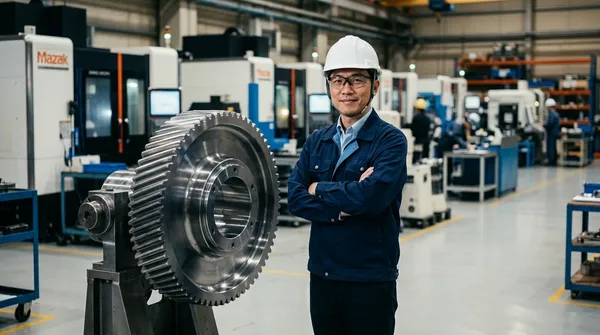
Taiwanese gear manufacturers occupy a specific position in this transition. Batom Co., Ltd., as one example, has moved from traditional gear manufacturing into EV drivetrain development — including a 2-Speed eAD Transmission, an ES30 E-Scooter Gearbox, and the EDM1-S-P95 3-in-1 System. That trajectory — from legacy ICE supplier to EV-capable systems integrator — illustrates the path that mid-tier gear manufacturers worldwide will need to follow to remain relevant.
The Bottom Line
The transmission industry is undergoing its most significant technical restructuring in a century. ICE multi-speed architectures are not simply being discarded — they are being replaced by fundamentally different engineering challenges: NVH control at higher rotational speeds, e-Axle integration, software-driven shift strategies, and lightweight compact packaging. For gear manufacturers, the 2026 opportunity depends on three capabilities: precision machining at EV-grade tolerances, certified quality systems that satisfy global OEM requirements, and collaborative development experience with drivetrain integrators.
Sources
- IEA Global EV Outlook 2025
- Fortune Business Insights – Electric Vehicle Transmission Market
- ScienceDirect – Topology Optimization and Evolution Trends of Two-Speed Transmission of EVs
- SAE International – ZF 2-Speed EV Transmission
- McKinsey & Company – The Future of Mobility
About the Author
Batom Co., Ltd. — Marketing Division
Founded in 1981 in Taichung, Taiwan, Batom is a precision transmission gear and EV drivetrain systems manufacturer. Over four decades, the company has transitioned from traditional ICE gear supply into integrated EV powertrain development, with products spanning two-speed eAD transmissions, electric scooter gearboxes, and 3-in-1 drive systems.
Author's perspective: In a market where EV transmission demand is accelerating faster than most manufacturers anticipated, the lasting competitive advantage for gear suppliers will not come from volume capacity alone. It will come from the ability to hold tight tolerances at scale — delivering gears that meet the NVH demands of motors spinning at 20,000 RPM, consistently and repeatably. That is a manufacturing discipline problem, and it favors companies with deep process knowledge over those simply chasing market size.
Ready to explore how precision gear solutions can support your EV transmission program? Schedule a consultation with Batom's engineering team to discuss specifications, prototyping timelines, and supply chain integration.
Frequently Asked Questions
Q: Do electric vehicles have transmissions? A: Yes. Every production EV uses at least a single-speed reduction gear — typically with a fixed ratio between 7:1 and 10:1 — to convert high motor RPM into usable wheel torque. Some performance and commercial EVs now use two-speed or multi-speed units to improve range and acceleration.
Q: Why don't most EVs need multi-speed gearboxes? A: Electric motors deliver peak torque from 0 RPM across a wide speed range, eliminating the narrow powerband that forces ICE engines to use multiple gear ratios. A single reduction gear covers the full operating range for most driving conditions, keeping the drivetrain simpler and cheaper.
Q: How much range can a two-speed EV transmission add? A: ZF's data on its two-speed eAxle system indicates approximately 5% improvement in driving range compared to a single-speed configuration, particularly at highway speeds. The gain is most pronounced at sustained highway speeds, where a taller second gear reduces motor RPM and battery draw.
Q: What is an e-Axle and why is it important for EVs? A: An e-Axle integrates the electric motor, transmission gearbox, and power electronics into a single compact housing mounted directly between the wheels. This architecture replaces the distributed powertrain layout inherited from ICE designs, reducing weight, simplifying assembly, and improving packaging efficiency.
Q: How does the shift to EV transmissions affect gear manufacturers? A: The number of gears per vehicle decreases — from 6–10 pairs in an ICE automatic to 1–2 pairs in an EV reducer — but precision requirements increase significantly. EV motors operating above 20,000 RPM demand tighter tolerances for NVH control, making manufacturing process capability and quality certifications like IATF 16949 more critical than volume capacity.