
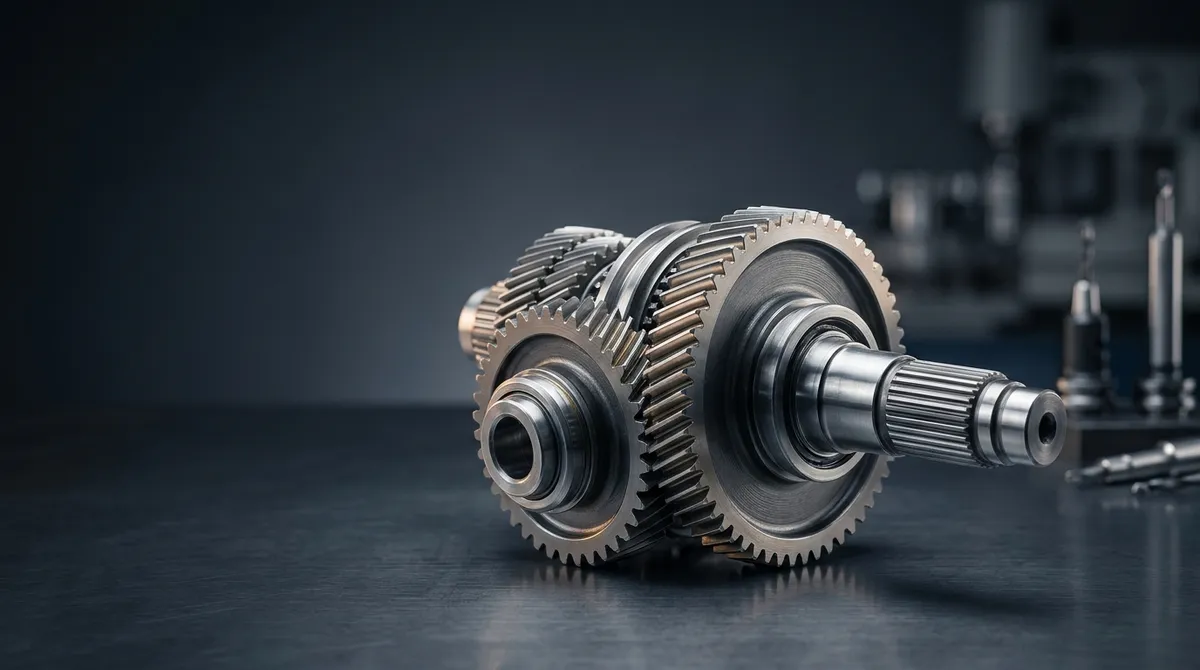
Batom Story: From a Taiwan Gear Shop (1981) to Global EV Transmission Gear Supplier
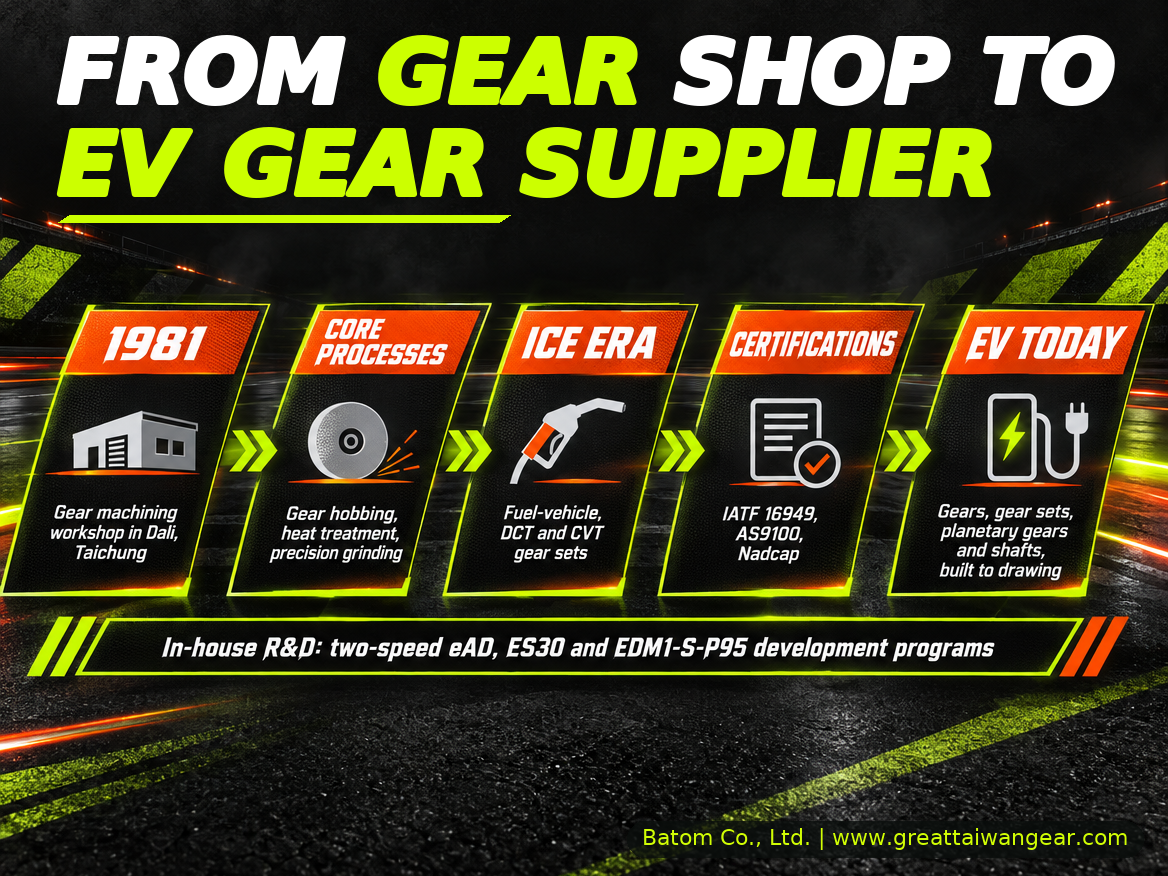
In 1981, Batom Co., Ltd. opened a small gear machining workshop in Dali District, Taichung City. The company cut industrial gears and tooling components for local manufacturers. Over 40 years later, Batom supplies precision gears to automotive and EV customers in the Americas and Asia. It has also developed Taiwan's first domestically developed two-speed EV transmission module (ITRI collaboration) as an in-house development program. This article traces the company's transformation from a traditional contract manufacturer into a one-stop supplier of custom EV drivetrain gear components, and examines the strategic decisions that made the shift possible. Today Batom builds those components to the customer's drawing, from early DFM review through series production, and does not sell standard gears, reducers or motors.
The Foundation: Industrial Gears and the Taichung Cluster
Taichung's Dali District was a hub for metalworking and precision machining throughout the 1980s. Dozens of small- and mid-sized factories clustered along a supply chain that ranged from raw material processing to finished component delivery. Batom built its early reputation on gear hobbing, heat treatment, and precision grinding — the three core processes that define a gear manufacturer's capability ceiling.
Certifications That Open Doors — and Keep Competitors Out
Automotive gear manufacturing operates under some of the tightest quality requirements in precision machining. IATF 16949, the global standard for automotive quality management systems, functions as a non-negotiable entry requirement for any supplier seeking to work with major OEMs.
Batom holds IATF 16949 certification alongside Nadcap accreditation for non-destructive testing (NDT), compliant with ASTM E1444 magnetic particle inspection standards, a credential rooted in aerospace manufacturing. This dual certification is not universal among Taiwanese gear manufacturers, and the cost of maintaining both — annual surveillance audits, process documentation, and continuous improvement mandates — places meaningful strain on smaller companies.
The strategic logic is straightforward: high certification barriers function as a moat. Competitors lacking the resources or organizational discipline to maintain these certifications cannot access the same customer base. Batom's quality management infrastructure spans the full production cycle, from gear design and analysis through final inspection.
From ICE Transmissions to EV Drivetrains
Batom's product milestones track a clear technology progression. The early product portfolio focused on fuel-vehicle gears and industrial applications. Over the following decades, the company expanded into dual-clutch transmission (DCT) and continuously variable transmission (CVT) gear sets.
Electric vehicles introduced a fundamental shift in drivetrain requirements. Internal combustion engines produce peak torque within a narrow RPM band (typically 2,000–5,000 RPM), which is why ICE vehicles need multi-speed gearboxes. Electric motors deliver peak torque from 0 RPM and operate across a range exceeding 16,000 RPM. Most production EVs use a single-speed reduction gear; typical fixed ratios fall between 7:1 and 10:1, depending on the vehicle.
The detail behind what high-speed, two-speed and 3-in-1 e-drives ask of their gears sits in the next-generation e-drive gear guide.
The simplification is deceptive. EV gears spin faster and face stricter noise constraints. Without engine noise to mask gear mesh sounds, transmission noise becomes the dominant cabin intrusion source. Batom achieves PPTE (peak-to-peak transmission error) < 3 μm via gear profile modification, with gear accuracy up to DIN 4 (AGMA A3).
Batom's EV gear portfolio now spans individual gears, gear sets, planetary gears, and shafts. Batom has also run three in-house drivetrain development programs. None is a catalog product, and Batom's own gearbox designs are not in commercial use:
| Development program | Application | Key Specification |
|---|---|---|
| 2-Speed eAD Transmission | Passenger EVs / commercial vehicles | Dual-ratio design, 4.3% energy savings (NEDC simulation), ~45 kg |
| ES30 E-Scooter Gearbox | Electric scooters | Lightweight, optimized for two-wheel EVs |
| EDM1-S-P95 3-in-1 System | Integrated EV drivetrain | Motor, inverter, and reduction gear in one unit |
The 2-Speed eAD deserves particular attention. Dual-speed EV transmissions remain rare in production vehicles, and only a few production models use a two-speed design. Batom developed its two-speed EV transmission module with support from ITRI to accumulate core drivetrain technology. It is not yet deployed in commercial production vehicles, reflecting a deliberate long-term strategy to build in-house R&D expertise ahead of market demand. A two-speed design enables higher torque at low speeds (for hill climbing and acceleration) and improved efficiency at cruising speeds.
Smart Manufacturing: The LCIM Approach
The transformation extends beyond products. In a 2021 DIGITIMES interview, Batom's general manager, Samuel Lin, described the company's smart manufacturing goal as LCIM, or Low Cost Intelligent Manufacturing, reached through automation. The automation spans six layers: production, loading and unloading, measurement, feedback, logistics and warehousing. The aim is uninterrupted 24-hour production, which by Batom's own calculation yields up to four times the output of conventional production.
The management dimension matters as much as the hardware. The DIGITIMES report also describes Batom moving from batch-level tracking to individual-piece traceability, a practice common in electronics manufacturing that is only gradually reaching automotive parts makers. A QR code marked on each gear at key process steps records its manufacturing history, a capability increasingly demanded by OEM customers running zero-defect programs.
Market Context: EV Transmission Growth
Batom's timing aligns with a rapidly expanding addressable market. Persistence Market Research valued the global EV transmission market at USD 12.8 billion in 2025, with projections reaching USD 28.6 billion by 2032 at a 12.8% CAGR. Asia-Pacific accounts for approximately 45% of this market, with China as the dominant single-country contributor.

The IEA's Global EV Outlook 2025 reported that global EV sales exceeded 17 million units in 2024, a year-over-year increase of more than 25%. Persistence Market Research projects battery electric vehicles (BEVs) at nearly 90% of EV transmission demand in 2025, with single-speed reduction gearboxes as the default architecture.
For a company like Batom, this market structure presents a trade-off. BEV dominance concentrates demand in single-speed gears, which carry lower per-unit pricing than multi-speed transmission gear sets. Volume growth compensates for the pricing gap. The in-house two-speed program addresses a premium and commercial vehicle niche that is growing but has not yet reached mainstream adoption.
Taiwan's SME Playbook for Industrial Transition
Batom's trajectory offers a concrete reference point for Taiwan's automotive component sector. The island's parts industry consists primarily of small and medium enterprises. A CENS industry report describes the structure: upstream manufacturers supply seats, pistons, and gears; midstream suppliers contribute dashboards, bumpers, and generators; downstream producers deliver integrated engine, steering, and ADAS systems.
Batom's case demonstrates that upgrading from a traditional gear job shop to a global EV gear supplier requires simultaneous progress on four fronts. Those fronts are certification depth (IATF 16949 + Nadcap), manufacturing intelligence (LCIM automation), product pivot (ICE → EV drivetrain gears), and international market access (U.S. and Mexico branches). Of these, international certification and local service capability are often undervalued by manufacturers who treat technology as the sole differentiator.
For the full treatment of what separates AS9100 from IATF 16949, see the AS9100 and IATF 16949 comparison.
Sources
- International Energy Agency (IEA) — Global EV Outlook 2025 — Global EV market data
- Persistence Market Research — EV Transmission Market — Market size and growth forecasts
- International Automotive Task Force (IATF) — About IATF 16949:2016 — Automotive quality management standard
- ASTM International — E1444/E1444M Magnetic Particle Testing for Aerospace — Magnetic particle inspection standard
- DIGITIMES (in Chinese), 2021-06-18 — Interview with Batom's general manager on low-cost smart manufacturing — LCIM automation and per-piece traceability
- Batom Co., Ltd. — 2024 Sustainability Report — Sales regions and EV gear line upgrade
Editor's Perspective
Author: Batom Co., Ltd. Marketing Department
Tracking Batom's four-decade trajectory reveals that the most consequential decisions were not about any single product. The company placed bets on international certification, overseas presence, and pre-market R&D investment before the returns were clear. When the EV transition accelerated, these foundational investments became competitive advantages that late movers could not replicate quickly. The two-speed EV transmission was developed while production orders were still uncertain — a risk tolerance pattern that distinguishes companies which survive paradigm shifts from those that merely react to them.
Ready to discuss EV transmission gears for your program? Whether it is still in development or heading into series production, send the drawing, and Batom's engineering team can review manufacturability and quote the gear components. Schedule a consultation. Batom builds to your drawing and does not sell standard gears, reducers or motors.
Frequently Asked Questions
Q: When was Batom founded? A: Batom Co., Ltd. was established in 1981 in Dali District, Taichung City, Taiwan. The company started as a small gear machining workshop focused on industrial gears and tooling components for local manufacturers.
Q: Does Batom make EV transmission gears? A: Yes. Batom provides a one-stop custom service for EV drivetrain gear components built to the customer's drawing: individual gears, gear sets, planetary gears and shafts. Its 2-speed eAD, ES30 and EDM1-S-P95 systems are in-house development programs, not products, and Batom does not sell standard gears, reducers or motors.
Q: What certifications does Batom hold? A: Batom's quality management system is certified to ISO 9001, IATF 16949 for automotive and AS9100 for aerospace. Batom also holds Nadcap accreditation for its in-house magnetic particle inspection, shot peening and cleanliness verification. Its other certifications include ISO 14001, ISO 45001, ISO 27001, ISO 14064-1 (carbon inventory) and ISO 14067 (carbon footprint).
Q: What is a two-speed EV transmission? A: A two-speed EV transmission uses two gear ratios instead of the single fixed ratio found in most electric vehicles. The lower ratio provides higher torque for acceleration and hill climbing, while the higher ratio improves energy efficiency at cruising speeds. Batom's in-house development program showed a 4.3% energy efficiency gain in NEDC simulation testing.
Q: Where is Batom located? A: Batom's headquarters and primary manufacturing facility is at No. 45, Siyu Street, Dali District, Taichung City 41279, Taiwan. Batom also has a Mexico branch, Gear GT, S.A. de C.V., in León, Guanajuato, and a U.S. branch.
Batom Co., Ltd. Headquarters: No. 45, Siyu St., Dali Dist., Taichung City 41279, Taiwan | Phone: +886-4-24929678