
Aircraft MRO Gear Sourcing: How to Find Qualified Replacement Gear Suppliers
Introduction
The aircraft Maintenance, Repair, and Overhaul (MRO) industry is experiencing unprecedented growth. As the global aircraft fleet ages and operators seek cost-effective solutions, the demand for qualified replacement gear suppliers has become critical. This comprehensive guide explores the landscape of aircraft MRO gear sourcing, including OEM versus alternative parts strategies, FAA approval processes, quality standards, and how to evaluate qualified suppliers in the global marketplace.
Global MRO Market Overview
Market Size and Growth Projections
The global aircraft MRO market is projected to reach over $100 billion by 2030, driven by:
- Fleet Age Management: Over 40% of commercial aircraft are over 20 years old, requiring frequent major overhauls
- Cost Pressures: Airlines seek 15-25% reductions in maintenance costs through alternative parts sourcing
- Supply Chain Resilience: Post-COVID emphasis on diversifying supplier bases beyond single OEM sources
- Emerging Markets: Rapid fleet expansion in Asia-Pacific drives regional MRO capacity requirements
Key MRO Market Segments
- Line Maintenance: Routine daily maintenance between flights
- Heavy Maintenance: Scheduled overhauls every 6-10 years
- Component Repair: Specialized repair facilities for engines, avionics, and landing gear
- Engine Overhaul: Major rebuild services with complete teardown and reassembly
OEM vs. PMA vs. DER Repair: Understanding Your Options
Original Equipment Manufacturer (OEM) Parts
OEM parts are manufactured by the aircraft or engine manufacturer's approved suppliers and carry the highest warranty coverage.
OEM Advantages:
- Full manufacturer responsibility and liability
- Guaranteed compatibility and performance
- Comprehensive technical support
- Simplified compliance and documentation
OEM Disadvantages:
- 40-60% higher cost than alternatives
- Longer lead times (12-24 weeks for some components)
- Limited negotiating power on pricing
- Dependency on OEM production schedules
Typical OEM Lead Times:
- Standard orders: 8-12 weeks
- Expedited orders: 4-8 weeks (with premium pricing)
- Made-to-order gears: 16-24 weeks
PMA (Parts Manufacturer Approval) Replacement Parts
PMA is an FAA certification program allowing manufacturers to produce parts meeting FAA standards as direct substitutes for OEM parts.
PMA Part Benefits:
- Cost savings: highly competitive vs. OEM equivalent (subject to part complexity and qualification scope)
- Faster delivery: typically faster than OEM channels (lead time depends on part complexity, qualification scope, and material availability)
- FAA-approved or FAA-accepted approval basis
- Direct engineering support from PMA manufacturer
PMA Qualification Requirements:
- Demonstrated design and manufacturing capability
- FAA technical data package approval
- Type certification (for complex parts)
- Quality system certification (AS9100 or equivalent; equivalent is customer- and program-dependent)
- Production standard verification
Limitations of PMA Parts:
- Limited application scope (specific aircraft/engine models)
- Smaller manufacturer base with less name recognition
- Potential warranty limitations from aircraft manufacturer
- Requires active FAA oversight and continuous compliance
DER (Designated Engineering Representative) Repair
DER repair is the pathway by which an FAA-appointed Designated Engineering Representative reviews and approves the technical repair data (and any minor alterations) used to return a specific damaged or worn part to an airworthy condition. A DER approval only covers the repair of that original, in-service part — it is not a pathway to manufacture new replacement parts. Any newly produced replacement part must instead be approved through the Parts Manufacturer Approval (PMA) process.
DER Repair Applications:
- Engine gear damage assessment and repair design
- Repair overlays (e.g. weld or thermal-spray deposit) using equivalent-performance materials on the original part
- Service life extension and recertification
- Non-destructive restoration of damaged components
DER Repair Advantages:
- Customized solutions for obsolete or unique components
- Extends life of expensive assemblies
- Creates precedent for future similar repairs
- Supports sustainment of aging fleets
DER Repair Process Timeline:
- Initial assessment and proposal: 2-3 weeks
- Design engineering and FAA review: 6-10 weeks
- Repair execution and testing: 4-8 weeks
- FAA approval and certification: 2-4 weeks
Comparative Analysis Table
| Criterion | OEM Parts | PMA Parts | DER Repair |
|---|---|---|---|
| Cost | 100% (baseline) | 50-70% | 60-75% |
| Lead Time | Long | Competitive | Long |
| Quality Assurance | Manufacturer | FAA + Manufacturer | FAA-Designated Engineer |
| Certification Scope | Unlimited | Type-specific | Component-specific |
| Technical Support | Extensive | Good | Specialized |
| Market Availability | High | Moderate | Limited |
| Warranty Coverage | Full manufacturer | Limited by design | Limited to repair scope |
| Regulatory Risk | Minimal | Low | Moderate |
FAA PMA Approval Process for Replacement Gears
Understanding the FAA PMA approval pathway is essential for identifying and qualifying replacement gear suppliers.
PMA Application and Technical Package
Phase 1: Pre-Application (4-6 weeks)
- Manufacturer submits Form 8110-12 (PMA Application)
- Provides detailed engineering drawings with dimensions, materials, and tolerances
- Submits manufacturing process specifications and quality control plans
- FAA conducts completeness review and provides Initial Data Review
Phase 2: Technical Substantiation (8-16 weeks)
- Manufacturer provides performance test data (tensile, hardness, fatigue testing)
- Heat treatment specifications with FAA-approved processes
- Non-destructive testing (NDT) procedures and acceptance criteria
- Airworthiness evaluation basis documentation
- Comparison data with original OEM component
Phase 3: Quality Assurance Plan (6-10 weeks)
- Submission of AS9100 or equivalent quality system documentation
- Production conformance inspection procedures
- In-process inspection and test plans
- Traceability and documentation systems
- Supplier qualification procedures
Phase 4: FAA Review and Approval (4-12 weeks)
- FAA technical review team assessment
- Conditional approval or Approved PMA issuance
- Publication on FAA PMA Parts Database
- Manufacturing authorization and first article certification
Total PMA Approval Timeline: typically 6–18 months (depending on complexity)
Key Gear Component PMA Categories
Engine Accessory Gears
- Dry sump lubrication system gears
- Generator drive gears
- Hydraulic pump drive gears
- Approved replacements for CFM56, PW1100, GE90 engines
Main Landing Gear Components
- Wheel brake gears
- Steering control mechanism gears
- Load control gears
- AS9100 + Nadcap heat treatment required
Auxiliary Power Unit (APU) Gears
- Main gear box components
- Starter/generator drive gears
- Fuel pump gears
Quality Standards and Certification Requirements
AS9100 Quality Management System
AS9100 (published by the SAE International on behalf of the IAQG / International Aerospace Quality Group) is the aerospace-specific quality-management standard layered on top of ISO 9001:2015, adding requirements for configuration management, FOD prevention, counterfeit-part prevention, risk management, and full traceability. Current revision: AS9100D.
For the full treatment of lot traceability and material records, see the aerospace traceability guide.
AS9100 Key Requirements for Gear Manufacturers:
- Foreign Object Damage (FOD) Prevention
- Controlled manufacturing environments
- Tool control and item tracking systems
- Cleaning and contamination control procedures
-
Defined responsibility for FOD accountability
-
Counterfeit Parts and Supply Chain Management
- Approved supplier lists (ASL) with qualification history
- Supplier audits and ongoing performance monitoring
- Configuration and change management procedures
-
Documentation of material certifications and traceability
-
Product Safety
- Design for manufacturability reviews
- Failure mode and effects analysis (FMEA)
- Design verification and validation testing
-
Risk management throughout product lifecycle
-
Traceability and Configuration Management
- Lot traceability from raw material to finished product
- Serial number assignment and tracking
- Engineering change procedures with impact assessment
- Configuration baseline and deviation documentation
Nadcap (National Aerospace and Defense Contractors Accreditation Program)
Nadcap is a specialized process-accreditation program administered by PRI (the Performance Review Institute) on behalf of aerospace primes including Boeing, Airbus, GE, Pratt & Whitney, Rolls-Royce, and Honeywell. Its rigor is why Nadcap accreditation is effectively a prerequisite, alongside AS9100, for any serious FAA PMA or OEM-approved gear supplier. For gear suppliers, key Nadcap certifications include:
The detail behind finding and qualifying a Nadcap-accredited supplier sits in the Nadcap supplier qualification guide.
Heat Treatment Nadcap
- Case hardening specifications (carburizing, nitriding)
- Through hardening procedures
- Quenching and tempering protocols
- Hardness verification and documentation
- Process capability studies
Non-Destructive Testing (NDT) Nadcap
- Ultrasonic testing for subsurface defects
- Magnetic particle inspection for surface flaws
- Penetrant inspection for micro-cracks
- Eddy current testing for conductivity changes
- Equipment calibration and operator certification
Surface Treatment Nadcap
- Plating specifications (cadmium, nickel, chromium alternatives)
- Corrosion resistance verification
- Coating thickness and adhesion testing
- Saltwater spray testing (ASTM B117)
Material Certification and Traceability
Every MRO gear moving through an FAA- or EASA-regulated supply chain must arrive with a full evidence pack — material certifications traceable to the heat lot, process certifications tying every special process back to a Nadcap-accredited supplier, and, for parts released into service, an FAA Form 8130-3 Authorized Release Certificate (or EASA Form 1 equivalent). Typical contents:
Mill Certificates (CMTR - Certified Material Test Report)
- Chemical composition analysis (certified by primary material supplier)
- Mechanical property test results (tensile strength, yield, elongation)
- Hardness measurements (HRC, HV values)
- Lot number and batch traceability
Manufacturing Records
- First article inspection (FAI) data
- In-process inspection logs
- Final inspection and acceptance documentation
- Non-conformance reports and dispositions
- Heat treat charts with time-temperature profiles
Compliance Documentation
- Nadcap certificates for special processes
- ASTM/AMS specification compliance letters
- Calibration records for measuring equipment
- Personnel qualification and training records
MRO Buyer's Evaluation Criteria
1. Regulatory and Certification Status
Critical Checkpoints:
- Is the supplier registered in the FAA PMA database for your specific component?
- Has the supplier maintained current AS9100 certification for at least 24 months?
- Are all Nadcap certifications current and within scope?
- Can the supplier provide audit history and corrective action records?
Documentation Required:
- FAA approval letter with part number and approval basis
- Current AS9100 certificate with scope statement
- All Nadcap certificates with accreditation body signatures
- Third-party audit reports from past 12 months
2. Technical Capability Assessment
Engineering Competency:
- Years of aerospace manufacturing experience (minimum 10 years recommended)
- Design capability for custom gear solutions
- In-house NDT laboratory with certified equipment
- Computer-aided design (CAD) systems and manufacturing (CAM) integration
Manufacturing Capability:
- Precision gear hobbing and grinding equipment with ±0.0005" tolerance capability (achievable in precision applications under controlled processes, with validation against ISO 1328 / AGMA 2015 gear-quality grades)
- Gear shaving and finishing operations
- Thermal processing equipment with precise temperature control
- Dimensional verification systems (CMM, optical comparators)
Testing and Validation:
- Fatigue testing laboratory or partnership
- Vibration analysis and modal testing capability
- Accelerated life testing protocols
- Failure analysis and root cause investigation procedures
3. Supply Capacity and Lead Time Management
Inventory Assessment:
- Common gear types maintained in stock
- Annual demand forecasting for high-volume parts
- Safety stock policies for critical components
- Supplier buffer stock agreements
Production Capability:
- Monthly production capacity in units
- Machine utilization rates (target: 70-85% to allow surge capacity)
- Order queuing and priority systems
- Expedited manufacturing procedures
Lead Time Performance:
- Standard delivery timeframe by component type
- AOG emergency response capability (24-48 hours)
- International shipping and logistics partnerships
- Tracking and visibility systems for in-transit orders
4. Cost Competitiveness
Pricing Structure Analysis:
- Unit pricing for various order quantities
- Volume discount thresholds and terms
- Tooling and first article charges (if applicable)
- Pricing stability and escalation clauses
Value Proposition:
- Total cost of ownership including testing and documentation
- Extended payment terms for qualified buyers
- Long-term pricing agreements for committed volumes
- Flexible order minimums and batch sizing
5. Quality Performance History
Key Metrics to Review:
- Defect rate and non-conformance frequency
- On-time delivery performance (target: >98%)
- First pass yield (FPY) rate by component
- Customer complaint resolution time
Customer References:
- Minimum 3-5 references from major MRO facilities
- Contact information verified with major airlines or MRO operators
- Request feedback on responsiveness and problem resolution
- Ask specifically about emergency AOG support experiences
6. Customer Service and Support Capabilities
Technical Support Services:
- Access to design engineers for consultation
- Reverse engineering capability for obsolete parts
- Material equivalency evaluation and substitution analysis
- Field failure investigation and root cause analysis
Documentation and Compliance:
- Complete documentation package delivery timeframe
- Electronic file formats compatible with common MRO systems
- Certification letter generation and expedited delivery
- Language availability (English, Mandarin, Japanese, etc.)
Warranty and After-Sales Service:
- Standard warranty period (typically 24 months)
- Warranty coverage scope (manufacturing defects vs. design issues)
- Exchange/return procedures for defective parts
- Spare parts availability for repair of supplied components
Lead Time Management Strategies
Demand Forecasting and Planning
Long-term Planning (12-24 months)
- Annual maintenance schedules from airline customers
- Projected fleet expansion and retirements
- Seasonal demand patterns (peak summer maintenance)
- Regulatory inspection cycles
Medium-term Planning (3-6 months)
- Rolling forecasts with 90-day firming horizon
- Framework agreements with volume commitments
- Supplier capacity reservations
- Safety stock determinations
Short-term Execution (0-3 months)
- Weekly purchase order releases
- Emergency procurement procedures
- Expedited transportation arrangements
- Supplier communication and progress tracking
Managing AOG (Aircraft on Ground) Emergencies
AOG situations require immediate response and can occur with minimal warning. Establishing AOG procedures with suppliers is critical:
AOG Response SLA Components:
- 24/7 availability for AOG inquiries
- 4-hour response commitment with status update
- Next-day delivery for in-stock items (via expedited courier)
- 48-72 hour delivery for manufactured items with rapid tooling
AOG Discount Structure:
- Premium pricing for AOG emergency orders (typically 20-40% uplift)
- Minimum order quantities waived for AOG situations
- Expedited testing and documentation procedures
- Direct communication channels with supply chain management
Building AOG Capability:
- Identify suppliers with strategic component inventory
- Pre-position parts at regional MRO facilities
- Establish distribution partnerships with emergency logistics providers
- Create emergency contact lists and escalation procedures
Taiwan MRO Gear Supply Chain
Taiwan's Position in the Global Aerospace Supply Chain
Taiwan has emerged as a critical hub for precision engineering and aerospace manufacturing, representing 2-3% of global aerospace supplier market share. The island's MRO gear supply chain offers distinct advantages:
Taiwan Aerospace Manufacturing Strengths:
- Over 400 certified aerospace suppliers with AS9100 or equivalent
- Precision tolerance capabilities: ±0.0003" achievable in high-volume production
- Advanced gear manufacturing using five-axis CNC hobbing equipment
- Strong partnerships with major Japanese and European gear manufacturers
Cost Advantages:
- 30-40% labor cost advantage compared to US/European suppliers
- Competitive raw material sourcing through regional networks
- Lower overhead costs while maintaining quality standards
- Volume-based economies enabling competitive pricing
Technology Transfer and Innovation:
Taiwan represents a small but strategically important segment of the global aerospace supply chain, punching above its weight through licensed manufacturing, joint ventures, and specialized process capability — not through scale.
- Licensed manufacturing from Bosch, Flender, and other European gear specialists
- Joint ventures with German and Swiss companies for advanced processes
- Growing in-house R&D capability in aerospace materials
- Nadcap heat treatment and NDT facilities established in major manufacturers
Key Taiwan-based MRO Gear Manufacturers and Suppliers
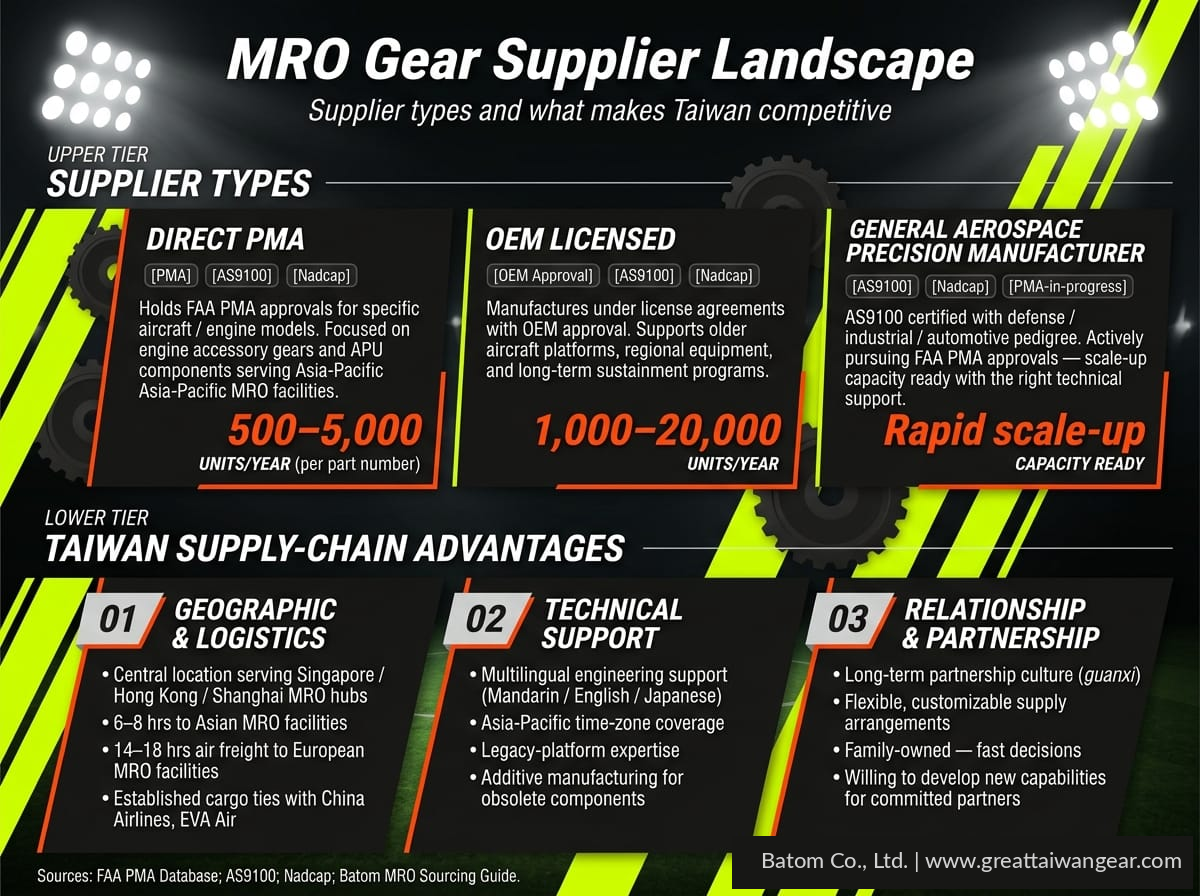
Category 1: Direct PMA Manufacturers
- Suppliers with active FAA PMA approvals for specific aircraft/engine models
- Focus on engine accessory gears and APU components
- Serving regional MRO maintenance facilities across Asia-Pacific
- Typical volume: 500-5,000 units annually per part number
Category 2: OEM Licensed Production
- Partners manufacturing under license agreements with OEM approval
- Producing gears for older aircraft platforms and regional equipment
- Supporting long-term sustainment programs
- Volume: 1,000-20,000 units annually
Category 3: General Aerospace Precision Gear Manufacturers
- AS9100 certified with technical capability to enter MRO market
- Currently serving defense, industrial, and automotive sectors
- Actively pursuing FAA PMA approvals in emerging categories
- Potential for rapid scale-up with appropriate technical support
Supply Chain Advantages
Geographic and Logistics Benefits:
- Central location in East Asia serving regional MRO hubs (Singapore, Hong Kong, Shanghai)
- Established air cargo relationships with major carriers (China Airlines, EVA Air)
- 6-8 hour delivery to major Asian MRO facilities
- 14-18 hour delivery to European facilities
Technical Support Infrastructure:
- Multilingual engineering support (Mandarin, English, Japanese)
- Time zone positioning optimal for Asia-Pacific MRO operations
- Growing expertise in legacy aircraft platforms and Chinese fleet requirements
- Emerging capability in additive manufacturing for obsolete component reproduction
Relationship and Partnership Dynamics:
- Strong relationship-building culture (guanxi) supporting long-term partnerships
- Flexible supply arrangements and customization capability
- Family-owned manufacturers with decision-making agility
- Willingness to develop new capabilities for committed partners
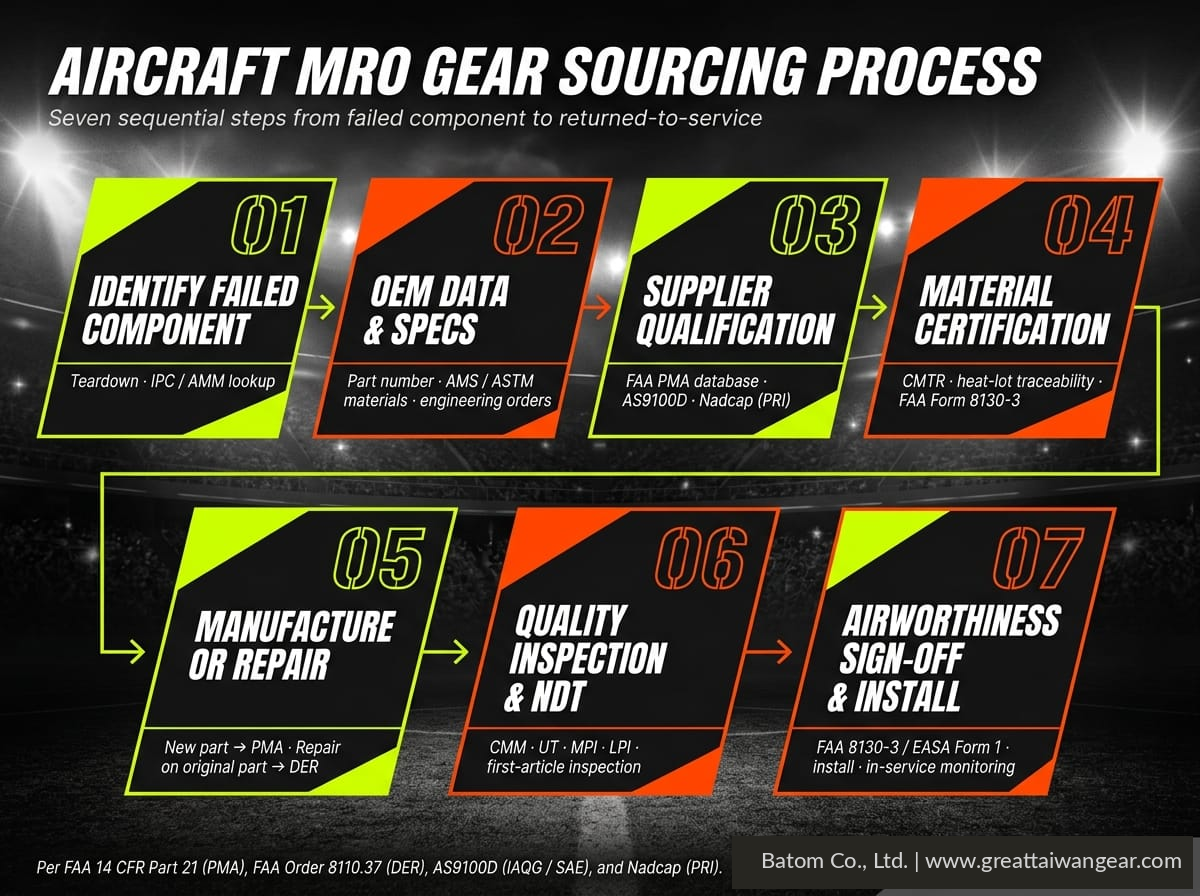
Aircraft MRO Gear Sourcing Workflow
Step 1: Requirement Definition and Component Identification
Information Gathering:
- Obtain Aircraft Maintenance Manual (AMM) and Illustrated Parts Catalog (IPC)
- Identify OEM part number and revision level
- Determine applicable engineering orders and service bulletins
- Confirm current part status (active production, superseded, or obsolete)
Specification Development:
- Extract applicable ASTM/AMS material specifications
- Document dimensional tolerances and surface finish requirements
- Record thermal processing requirements (case depth, hardness range)
- Identify any special coatings or finish requirements
Airworthiness Assessment:
- Determine certification basis (Type Certificate, TSO, PMA precedent)
- Identify equivalent parts from other aircraft/engine manufacturers
- Assess inventory holding requirements and demand patterns
- Evaluate obsolescence risk and long-term sustainability
Step 2: Supplier Identification and Screening
Resource Identification:
- Search FAA PMA database (faa.gov/pma) for approved replacement parts
- Consult industry supplier directories (MRO networks, industry associations)
- Request recommendations from existing MRO facility partners
- Review aerospace trade publications and supplier announcements
- Contact original aircraft manufacturer for approved supplier lists
Initial Qualification Screening:
- Verify current certification status (AS9100, Nadcap, FAA approval)
- Confirm supplier experience with requested component category
- Assess financial stability and company longevity
- Evaluate geographic location and supply chain proximity
- Confirm capacity and willingness to serve new customers
Step 3: Technical Evaluation and Sample Testing
Documentation Review:
- Request and review FAA approval documentation
- Analyze technical data package and engineering drawings
- Evaluate manufacturing and quality control procedures
- Assess design specifications and test data supporting approval
Sample Request and Inspection:
- Order representative samples (typically 3-5 units minimum)
- Specify all required documentation (certifications, test reports, traceability)
- Conduct incoming inspection per customer specifications
- Perform dimensional verification and material composition analysis
Testing and Validation:
- Conduct hardness testing and comparison to OEM parts
- Perform non-destructive testing (ultrasonic, magnetic particle, penetrant)
- Review surface finish and coating uniformity
- Validate documentation accuracy and completeness
Operational Compatibility Assessment:
- Install samples in test equipment or simulator
- Verify fit and function with mating components
- Assess vibration characteristics and noise signature
- Monitor performance during initial operational use
Step 4: Commercial Negotiation and Contract Development
Price Negotiation:
- Request formal quotation for various order quantities
- Benchmark pricing against other suppliers and OEM parts
- Negotiate volume discounts and pricing terms
- Discuss extended payment terms for large commitments
Terms and Conditions:
- Establish delivery terms (FOB, CIF, DDP)
- Define payment schedule (advance, net 30/60/90, milestone-based)
- Specify quality assurance and warranty terms
- Establish procedures for change management and corrective actions
Contractual Agreements:
- Develop Master Supply Agreement or framework contract
- Include specific part numbers and pricing in exhibits
- Define intellectual property and confidentiality provisions
- Establish dispute resolution and governing law clauses
Step 5: Order Placement and Supply Chain Management
Purchase Order Issuance:
- Prepare detailed purchase orders with part numbers and specifications
- Reference approved quality and technical specifications
- Include delivery and acceptance criteria
- Specify documentation requirements and delivery schedules
Supply Chain Visibility:
- Establish order tracking and visibility systems
- Define reporting requirements and communication protocols
- Implement progress meetings for large/critical orders
- Plan for expedited transportation if necessary
Receipt and Final Acceptance:
- Conduct incoming inspection per acceptance criteria
- Verify documentation completeness and accuracy
- Perform any required customer testing or validation
- Process final payment upon successful acceptance
FAQ: Aircraft MRO Gear Sourcing
Q1: What is the difference between a PMA part and an OEM part?
A: PMA (Parts Manufacturer Approval) parts are FAA-approved replacements manufactured by suppliers other than the original equipment manufacturer. They must demonstrate airworthiness equivalency to the OEM part, and typically cost 30-50% less. PMA parts carry the same FAA approval authority but are limited to their specific approved application, unlike OEM parts which have broad application across all variants.
Q2: How long does FAA PMA approval take?
A: The FAA PMA approval process typically takes 6–18 months depending on complexity. Simpler components land at the shorter end of that range; complex engine parts and anything requiring a full test-based or identicality-plus-test approval path sit near the longer end. Manufacturers can apply for conditional approval to accelerate the timeline.
Q3: What is AOG and how does it affect gear sourcing?
A: AOG (Aircraft on Ground) occurs when an aircraft is grounded due to a parts failure, resulting in significant operational losses ($10,000-$50,000+ per hour for large aircraft). Suppliers with AOG response capability can deliver critical parts within 24-72 hours, commanding premium pricing (20-40% uplift) to compensate for emergency manufacturing and expedited logistics.
Q4: Why should I consider Taiwan as a MRO gear supplier source?
A: Taiwan offers significant cost advantages (30-40% savings), maintains strict quality standards (AS9100, Nadcap), and provides faster lead times to Asian MRO facilities. Taiwan suppliers have established relationships with European gear manufacturers, enabling technology transfer and innovation. The geographic proximity to major Asian MRO hubs reduces shipping time and costs.
Q5: How can I verify that a replacement gear supplier is genuinely FAA-approved?
A: You can verify FAA PMA approval by: 1. Searching the FAA PMA Database (faa.gov/pma) using part number or manufacturer name 2. Requesting the supplier provide their FAA approval letter with specific part numbers 3. Contacting the FAA Certification Office directly to confirm approval status 4. Verifying that the supplier's AS9100 and Nadcap certificates are current through official certification bodies 5. Requesting references from other major MRO facilities using the same supplier for the component
Conclusion
Sourcing qualified aircraft MRO gears requires a systematic approach balancing cost, quality, regulatory compliance, and supply reliability. Whether choosing between OEM, PMA, or DER repair solutions, thorough supplier evaluation and long-term partnership development are essential. Taiwan's emerging role as a competitive supplier base offers significant opportunities for cost reduction while maintaining rigorous quality standards.
The MRO gear sourcing landscape will continue evolving with increasing emphasis on supply chain resilience, sustainability, and technological innovation. Organizations that develop strong supplier relationships, implement robust quality assurance procedures, and maintain flexibility in their sourcing strategies will be best positioned to optimize maintenance costs while ensuring aircraft safety and operational reliability.
Ready to Optimize Your MRO Gear Sourcing?
Batom Co., Ltd connects you with qualified aerospace suppliers across Asia-Pacific. Our expert team understands the complexities of aircraft maintenance and can help you navigate the PMA approval process, supplier qualification, and long-term supply partnerships.
Contact us today for a consultation
We specialize in aircraft MRO gear sourcing, PMA part qualification, and supply chain optimization for major airline and MRO facility partners.