
How to Find and Qualify a Nadcap Certified Gear Supplier (2026 Guide)
In the aerospace, defense, and high-reliability manufacturing sectors, Nadcap (National Aerospace and Defense Contractors Accreditation Program) certification stands as the gold standard for quality and reliability. For companies seeking to procure gears from Nadcap-certified suppliers, understanding the certification process, verification procedures, and supplier evaluation methods is critical to success.
Whether you're sourcing gears for military aircraft, commercial aerospace, or mission-critical industrial applications, this comprehensive guide will walk you through finding, qualifying, and partnering with Nadcap-certified gear suppliers in 2026.
What Nadcap Certification Means for Gear Suppliers
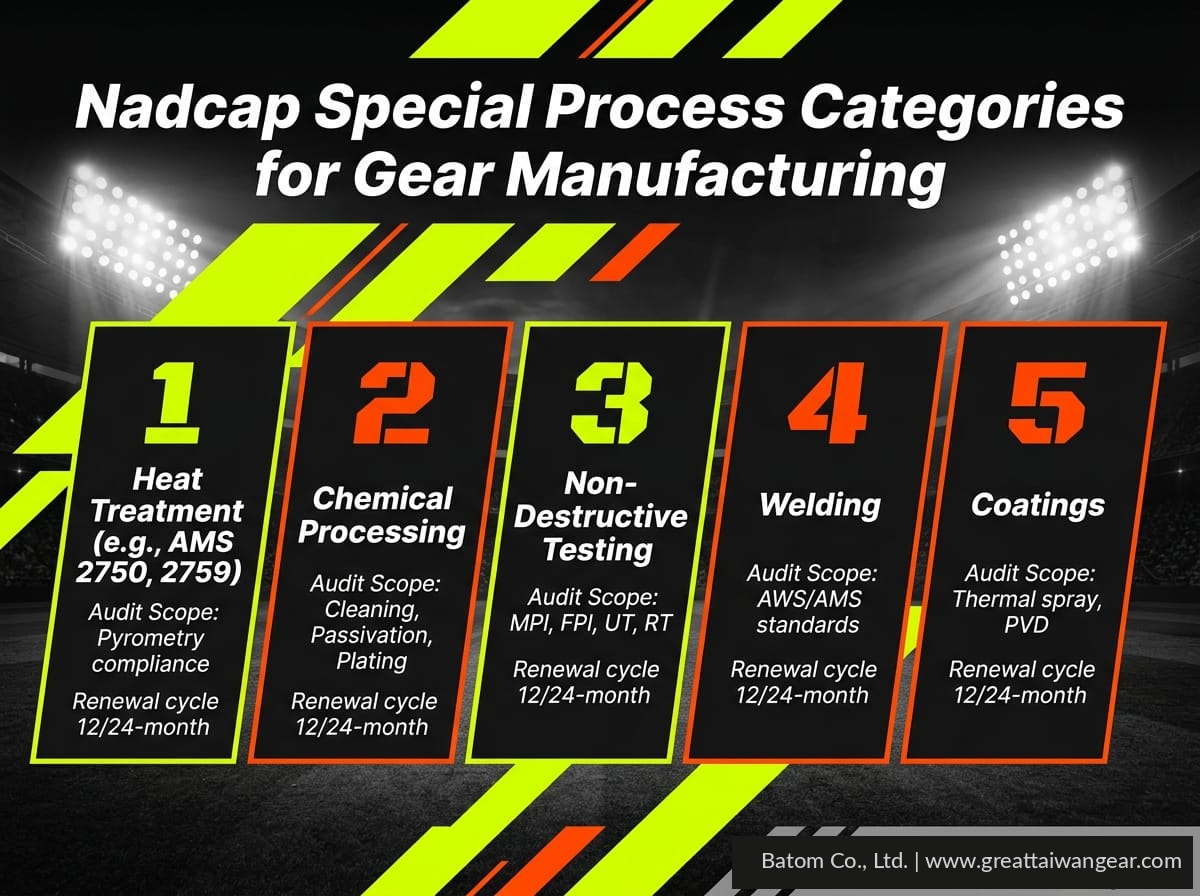
Nadcap is a voluntary accreditation program administered by the Performance Review Institute (PRI) in partnership with industry organizations. It specifically accredits suppliers who demonstrate specialized expertise in critical manufacturing processes, including heat treatment, nondestructive testing (NDT), chemical processing, and other precision operations.
For gear manufacturers, Nadcap certification signifies:
- Rigorous Quality Control: Independent auditors regularly evaluate manufacturing processes and quality management systems
- Specialized Process Expertise: The supplier has proven proficiency in specific disciplines (such as gear heat treatment) that directly impact product performance
- Customer Confidence: Most aerospace and defense customers require or strongly prefer Nadcap-certified suppliers for critical components
- Continuous Improvement: Certification mandates regular external audits and ongoing compliance verification
- Risk Mitigation: Reduces buyer risk by ensuring suppliers maintain strict process controls and documentation
A Nadcap-certified gear supplier isn't just delivering products—they're delivering verified manufacturing excellence and a documented commitment to reliability.
How to Search PRI's eAuditNet Database for Nadcap Suppliers
The Performance Review Institute (PRI) maintains eAuditNet, the official database for locating Nadcap-certified organizations. Learning to effectively navigate this resource is essential for finding qualified suppliers.
Accessing eAuditNet
- Navigate to https://www.eauditnet.com/
- Select "Find Certified Organizations" from the main menu
- Access the advanced search interface for detailed filtering options
Key Search Parameters for Gear Suppliers
- Special Process Category: Select "Gear Manufacturing" or component-specific processes
- Geographic Location: Filter by country or region (e.g., Taiwan, United States, Europe)
- Certification Status: Limit results to "Active" certifications only
- Audit Date Range: View suppliers with recent audits (within the last 12-24 months)
- Organization Name/ID: Search by specific supplier if you have a candidate in mind
Understanding Search Results
Each certified supplier record in eAuditNet should display:
- Certification Number: Unique identifier for tracking and verification
- Issue and Expiration Dates: Validity period of the current certification
- Certification Scope: Detailed list of special processes, product types, and material categories covered
- Last Audit Date and Results: Most recent surveillance or recertification audit outcome
- Next Scheduled Audit Date: When the supplier's next audit is scheduled
- Audit Status: Designation such as "Excellent," "Satisfactory," or "Not Satisfactory"
Additional eAuditNet Features
- Download Scope Documents: Many suppliers' scope documents are available for download
- View Audit History: Review audit trends and corrective action responses
- Verify Signer Authority: Confirm who is authorized to sign off on quality certifications for that supplier
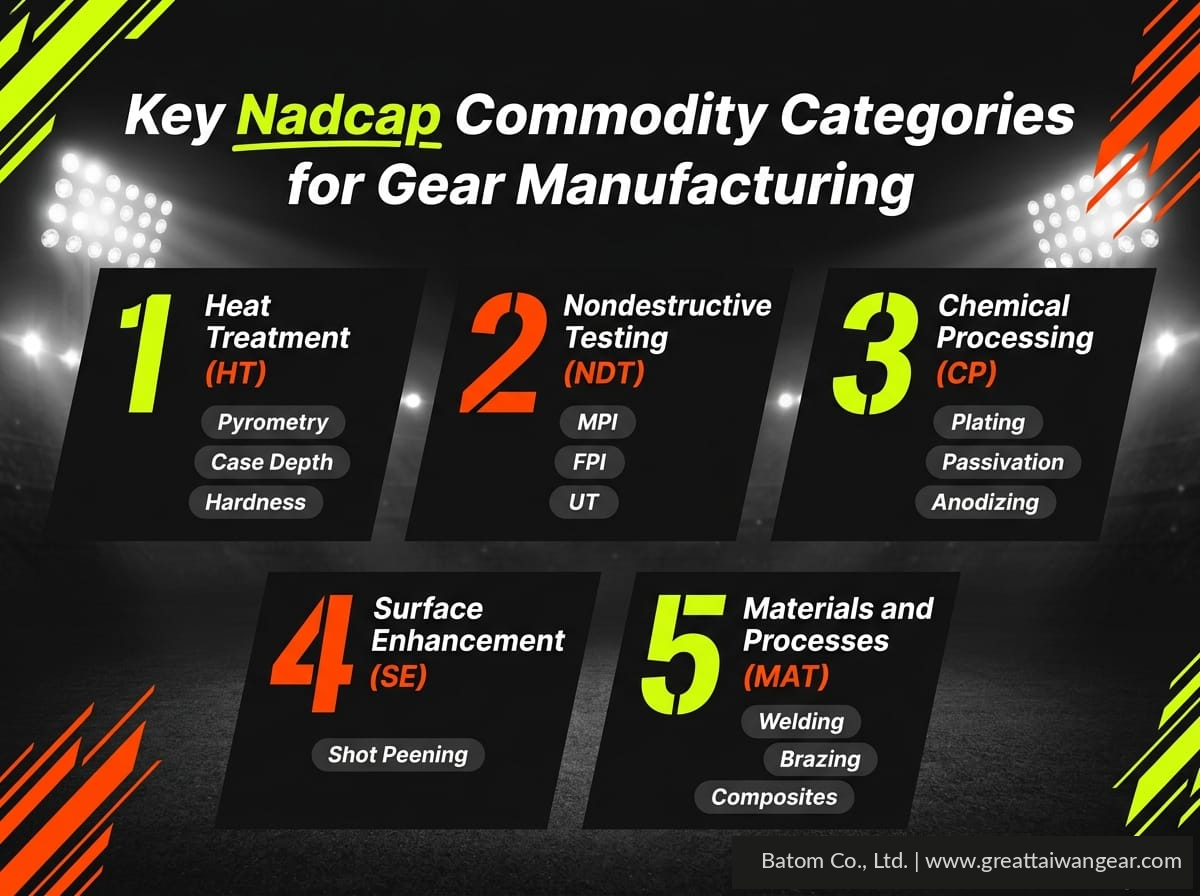
Key Nadcap Categories for Gears (CAC Abbreviations)
Gear manufacturing involves multiple Nadcap-accredited special process categories. Understanding each ensures you're selecting suppliers with the right certifications.
Heat Treatment (HT)
Gear heat treatment is the critical process that determines hardness, toughness, and long-term durability. Nadcap heat treatment accreditation ensures suppliers:
- Operate calibrated furnaces with verified temperature control systems
- Follow precise heating rates, hold times, and cooling curves
- Maintain process documentation and statistical control data
- Perform regular hardness testing and verification per specifications
- Implement proper quenching and tempering protocols
- Have qualified, trained personnel conducting all thermal cycles
Heat treatment quality directly impacts gear fatigue life, wear resistance, and failure mode prevention. A supplier's HT certification verifies their mastery of this critical process.
Nondestructive Testing (NDT)
NDT methods detect internal defects, surface flaws, and material inconsistencies without damaging the component. Nadcap NDT accreditation covers multiple methods:
- Magnetic Particle Testing (MT): Detects surface and near-surface defects in ferromagnetic materials
- Ultrasonic Testing (UT): Identifies internal voids, inclusions, and structural anomalies
- Penetrant Testing (PT): Reveals surface-breaking defects in non-ferromagnetic materials
- Eddy Current Testing (ET): Detects surface and subsurface flaws in conductive materials
- Radiography (RT): X-ray and gamma ray inspection for internal anomalies
A supplier's NDT certification demonstrates that their inspection personnel are qualified, their equipment is calibrated, and their procedures comply with aerospace standards.
Chemical Processing (CP)
This broad category encompasses coatings, plating, surface treatments, and corrosion protection—all critical for gear performance in harsh environments. Nadcap chemical processing accreditation verifies:
- Adherence to chemical process specifications and material compatibility
- Proper environmental controls and safety protocols
- Material traceability and batch documentation
- Process parameter verification and product performance testing
- Compliance with MIL-SPEC and FAA requirements
For gears intended for marine, aircraft, or long-term outdoor use, a supplier's CP certification ensures protective coatings will perform as specified.
Mechanical Processing (MC)
Precision machining determines gear profile accuracy, runout, and dimensional consistency. While less commonly required than heat treatment, Nadcap mechanical processing accreditation ensures:
- CNC machine calibration and preventive maintenance
- Process parameter control and documentation
- Tool management and tool life verification
- In-process dimensional verification
Materials and Processes (MAT)
Some suppliers also hold MAT accreditation for advanced material processes, welding, or composite work—important if your gears involve multi-material construction or special bonding.
Nadcap Supplier Qualification Checklist
Before committing to a partnership with a Nadcap-certified gear supplier, use this detailed checklist to verify their credentials and ensure they meet your requirements.
Certification Validity Verification
- [ ] Confirm current active status in the eAuditNet database
- [ ] Verify certification number matches the supplier's documentation
- [ ] Check issue and expiration dates—certification should not expire within 6 months of your first order
- [ ] Ensure the supplier hasn't been decertified or suspended from the program
- [ ] Confirm that the certification type matches the product classification (Tier 1 or Tier 2 supplier)
Scope Coverage Confirmation
- [ ] Verify the supplier's scope covers the specific special processes your gears require
- [ ] Confirm material coverage (steel, stainless, nickel alloy, etc.)
- [ ] Check that the scope includes your required size range (minimum and maximum dimensions)
- [ ] Ensure complexity level and feature types are within the supplier's certified range
- [ ] Confirm any specialized processes (carburizing, nitriding, case hardening) are included
Audit History Review
- [ ] Examine the last three audit dates and results
- [ ] Look for "Excellent" or "Satisfactory" ratings (avoid suppliers with "Not Satisfactory")
- [ ] Identify any major nonconformances and verify corrective actions were completed
- [ ] Check that surveillance audits occur at least annually
- [ ] Review trends—are audit scores improving, stable, or declining?
- [ ] Verify that the supplier is not under any probationary status
Merit Status Assessment
- [ ] Confirm the supplier holds "Excellent" status (indicating superior performance)
- [ ] Review how long the supplier has held merit status
- [ ] Check if there are any recent changes to merit status or downgrade notices
- [ ] Understand that "Excellent" status typically provides audit frequency relief (audits every 18-24 months vs. annually)
Organization Stability and Ownership
- [ ] Verify the company remains under the same ownership or management
- [ ] Check for any recent mergers, acquisitions, or facility relocations
- [ ] Confirm that key personnel (quality managers, process engineers) remain with the organization
- [ ] Review the company's financial stability if public information is available
RFQ Process for Nadcap-Certified Suppliers
Preparing Your Request for Quote
1. Detailed Gear Specifications Include complete technical details:
- Material and alloy designation (e.g., AISI 9310 carburizing steel)
- Gear type and application (spur, helical, bevel, herringbone, internal)
- Pitch diameter, module, number of teeth, and precision class
- Surface finish requirements (Ra value in micrometers)
- Hardness specifications (case depth, core hardness, surface hardness)
- Quality level and any aerospace or military standards (AS9100, ISO 6336, etc.)
2. Nadcap Requirements Section Explicitly state which certifications are mandatory:
- "Supplier must hold active Nadcap HT accreditation"
- "Nadcap NDT inspection required for 100% of production lots"
- "Certification scope must cover [material type] and [size range]"
3. Inspection and Quality Standards Reference the standards your gears must meet:
- Applicable military standards (MIL-G-19500, MIL-G-21040, etc.)
- Industry standards (ISO 10825, AGMA 2001-D04 / AGMA 2101-D04)
- Customer-specific engineering drawings and requirements
Key Questions to Include in Your RFQ
About Certifications:
- What is your current Nadcap accreditation portfolio? (List all CAC designations)
- What is your certification validity period and next scheduled audit date?
- Please provide a copy of your current certification scope document.
About Specific Processes:
- Can you provide documentation that your certification scope covers our material specification ([material])?
- What is your process capability (Cpk) for hardness control on gears in our size range?
- How do you ensure consistency of heat treatment processes across multiple furnaces or shifts?
- What is your sampling plan for destructive hardness testing? How frequently is it performed?
About Quality Documentation:
- Can you provide the last three audit reports (or at least a summary of audit results)?
- What nonconformances were identified in your last audit, and how were they addressed?
- Do you maintain process capability studies for your thermal cycles?
- What is your first-piece inspection process and product release procedure?
About Logistics:
- What is your typical lead time for gear orders?
- Do you have capacity to absorb our expected production volume?
- What is your price and volume discount structure?
- Can you meet our delivery schedule requirements?
Evaluating Supplier Responses
When reviewing RFQs returned by Nadcap suppliers:
- Clarity of Documentation: Suppliers should confidently provide certification proof and technical documentation
- Process Knowledge: Look for detailed answers that demonstrate deep understanding of their thermal and inspection processes
- Quality Mindset: Assess whether the supplier views Nadcap compliance as merely checking boxes or as genuine commitment to excellence
- Responsiveness: Quick, thorough responses suggest a well-organized supplier
Request references from the supplier—ask to speak with current aerospace or defense customers who have been satisfied with their gear quality and Nadcap compliance.
Red Flags and Due Diligence Procedures
Major Red Flags
- No eAuditNet Verification: Supplier claims Nadcap certification but cannot be verified in the PRI database—immediately disqualify
- Expired or Suspended Certification: Any certification no longer active raises serious concerns
- Scope Mismatch: Claimed certification doesn't actually cover your gear type, material, or size
- Multiple Recent Nonconformances: More than two major findings in the last audit cycle suggests process control issues
- Evasive Documentation Requests: Inability or reluctance to provide audit reports or scope documents is a major red flag
- Vague Process Knowledge: Supplier cannot clearly explain their heat treatment cycles, control parameters, or inspection criteria
- Frequent Personnel Changes: High turnover in quality or process engineering roles suggests instability
- Recent Ownership Changes: Supplier was acquired, relocated, or restructured—verify that Nadcap standards are maintained post-transition
Recommended Due Diligence Activities
1. Direct PRI Verification Contact PRI directly to independently verify:
- Current certification status
- Exact scope of accreditation
- Recent audit outcomes
- Any probationary or suspended status
2. Audit Report Review Request to review the supplier's latest audit report. Look for:
- Trend analysis of findings over multiple audit cycles
- Corrective action effectiveness
- Witness auditor comments and observations
- Areas of strength and opportunities for improvement
3. Customer References Request contact information for three aerospace or defense customers. Ask them:
- How long have they been sourcing gears from this supplier?
- Have they experienced any quality issues or delivery problems?
- Is the supplier proactive about process improvements?
- Would they recommend this supplier to others?
- Any concerns about consistency or reliability?
4. Site Visit and Facility Assessment If possible, conduct a supplier audit or facility visit to:
- Observe the production environment and cleanliness standards
- Meet the quality manager and process engineers
- Review in-house documentation and control charts
- Assess equipment condition and maintenance practices
- Evaluate the facility's overall organizational maturity
5. Quality History Investigation Ask about:
- Number of supplier-corrective action requests (SCARs) in the past 2-3 years
- Any warranty claims or field failures related to gears they supplied
- How disputes or quality issues are resolved
- Their approach to continuous improvement
6. Financial and Organizational Stability Research:
- The supplier's company age and ownership structure
- Any public financial information indicating stability
- Key personnel tenure and potential succession risks
- Industry reputation and standing
Taiwan's Nadcap-Certified Gear Supplier Landscape
Taiwan occupies a prestigious position in global precision gear manufacturing. The country is home to several Nadcap-certified gear suppliers who combine established manufacturing excellence with competitive pricing.
Advantages of Taiwan Nadcap-Certified Suppliers
Manufacturing Heritage
- Decades of accumulated expertise in gear design and production
- Strong foundational ISO 9001 and quality management maturity
- Established supply chains for raw materials and precision components
Increasing Nadcap Adoption
- Growing number of Taiwan-based manufacturers pursuing Nadcap certification
- Recognition that aerospace and defense contracts increasingly require Nadcap validation
- Investment in advanced heat treatment and inspection equipment
Cost Competitiveness
- Highly competitive cost structures and total-cost-of-ownership advantages versus comparable U.S. or European supply chains
- Competitive pricing without compromising quality standards
- Favorable currency positioning for U.S.-based customers
Technical Capability
- Expertise in complex gear designs (helical, herringbone, internal gears)
- Ability to work with premium materials (carburizing steels, stainless, nickel alloys)
- Advanced CNC and grinding technology for tight tolerances
Communication and Service
- Strong English-language capabilities in technical and commercial teams
- Responsive to customer inquiries and custom requirements
- Growing familiarity with aerospace industry standards and expectations
How to Find Taiwan-Based Nadcap Suppliers
- Access eAuditNet and filter by location: "Taiwan"
- Sort results by certification date to identify recent accreditations
- Contact Taiwanese gear manufacturing associations for supplier recommendations
- Leverage industry contacts who have established relationships in Taiwan
Cost Implications of Nadcap-Certified Gears
Many procurement managers ask: "Will using Nadcap-certified suppliers significantly increase costs?" The answer is nuanced and depends on several factors.
Direct Cost Drivers
Certification Overhead
- Nadcap certification involves regular audits, training, and system maintenance
- Suppliers typically distribute these costs across their customer base
- Expect 5-15% higher unit prices compared to non-certified competitors for equivalent specifications
Advanced Equipment Investment
- Nadcap-certified suppliers typically invest in: - Calibrated furnaces with temperature monitoring - Advanced nondestructive testing equipment (ultrasonic, eddy current, etc.) - Statistical process control systems - Controlled storage and material handling systems
- These capital investments translate to higher production costs
Quality and Inspection Labor
- More rigorous process documentation and verification requires additional personnel
- In-process inspections and first-piece qualification consume production time
- Statistical sampling and capability studies require skilled technicians
Long-Term Cost Benefit Analysis
Defect Reduction
- Nadcap suppliers typically deliver lower defect rates (0.1-0.5% vs. 1-3% for non-certified suppliers)
- Fewer field returns and warranty claims
- Reduced production line disruption from defective incoming materials
Supply Chain Efficiency
- Reduced receiving inspection burden—you can rely on supplier's Nadcap-verified testing
- Lower non-conformance rates mean less time managing supplier quality issues
- Faster cycle times from reduced rework and expediting
Risk Mitigation Value
- If your gears enter the aerospace or defense supply chain, Nadcap becomes a non-negotiable requirement
- Reduces regulatory and compliance risk for high-reliability applications
- Provides documented evidence of due diligence if product failures occur
Long-Term Partnership Stability
- Nadcap-certified suppliers tend to be more stable and financially sound
- Lower risk of supplier bankruptcy or facility closure
- Access to suppliers with continuous improvement mindset
Cost Decision Framework
Nadcap Certification is Essential When:
- Gears are specified for aerospace or military applications
- Your product specifications reference MIL-SPEC or AS9100 standards
- Quality failures could result in safety risks, regulatory penalties, or liability exposure
- Your customers explicitly require Nadcap-certified suppliers
- Gears are mission-critical components with high reliability expectations
Nadcap Certification is Recommended When:
- You're sourcing from international suppliers (adds credibility and verification)
- Your industry has emerging quality expectations that align with aerospace standards
- Long-term strategic cost reduction through fewer quality issues justifies premium pricing
Nadcap Certification May Be Optional When:
- Gears are for non-critical consumer applications with commodity-like requirements
- Price competition is primary driver and quality margins are very wide
- Your internal inspection capabilities are robust enough to catch major defects
Frequently Asked Questions (FAQs)
Q1: How often are Nadcap-certified suppliers audited?
A: Frequency depends on audit results and merit status. Suppliers rated "Excellent" with merit status typically undergo surveillance audits every 18-24 months, while "Satisfactory" rated suppliers are audited annually. Initial certifications require more frequent oversight. You can verify exact audit schedules in eAuditNet.
Q2: What happens if a supplier loses their Nadcap certification?
A: If a supplier's certification expires or is suspended, products manufactured after the loss of certification may not be acceptable for aerospace or defense applications. Always maintain current verification of supplier certification status before placing orders and monitor certification renewal dates.
Q3: Can I rely solely on the supplier's Nadcap certification, or do I still need to perform my own inspections?
A: Nadcap certification significantly reduces your inspection burden, but the extent of your inspections should align with your risk tolerance and product criticality. For mission-critical components, many buyers perform periodic receiving inspections or first-piece audits, while trusting the supplier for in-process and final verification.
Q4: How do I verify that a supplier's Nadcap certification is legitimate?
A: Always verify through eAuditNet (https://www.eauditnet.com/). Cross-reference the certification number, scope, and audit dates. You can also contact PRI directly or ask the supplier to provide recent audit reports. Never rely solely on the supplier's word or photocopied certificates.
Q5: Does Nadcap certification guarantee zero defects?
A: No. Nadcap certification ensures that the supplier has established and maintains rigorous process controls, but defects can still occur in any manufacturing operation. What Nadcap ensures is that processes are controlled, documented, and regularly verified—significantly reducing defect rates compared to non-certified suppliers.
Conclusion and Next Steps
Finding and qualifying a Nadcap-certified gear supplier requires diligence, but the payoff in terms of quality assurance, risk mitigation, and long-term partnership stability is substantial. By mastering the eAuditNet database, understanding Nadcap's key categories for gears, and implementing thorough supplier qualification procedures, you can identify partners who will reliably deliver high-quality gears to your specifications.
The 2026 landscape for gear suppliers includes an increasing number of Taiwan-based and international manufacturers pursuing Nadcap certification to meet global customer expectations. Leverage this guide to navigate the supplier selection process with confidence.
Key Takeaways: 1. Always verify Nadcap status through eAuditNet—never trust claims without independent verification 2. Ensure the supplier's certification scope covers your specific gear requirements 3. Request and review audit history and corrective action documentation 4. Conduct thorough due diligence including customer references and facility visits 5. Understand that Nadcap certification is an investment in long-term quality and reliability 6. Establish clear expectations in your RFQ regarding inspection, documentation, and delivery 7. Maintain ongoing monitoring of supplier certification status throughout your partnership
Ready to Source From a Trusted Nadcap-Certified Gear Supplier?
At Batom Co., Ltd., we understand the critical importance of Nadcap certification in today's aerospace and defense supply chains. Our team specializes in supplying precision gears that meet the world's most stringent quality and reliability standards.
Whether you're looking for a new Nadcap-certified supplier or want to learn more about our capabilities and certifications, we're here to help.
Contact Batom Co., Ltd. Today to discuss your gear requirements and explore how our Nadcap-certified expertise can support your program.