

AS9100 + Nadcap Dual Certification: What It Means for Aerospace Gear Quality
In the aerospace supply chain, quality certification is not a formality — it determines which OEM programs you can bid on and which supply chains you can participate in. AS9100 establishes the foundational quality management system for aerospace manufacturing. Nadcap provides third-party accreditation for special processes such as heat treatment, non-destructive testing, and chemical processing. When a gear manufacturer holds both certifications simultaneously, it signals that the organization's quality system and process capabilities have passed the aerospace industry's most rigorous independent verification.
This guide examines the specific scope of each certification, the qualification process, cost-benefit analysis, and the practical impact on supply chain positioning for gear manufacturers.
AS9100 Rev D: The Aerospace Quality Management Foundation
AS9100 Rev D (released September 2016) adds over 100 aerospace-specific requirements to the ISO 9001:2015 framework. For gear manufacturers, several clauses have direct daily operational impact.
Clause 8.1.3 (Product Safety) requires organizations to identify and manage safety risks throughout the entire product lifecycle. Clause 8.1.4 (Counterfeit Parts Prevention) mandates procurement controls, enhanced traceability, and verification methods for incoming materials. Clause 8.5.1 (Production and Service Provision) requires documented work instructions, defined critical parameters, and controlled special processes including heat treatment and surface finishing.
For a closer look at lot traceability and material records, see the aerospace traceability guide.
Clause 8.4.3 (Supplier Flowdown) is particularly consequential for gear suppliers. It requires explicit communication of critical item definitions, SPC requirements, and Nadcap certification requirements to sub-tier suppliers. If heat treatment is outsourced, the gear manufacturer must verify that the external processor holds valid Nadcap accreditation for the relevant processes.
Nadcap: The Gold Standard for Special Process Accreditation
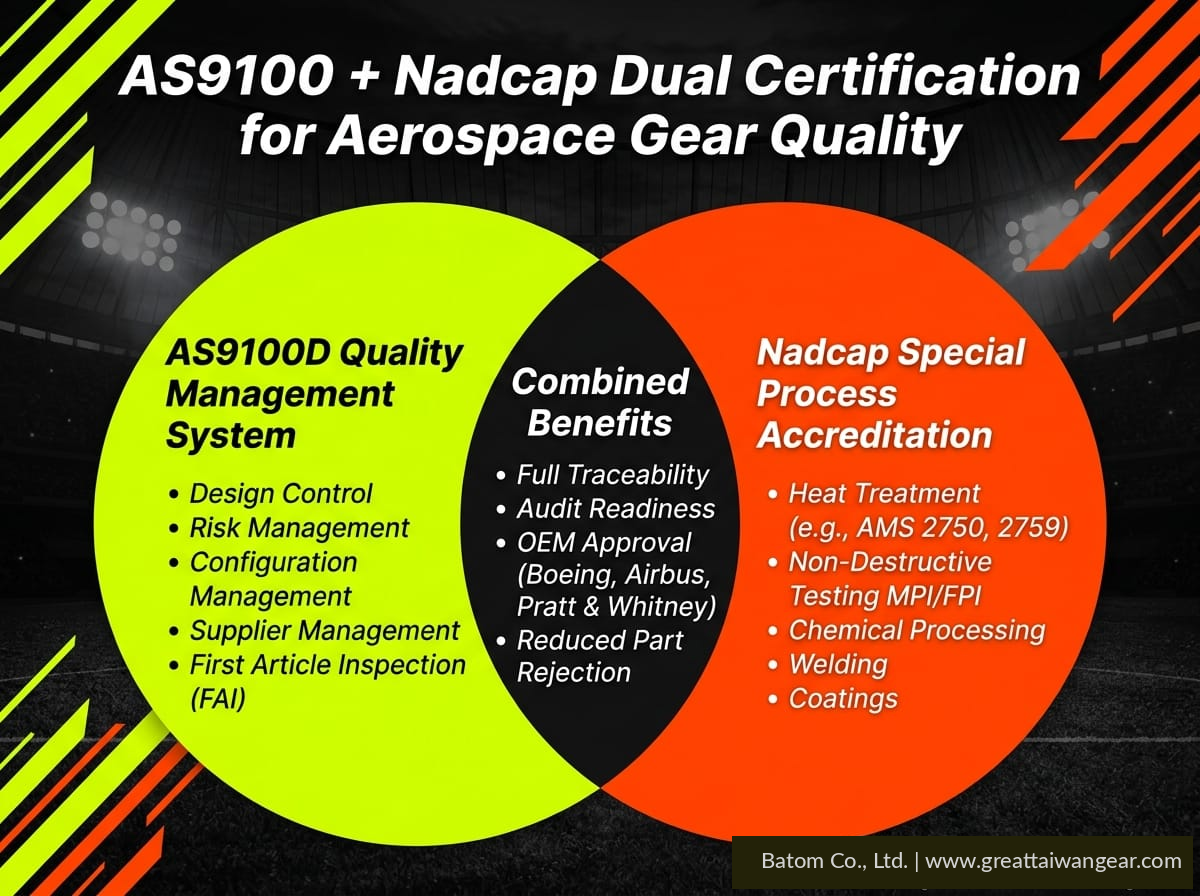
Nadcap (National Aerospace and Defense Contractors Accreditation Program) covers 26 categories of critical process accreditation. The most relevant categories for gear manufacturers include heat treatment (governed by AMS 2750 for pyrometry, and the AMS 2759 series for steel heat treatment including carburizing and nitriding), non-destructive testing (radiography, liquid penetrant, ultrasonic, eddy current, and magnetic particle inspection), and chemical processing (anodizing, plating, passivation, and conversion coating).
Heat treatment is the single most critical special process in gear manufacturing. Carburizing, nitriding, and quench parameters directly control gear durability and load capacity. Nadcap accreditation for heat treatment requires certified operators, periodic equipment capability validation, continuous process parameter monitoring, and complete lot traceability documentation.
A prerequisite for Nadcap application is that the organization must already hold AS9100 certification. Nadcap does not replace AS9100 — it builds on top of it for specific process areas.
How Dual Certification Impacts Supply Chain Qualification
The market access numbers tell a clear story. Suppliers holding only ISO 9001 can access less than 10% of the aerospace supply chain. Adding AS9100 extends reach to 40–60%. Dual AS9100 + Nadcap certification opens access to over 95% of aerospace supply chains globally.
Boeing, Airbus, Safran, GE Aviation, Pratt & Whitney, and Rolls-Royce all require dual certification from suppliers performing special processes. GE Aviation's supplier qualification portal states explicitly: "AS9100 certification is the minimum quality requirement for flight hardware; Nadcap certification is required for special processes."
The most tangible benefit is audit burden reduction. Before Nadcap accreditation, a supplier may face 6–12 individual customer audits per year. After accreditation, a single Nadcap audit (conducted every three years) satisfies all OEM audit requirements for that process category. The estimated savings reach USD 225,000–500,000 annually in audit preparation and travel costs alone, based on 15–20 eliminated audits at USD 15,000–25,000 each.
For a closer look at finding and qualifying a Nadcap-accredited supplier, see the Nadcap supplier qualification guide.
Certification Timeline and Cost Analysis
AS9100 certification for a mid-size organization (50–200 employees) typically takes 6–10 months. Consultant fees for gap analysis and training run USD 5,000–15,000. Internal implementation costs (staff time, documentation development) range from USD 20,000 to USD 100,000. Certification body audit fees fall between USD 8,000 and USD 25,000. Total first-year investment for small-to-medium organizations: USD 40,000–150,000. Annual surveillance audits cost USD 5,000–15,000 thereafter.
Nadcap accreditation requires a longer preparation period — 12–18 months on average. Pre-audit preparation (consultant engagement, process optimization, documentation compilation, internal audits) takes 6–12 months. PRI application fees run approximately USD 2,500–3,000 per special process category. Onsite audit costs range from USD 10,000 to USD 30,000. Total first-year investment: USD 30,000–150,000 depending on process complexity and current readiness.
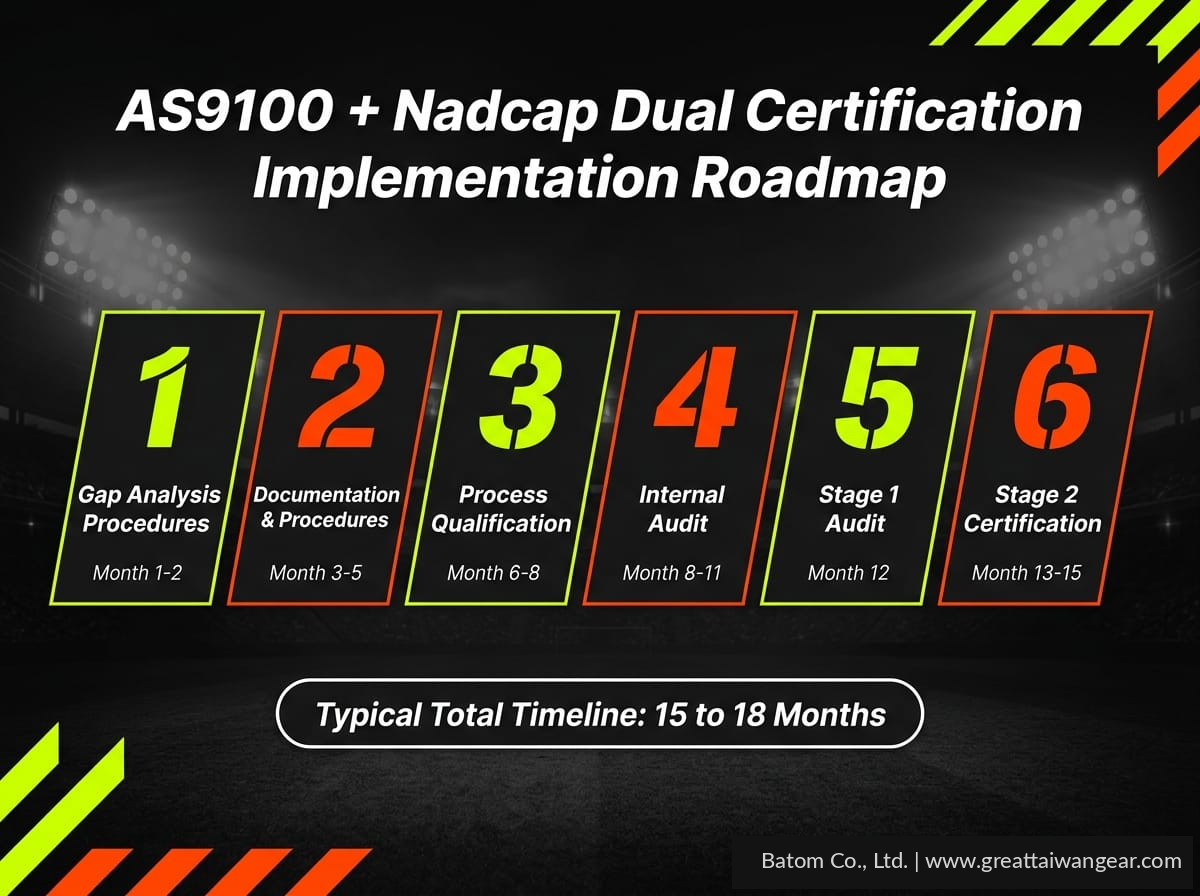
Sequential dual certification (AS9100 first, then Nadcap) spans 18–30 months. With deliberate planning, a 6-month overlap is achievable, bringing total elapsed time closer to 15–24 months.
Common Audit Non-Conformances in Gear Manufacturing
IAQG audit data from 2019–2025 reveals consistent patterns in AS9100 findings. Production control (Clause 8.5.1) accounts for 15–20% of all findings — work instructions not matching actual shop floor practices, missing equipment validation records, and absent process capability studies. Corrective action (Clause 10.2.1) represents 12–18% of findings and generates the most major non-conformances, typically from superficial root cause analysis and ineffective corrective actions that allow problems to recur. Measurement traceability (Clause 7.1.5.2) accounts for 10–15% of findings, primarily expired calibration intervals and incomplete traceability documentation.
Nadcap heat treatment audits surface more process-specific findings: expired operator certifications, equipment capability not re-validated after major maintenance, process parameter drift beyond specification limits, and incomplete hardness verification records. For gears specifically, tooth-to-tooth hardness variation is a direct indicator of insufficient process control capability.
Quantified Business Benefits of Dual Certification
Beyond market access, dual certification delivers measurable commercial returns. Dual-certified suppliers typically command a 10–15% price premium in competitive bidding situations. Order volume growth of 30–50% within 12–18 months of achieving dual certification is common, driven by access to previously restricted programs and contract consolidation from OEMs preferring certified suppliers.
Quality metrics improve as well. Customer-reported quality issues typically decrease by 20–40% post-Nadcap accreditation. Warranty costs drop 15–25%. On-time delivery improves 5–10% from better process control, and manufacturing scrap reduces 10–20%.
Supply chain tier advancement is perhaps the most strategically significant benefit. ISO 9001-only suppliers typically operate at Tier 3. AS9100 enables Tier 2 positioning. Dual certification qualifies suppliers for Tier 1 or strategic supplier designation — which unlocks 3–5 year blanket purchase agreements, 18–24 month forecast visibility, and engineer-to-engineer collaboration on new product development programs.
For Taiwan-based gear manufacturers, dual certification is the most effective tool for breaking past the "low-cost supplier" perception. It demonstrates to global aerospace OEMs that quality systems and process capabilities meet the highest international standards.
Contact Batom to discuss our aerospace gear manufacturing capabilities and quality certification status.
Frequently Asked Questions
What is the difference between AS9100 and Nadcap certification? AS9100 is a quality management system standard that covers the entire organization — from design control and risk management to supplier oversight and corrective action processes. Nadcap is a special process accreditation that validates specific manufacturing processes such as heat treatment, NDT, and chemical processing. AS9100 is a prerequisite for Nadcap; both are required for full aerospace supply chain access.
How long does it take to achieve AS9100 + Nadcap dual certification? Sequential certification typically takes 18–30 months. AS9100 alone requires 6–10 months for a mid-size manufacturer. Nadcap adds another 12–18 months of preparation and audit. With deliberate planning and some overlap, total elapsed time can be reduced to 15–24 months.
What does dual certification cost for a gear manufacturer? First-year investment for AS9100 ranges from USD 40,000 to USD 150,000 depending on organization size and existing quality system maturity. Nadcap adds USD 30,000–150,000. Total dual certification investment typically falls between USD 80,000 and USD 300,000, with annual maintenance costs of USD 8,000–20,000 thereafter.
Which aerospace OEMs require AS9100 + Nadcap dual certification? All major aerospace OEMs require dual certification for suppliers performing special processes. This includes Boeing, Airbus, Safran, GE Aviation, Pratt & Whitney, Rolls-Royce, Honeywell Aerospace, Lockheed Martin, and Leonardo Helicopters. Dual certification provides automatic qualification across all these supply chains.
What are the most common audit failures for gear manufacturers? The top AS9100 findings are production control issues (15–20% of findings), ineffective corrective actions (12–18%), and measurement traceability gaps (10–15%). Nadcap heat treatment audits commonly find expired operator certifications, equipment capability validation gaps, and incomplete hardness verification records. Tooth-to-tooth hardness variation is a gear-specific indicator of process control deficiency.
Written by the Batom Co., Ltd. engineering team. Batom has specialized in precision gear manufacturing since 1981, serving global automotive, aerospace, and industrial customers.