Why Global OEMs Are Sourcing Gears From Taiwan: Supply Chain Diversification in 2026
The global manufacturing landscape has undergone a seismic shift over the past five years. Geopolitical tensions, pandemic-induced supply chain disruptions, and the accelerating transition to electric vehicles have fundamentally changed how original equipment manufacturers (OEMs) source critical components. Today, more multinational corporations than ever before are turning their attention to Taiwan as a strategic sourcing hub for precision gears and drivetrain components. This isn't a temporary trend—it represents a structural realignment of global manufacturing strategy.
For OEM procurement and supply chain professionals, understanding the Taiwan advantage has become essential to maintaining competitive advantage, reducing supply chain risk, and accelerating time-to-market. This article explores why Taiwan has emerged as the go-to destination for gear sourcing in 2026 and how to evaluate and qualify suppliers in this thriving ecosystem.
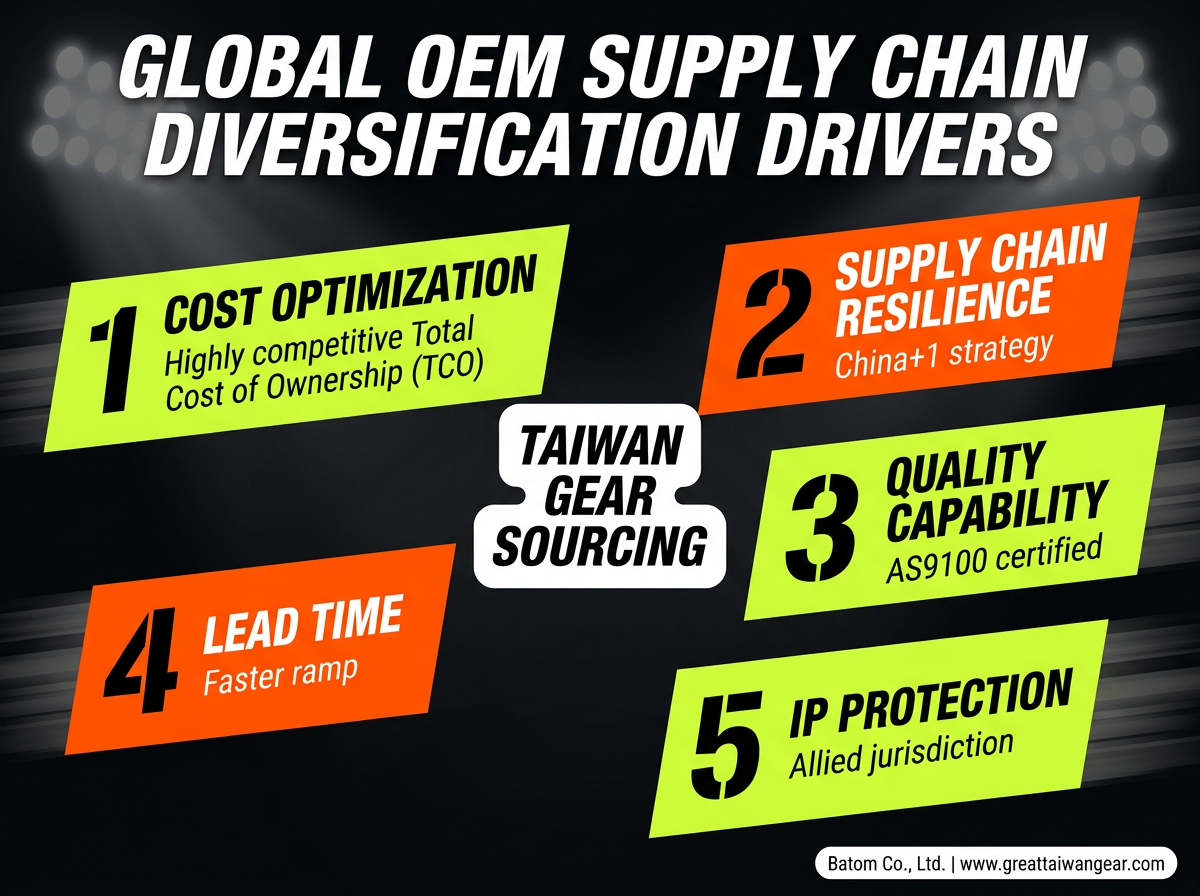
1. The Supply Chain Diversification Imperative
Geopolitical Risk and the China+1 Strategy
The past five years have fundamentally altered how multinational OEMs approach supply chain architecture. The U.S.-China trade tensions, evolving regulatory frameworks, and growing concerns about single-source concentration have forced procurement teams to rethink their supplier base.
The "China+1" strategy—which involves maintaining some manufacturing in China while deliberately diversifying to secondary sources—has become standard practice across automotive, aerospace, and industrial sectors. However, many OEMs have discovered that simply adding a second source isn't enough. They need alternative sources that may not match China's sheer raw volume, but offer superior precision, faster response times, stronger IP protection, and high-mix/low-volume flexibility.
For many OEMs building resilient 2026 supply chains, Taiwan has evolved from a secondary option into a strategic primary or co-sourcing destination — although the right fit ultimately depends on each OEM's product mix, cost structure, and risk tolerance. As a technologically advanced region with strong intellectual property protections and a distinct supply chain network, Taiwan offers meaningful geographic diversification together with deep precision-manufacturing expertise.
COVID-19 and Supply Chain Fragility
The COVID-19 pandemic exposed the brittleness of globally concentrated supply chains. When lockdowns in China's manufacturing hubs disrupted production in 2020-2022, companies that had all-in-one supplier relationships suffered catastrophic delays. OEMs learned that resilience requires multiple suppliers across different geographies.
This lesson has stuck. According to supply chain executives, the pandemic accelerated diversification plans by three to five years. Taiwan, with its uninterrupted production capacity and strong government support for semiconductor and precision manufacturing, became an obvious diversification target.
Reshoring and Nearshoring Trends
While "reshoring" manufacturing back to North America and Europe has gained political momentum, it's economically unfeasible for high-volume components like gears. Nearshoring—moving production to nearby, politically stable jurisdictions—has proven more practical. For North American and European OEMs, Taiwan serves as a trusted friendshoring destination, offering deep precision-manufacturing expertise in a stable, allied jurisdiction.
2. Taiwan's Precision Gear Manufacturing Ecosystem
40+ Years of Precision Machining Heritage
Taiwan's gear manufacturing excellence is not new. The industry traces its roots to the 1980s when Taiwanese manufacturers began establishing themselves as precision machining specialists. Over four decades, Taiwanese gear makers have accumulated deep expertise in everything from material science to advanced CNC programming to quality control methodologies.
This heritage translates into institutional knowledge that competitors simply cannot replicate. Taiwanese engineers grow up in a culture of continuous improvement, precision optimization, and customer obsession. When you source from a Taiwanese gear manufacturer, you're tapping into decades of accumulated problem-solving expertise.
The Central Taiwan Precision Machinery Cluster
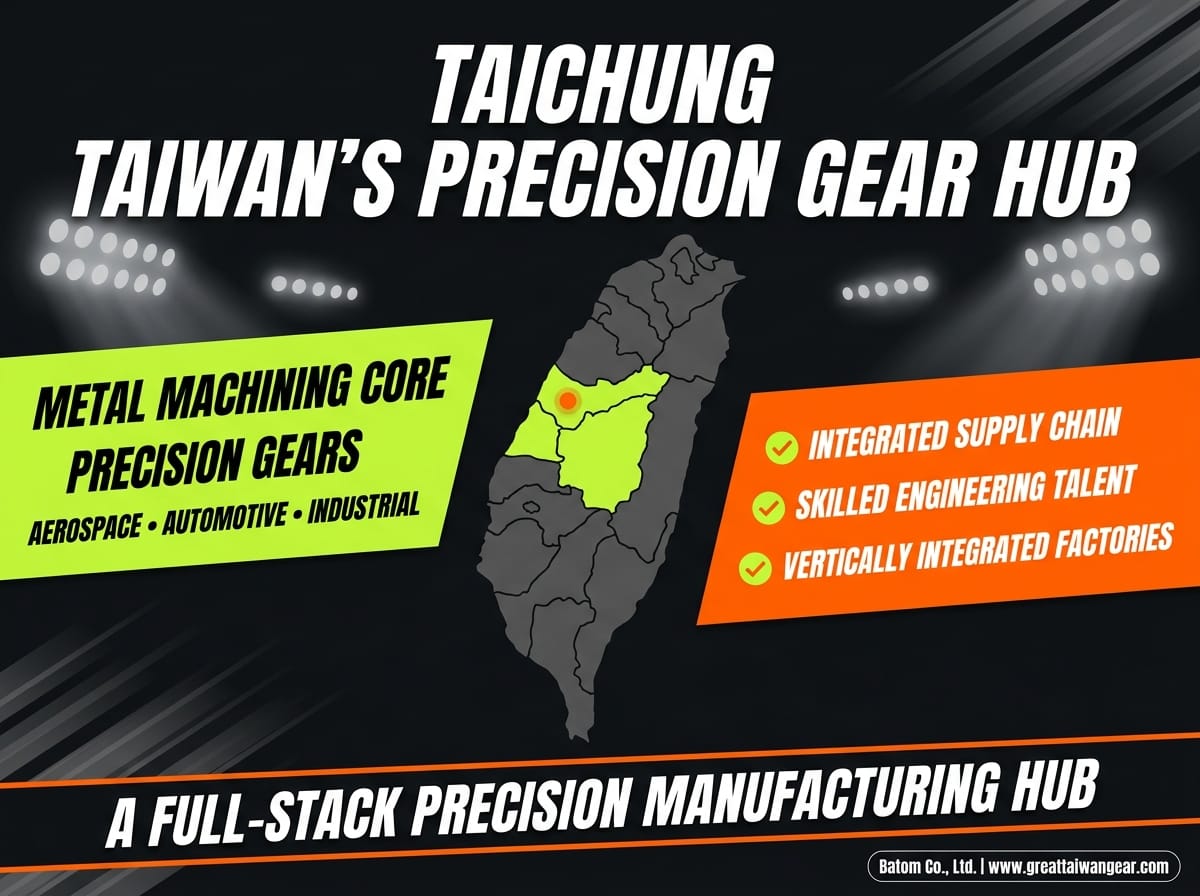
Taiwan's precision gear manufacturing is geographically concentrated in central Taiwan, particularly in Taichung and surrounding areas. This clustering creates powerful competitive advantages:
- Supply Chain Density: Support industries (heat treatment, grinding, inspection, surface finishing) are located within a few kilometers, reducing lead times and transportation costs.
- Talent Pool: A dense concentration of precision machining specialists makes it easier for manufacturers to hire skilled engineers, CNC programmers, and quality specialists.
- Robust Supply Chain Synergy: Close proximity to specialized sub-tier suppliers supports efficient integration, faster problem-solving, and continuous improvement within a strictly IP-protected ecosystem.
- Infrastructure: Local governments have invested heavily in supporting manufacturing infrastructure, including testing facilities, training centers, and business support services.
This ecosystem advantage means Taiwanese manufacturers can offer integrated solutions that would require coordinating multiple vendors in other regions.
For a closer look at sourcing precision gears from Taiwan, see the Taiwan sourcing guide.
200+ Gear Manufacturers at Multiple Capability Levels
Taiwan is home to more than 200 gear manufacturers, ranging from small, specialized shops to large-scale industrial operations. This diversity ensures that OEMs can find suppliers at any capability level:
- Precision Automotive Tier-1 Suppliers: Critical precision component manufacturers serving global Tier-1s in automotive, aerospace, and industrial transmission applications.
- Mid-Tier Specialists: Manufacturers (30-100 employees) with deep expertise in specific gear types or materials, offering flexibility and responsive customer service.
- Specialized Precision Job Shops: Small operations specializing in prototyping, complex geometries, or material innovations.
This ecosystem structure allows OEMs to begin with a mid-tier partner for prototyping and then scale to larger Tier-1 suppliers for mass production—all within Taiwan.
3. Cost Competitiveness
Price Advantage vs. Western and Japanese Suppliers
Taiwanese gear manufacturers typically offer highly competitive cost structures and superior Total Cost of Ownership (TCO) when evaluated against equivalent Western and Japanese suppliers. These efficiencies reflect:
- Labor Costs: While Taiwan's manufacturing wages are higher than China's, they remain significantly below U.S. and European levels.
- Manufacturing Efficiency: Decades of operational optimization have driven down production costs without sacrificing quality.
- Scale: The density of the industry supports high-volume production of standard components at competitive unit costs.
Competitive with China on Quality-Adjusted Basis
One of the most important discoveries for OEMs has been that while Taiwanese suppliers may cost slightly more than Chinese alternatives, the quality-adjusted cost (total cost of ownership including defect rates, rework, supply reliability, and warranty claims) often favors Taiwan.
Chinese suppliers excel at high-volume commodity gears. But for applications requiring tighter tolerances, exotic materials, or application-specific engineering, Taiwanese suppliers deliver better value. When you factor in supply chain risk, intellectual property protection, and supply reliability, Taiwan's cost advantage becomes even more compelling.
4. Quality Certification Coverage
Comprehensive International Standards Compliance
One of the most tangible advantages of sourcing from Taiwan is certification coverage. The vast majority of Taiwanese gear manufacturers maintain multiple international quality certifications, demonstrating commitment to globally recognized standards:
ISO 9001 (Quality Management)
- The vast majority of export-oriented Taiwanese gear manufacturers hold active ISO 9001 certification
- Demonstrates foundational quality systems across design, manufacturing, and delivery
IATF 16949 (Automotive Quality)
- An increasing share of Taiwanese suppliers — estimated at roughly 60% among larger, export-focused manufacturers — now hold IATF 16949 certification
- Essential for Tier-1 and Tier-2 suppliers providing critical components to automotive OEMs, including EV drivetrain systems and precision transmission applications
AS9100 (Aerospace Quality)
- A select group of Taiwanese gear manufacturers hold active AS9100 certification, reflecting the stringent quality and traceability requirements of aerospace supply chains
- Indicates capability to meet the most stringent quality, traceability, and safety requirements
Nadcap Certification (Special Processes)
- A highly select group of Taiwanese suppliers have achieved Nadcap accreditation for critical special processes such as heat treatment and NDT
- Demonstrates third-party validation of specialized manufacturing capabilities
ISO 13485 (Medical Devices)
- An estimated 15-20% of medical-oriented Taiwanese manufacturers hold ISO 13485 certification
- Enables participation in medical robotics and surgical device supply chains
This certification coverage gives OEMs confidence that Taiwanese suppliers understand and can reliably execute global quality standards.
5. Full Process Chain Under One Roof
Vertical Integration as a Competitive Advantage
One of the most underrated advantages of Taiwanese gear manufacturers is their ability to deliver integrated solutions. Many larger Taiwanese suppliers maintain in-house capabilities across the entire production chain:
Design and Engineering
- CAD/CAM capability for gear design, simulation, and optimization
- Material selection and metallurgy consulting
- Application-specific engineering support
Prototyping
- Wire EDM (electrical discharge machining) for rapid prototyping of complex gear profiles, such as internal splines and gears, without waiting for custom cutting tools
- Small-batch CNC capabilities for proof-of-concept production
- Highly responsive prototyping with dedicated fast-track routing for urgent design iterations
Precision Manufacturing
- CNC gear hobbing for spur, helical, and worm gears, supported by specialized bevel gear cutting and grinding systems
- Gear shaping for internal gears and other specialized geometries
- Multi-axis CNC machining for complex bearing surfaces and mounting features
Heat Treatment
- In-house carburizing, hardening, and tempering for tooth hardness optimization
- Vacuum heat treatment for critical aerospace applications
- Process documentation and traceability for supply chain transparency
Finishing and Grinding
- Precision grinding for tooth profile optimization
- Surface finishing (honing, lapping) for noise and wear reduction
- Deburring and edge treatment for safety and assembly compatibility
Quality Control and Inspection
- CNC gear inspection with automated profile and lead checking
- Surface finish measurement
- Hardness testing and material verification
- 100% traceability documentation for critical applications
This vertical integration delivers several advantages:
- Single Point of Accountability: Quality issues can be diagnosed and resolved internally without coordinating multiple vendors.
- Streamlined Production: Eliminating inter-vendor coordination minimizes handoff friction, supporting more predictable delivery schedules and faster responses to design changes compared to multi-source production.
- Cost Optimization: In-house capabilities eliminate third-party markups on finishing, heat treatment, and inspection services.
- Engineering Agility: Design modifications can be quickly implemented across the production chain without vendor communication delays.
6. Flexibility and Responsiveness
Low Minimum Order Quantities (MOQs)
Unlike many Asian suppliers that enforce high minimum order quantities, Taiwanese gear manufacturers are known for their flexibility on MOQs. Many suppliers will accept:
- Prototype Quantities: Small validation builds for early-stage development and engineering qualification
- Low-to-Medium Volume Production: Flexible low-to-medium volume production supports pilot builds, qualification runs, and high-mix/low-volume aerospace and medical programs, where demand is often project-based rather than mass-market driven
- Graduated Scaling: Flexible transitions from prototype → qualification → full production
This flexibility is invaluable for OEMs launching new products, testing market demand, or serving specialized applications with lower volumes.
Lead Times: Typical Ranges
Every custom gear is different, so lead times vary with geometry complexity, batch size, and the availability of existing tooling, cutters, and fixtures. As a general guide, fully custom gears typically ship in 8-12 weeks from order placement, while catalog or repeat-tooled geometries can move much faster. Drivers include:
- Standard vs. Custom Gears: Catalog gears typically ship in 2-4 weeks; fully custom geometries are typically 8-12 weeks, depending on complexity and on whether existing tooling can be reused
- Batch Sizes: Smaller batches (under 1,000 pieces) often have shorter lead times than bulk orders due to scheduling efficiency
- Tooling Requirements: Existing or modifiable tooling enables much faster turnaround; new tooling extends the schedule (see Rapid Tooling below)
To further support just-in-time supply chains, predictable manufacturing lead times can be combined with Vendor-Managed Inventory (VMI) programs and regional buffer hubs, helping OEMs maintain service levels while mitigating transoceanic logistics risks.
Rapid Tooling and Engineering Support
Beyond standard production, Taiwanese suppliers excel at rapid prototyping and tooling:
- Custom Tooling: New custom gear hobbing tools can typically be procured and delivered within 4–8 weeks, depending on the tool design and complexity
- Tool Modification: Existing tools can typically be modified to support specification changes in 2-4 weeks, depending on the scope of the change
- Engineering Consulting: Many suppliers offer free or low-cost engineering support to optimize designs for manufacturability, cost, and performance
7. Industry Success Stories
Automotive: EV Transmission Gears
The transition to electric vehicles has created explosive demand for multi-speed transmission gears and single-speed reducer gears. Taiwanese suppliers have become critical partners for Tier-1 suppliers and OEMs:
There is more on how an EV gearbox program is developed in the EV gearbox development story.
- EV Transmission Gears: Taiwanese manufacturers supply high-precision helical and spur gears optimized for the extreme high-RPM environments of modern EV single-speed reducers and select high-performance multi-speed applications.
- Reducer Gears: Single-speed reduction gears for direct-drive EV powertrains require extreme precision (gear noise targets: <70 dB) and low-torque ripple characteristics.
- Material Innovations: Taiwanese suppliers are leading development of new carburizing and hardening processes to extend gear life in high-torque EV powertrains.
Key Players: Multiple Taiwanese suppliers now serve global automotive Tier-1 companies (ZF, Bosch, Dana, Magna), supplying gears for EV platforms from legacy OEMs and EV startups alike.
Aerospace: Actuator and Gearbox Components
Aerospace demands are perhaps the most demanding: zero-fault tolerance, extensive documentation, and traceability requirements. Taiwanese suppliers meeting these standards have carved out critical market positions:
- Flight Control Actuators: Precision gears for aircraft trim, flap, and landing gear actuation systems
- Engine Gearboxes: Gears for auxiliary power units (APUs) and engine accessory drives
- Precision Spiral Bevel Gears: Complex gear geometries optimized for high-speed, right-angle power transmission in rotorcraft and aerospace actuation systems
Key Certifications: AS9100 certification and Nadcap accreditation are now table-stakes for aerospace applications.
Medical: Surgical Robot Drive Gears
The explosion in robotic surgery has created demand for miniaturized, extremely precise gears for surgical robot joint drives:
- Ultra-Miniature Gears: Sub-5 mm diameters and micro-modules such as 0.1 to 0.2, requiring extreme manufacturing precision and tight quality control
- Backlash Control: Ultra-low backlash requirements (under 2 arc-minutes) to ensure surgical precision
- Material Biocompatibility: Gears made from implant-grade materials where gears contact tissues or fluids
Key Standards: ISO 13485 certification is mandatory; many suppliers also pursue ISO 14644 cleanroom classification for ultra-clean processing, washing, inspection, and packaging of medical-grade components.
Robotics: Cobot and Industrial Robot Joint Gears
Collaborative robots (cobots) and industrial robots require lightweight, high-strength gears for precise joint articulation:
- Planetary Gearboxes: Multi-stage planetary drives combining high torque density with compact geometry
- Backlash Minimization: Extremely tight tolerances to enable accurate position feedback and closed-loop control
- Fatigue Strength: Gears optimized for millions of cycles with minimal wear
8. How to Evaluate and Qualify a Taiwan Gear Supplier
RFQ Process: What to Specify
When issuing a Request for Quote (RFQ) to Taiwanese suppliers, include these critical elements:
Detailed Specifications
- Gear geometry (module, number of teeth, helix angle, face width, bore diameter)
- Material and hardness requirements (e.g., AISI 8620 carburized to 58–62 HRC surface hardness, with minimum 35 HRC core hardness and 0.8–1.2 mm effective case depth, subject to customer drawing and final approval)
- Tolerance requirements (DIN, ISO, AGMA, or custom)
- Surface finish and runout tolerances
- Desired tooth flank deviations (profile form deviations, lead deviations)
Quality Requirements
- Certification requirements (ISO 9001, IATF 16949, AS9100, etc.)
- Inspection scope (100% or AQL-based sampling)
- Documentation requirements (material certs, heat treat reports, CMM reports)
- Traceability requirements (serial numbering, lot codes, etc.)
Volume and Timing
- Expected annual volumes (for supplier capacity planning)
- Lead time requirements for prototypes and production
- Minimum order quantities you can accept
- Scalability plans (prototype → pilot → full production)
IP and Confidentiality
- NDA requirements
- Tooling ownership terms (your company vs. supplier)
- Design confidentiality provisions
- Usage restriction clauses (e.g., "sole supplier for this application")
Factory Audit Checklist
Before awarding a production order, conduct an on-site or virtual factory audit. Use this checklist:
Facility & Equipment
- ☐ High-precision CNC hobbing and grinding equipment with documented process capability (e.g., Cpk), regular calibration, and preventative maintenance records
- ☐ Advanced gear metrology: dedicated CNC gear profile analyzers and high-precision CMMs for rigorous dimensional and topological validation
- ☐ Heat treatment furnaces with temperature control documentation
- ☐ Finishing equipment: grinding, honing, or equivalent
- ☐ Strictly climate-controlled facilities (temperature and humidity regulation) essential for precision gear grinding and high-end metrology
Quality Systems
- ☐ Documented quality procedures and work instructions
- ☐ Documented material and heat treatment traceability
- ☐ Statistical process control (SPC) charts and control limits
- ☐ Documented quality problem-solving frameworks, including 8D for automotive programs and CAPA for medical applications, together with robust PPAP/APQP execution for new product launches
- ☐ Current certifications validated and actively maintained in global registries (e.g., IAQG OASIS for AS9100, or IATF Global Database)
Engineering & Design
- ☐ CAD/CAM capability for design review and optimization
- ☐ Gear design software (KISSsoft, Gleason, or equivalent)
- ☐ Evidence of metallurgical expertise (material selection, hardness optimization)
- ☐ Documentation of previous similar projects (portfolio review)
Supply Chain & Capacity
- ☐ Evidence of stable raw material supply, managed through strict Approved Vendor Lists (AVL) and complete mill-to-machine traceability, supports aerospace and medical compliance requirements
- ☐ Documented lead times for standard and custom tooling
- ☐ Production scheduling and capacity planning systems
- ☐ Evidence of on-time delivery track record
Personnel
- ☐ Dedicated quality manager and engineering manager
- ☐ CNC programmer with demonstrated expertise
- ☐ Evidence of staff training and skill development programs
Sample Validation Process
Before committing to production volumes, always validate samples:
Protocol
- Specification Alignment: Verify that samples meet all geometric, material, and hardness specifications.
- Performance Testing: If applicable, test sample gears in your application (backlash, noise, wear, efficiency).
- Quality Documentation: Request and review all documentation (material certs, heat treat reports, CMM reports, traceability records).
- Initial Process Capability: Request comprehensive First Article Inspection (FAI) reports and verify that the initial pilot lot demonstrates strong process control before authorizing mass production.
- Edge Cases: Verify samples under extreme operational conditions specified in the drawing, such as peak torque loads and temperature extremes, to confirm dimensional stability, material integrity, and heat-treatment performance.
Approval Criteria
- Samples meet all specifications without deviation
- Documentation is complete and traceable
- Multiple lots show consistent quality
- Performance testing meets or exceeds expectations
- Supplier can clearly explain their process and any deviations
IP Protection Considerations
When sourcing gears to custom specifications, protect your intellectual property:
Design Ownership
- Specify in your purchase agreement that your company owns the design and tooling
- Require that the supplier not use the tooling or design for any other customer
- Include provisions for tooling return or destruction if the business relationship ends
Confidentiality
- Require signed NDA covering all aspects of the design and your application
- Document all design communications (email, meetings) as confidential
Quality & Compliance
- Maintain detailed documentation of all specifications, changes, and quality issues
- Require supplier to maintain similar documentation and provide it upon request
- Include provision for source inspection and audits to verify compliance
Conclusion
The shift toward Taiwan-based gear sourcing represents a rational response to fundamental changes in the global manufacturing environment. Geopolitical risk, supply chain fragility, and the need for responsive, flexible suppliers have made Taiwan an indispensable part of global OEM strategy.
Taiwan offers a unique combination of advantages: four decades of manufacturing expertise, a dense ecosystem of specialized suppliers, competitive cost structure, comprehensive quality certifications, vertical integration capabilities, and a responsive, customer-centric culture. For OEMs launching new products, diversifying supply sources, or scaling production, Taiwan deserves serious consideration.
The companies leading their industries in 2026 are those that have successfully built diversified, resilient supply chains. For many OEMs, Taiwan has evolved from a secondary option into a strategic primary or co-sourcing destination — though the right role for Taiwan in any given supply chain still depends on the specific product mix, cost structure, and risk tolerance involved.
Frequently Asked Questions
Q1: How do Taiwanese gear manufacturers compare to Chinese suppliers on cost?
A: Price is only one factor. For aerospace and medical applications, Taiwanese manufacturers are often selected for precision, consistency, and long-term supply reliability, which can reduce total landed cost over the full product lifecycle.
Q2: What's the typical lead time for custom gears from Taiwan?
A: It depends on the gear: every custom design is different, and lead time varies with complexity, batch size, and whether existing cutters and fixtures can be reused. As a general guide, fully custom gears typically run 8-12 weeks, while catalog or repeat-tooled geometries can ship in 2-4 weeks. If new tooling is required, add roughly 4-8 weeks for hobbing tool fabrication, depending on the tool design. If only an existing tool needs to be modified, add roughly 2-4 weeks. Prototype quantities (10-100 pieces) often move faster than full production runs because they can be slotted into existing schedules.
Q3: Do Taiwanese suppliers require long-term contracts?
A: Taiwanese suppliers are well suited to both project-based prototyping and Long-Term Agreements (LTAs) for mass production, enabling OEMs to secure capacity, improve cost predictability, and strengthen supply chain resilience.
Q4: What certifications should I require from a Taiwanese gear supplier?
A: Minimum baseline should be ISO 9001. For automotive, IATF 16949 is increasingly expected. For aerospace, AS9100 certification is mandatory. For medical devices, ISO 13485 is required. Many suppliers hold multiple certifications; during the RFQ process, specify which certifications are relevant to your application.
Q5: How do I protect my gear designs when sourcing from Taiwan?
A: Include clear IP ownership clauses in your purchase agreement specifying that your company owns the design and tooling. Require NDA and confidentiality agreements covering the design, application, and customer base. Maintain documented communication of all specifications and changes. Include provisions for tooling return or destruction if the relationship ends. Regular audits and source inspections also help ensure compliance.
Ready to Diversify Your Gear Supply Chain?
If you're an OEM procurement or supply chain professional evaluating Taiwan as a sourcing destination, Batom Co., Ltd. can help. As a leading precision gear manufacturer in Taiwan with over 40 years of expertise, we offer fully integrated in-house production, from advanced DFM engineering to final precision grinding, to secure your global supply chain.
Contact Batom Today to learn how we can help you build a more resilient, cost-effective gear supply chain.