
Taiwan's Rise as an Aerospace Gear Hub: Certifications, Capabilities & Key Players
Taiwan has firmly established itself as a critical node, and nowhere is this more evident than in precision gear manufacturing. Once known primarily for consumer electronics, Taiwan's aerospace sector now boasts world-class capabilities, stringent certifications, and an ecosystem of specialized manufacturers serving major OEMs worldwide. This comprehensive guide explores what makes Taiwan an indispensable partner for aerospace gear sourcing.
Taiwan's Aerospace Industry Growth: The Foundation
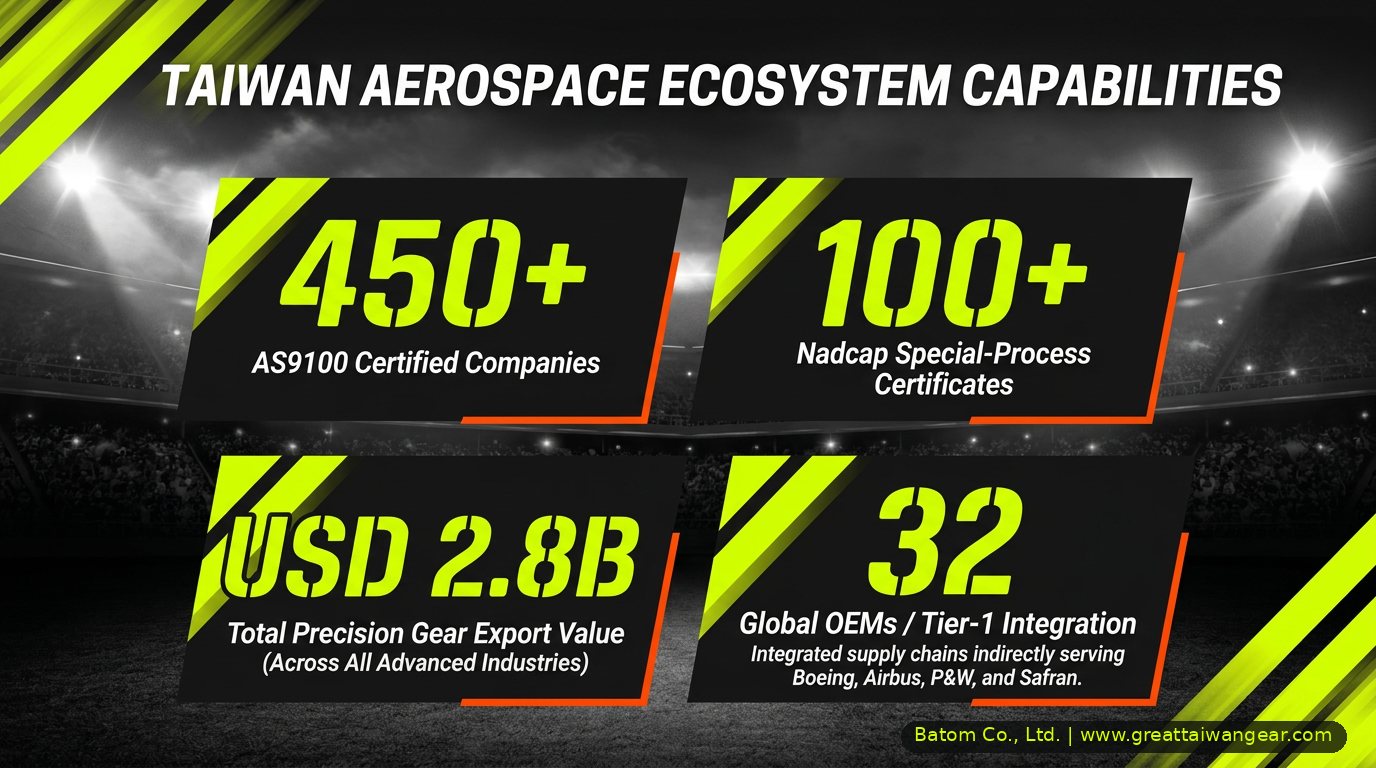
The transformation of Taiwan's aerospace sector began in earnest during the 2000s. Government investment in defense and civil aviation drove infrastructure development, talent recruitment, and process standardization. Today, the sector employs tens of thousands of skilled professionals across a robust ecosystem of 450+ AS9100-certified, tier-capable manufacturers and generates annual revenues continuously growing past the USD 4 billion mark, with strong future projections supported by ongoing OEM demand and Tier-1 partnerships.
What distinguishes Taiwan's aerospace growth is its strategic positioning. Located between major Asian manufacturing hubs and Western markets, Taiwan developed as a natural hub for:
- Rapid prototyping and tooling design
- Complex subassembly manufacturing
- Quality-driven production runs
- Supply chain coordination across multiple suppliers
Taiwan-based suppliers participate in supply chains serving major aerospace OEMs and tier-1 integrators worldwide, operating in a competitive ecosystem where quality standards are non-negotiable.
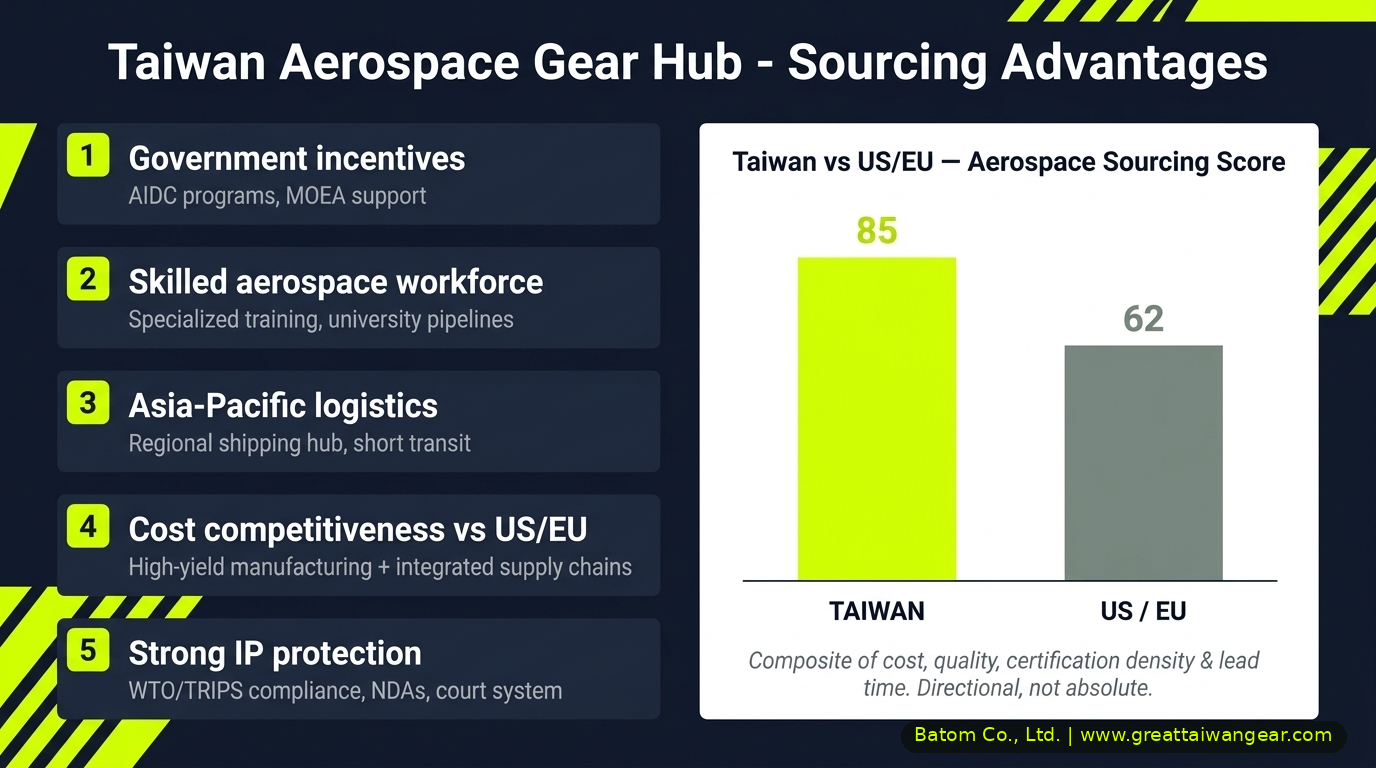
Government Support and AIDC Programs
The Aerospace Industrial Development Corporation (AIDC) — known in Taiwan as 漢翔航空工業 — is the country's prime contractor in aerospace. As the anchor of the domestic ecosystem, AIDC drives downstream supplier upgrading by qualifying local Tier-2 and Tier-3 partners, transferring aerospace process discipline (AS9100, Nadcap) into the broader supply chain, and aggregating demand from Boeing, Airbus, and the major engine OEMs into Taiwan's industrial base. This prime-contractor role has been one of the single most important catalysts for Taiwan's aerospace gear capability over the past two decades.
Key AIDC Programs:
- National Aerospace Program (NAP): Developed commercial aircraft component supply chains
- Advanced Manufacturing Initiative: Invested in Industry 4.0 technologies, digital twins, and IoT integration
- Talent Development Partnerships: Collaborated with universities to train aerospace engineers and technicians
Government Defense & Aerospace Initiatives (separate from AIDC's core programs):
- Indigenous Defense Submarine (IDS) Program: A separate national defense initiative that has spurred investment in advanced mission-critical defense components and tightened the local precision-machining ecosystem, even though it sits outside AIDC's core aerospace remit.
These government programs are widely credited with accelerating technology adoption compared to a purely market-driven path. Government-backed testing facilities, metrology centers, and quality assurance labs are now available to approved manufacturers, creating a competitive advantage for Taiwan-based suppliers.
The Certification Landscape: AS9100 and Nadcap
Aerospace suppliers must navigate a complex certification environment. Taiwan's manufacturers have made substantial investments to comply with international standards, making them reliable partners for regulated applications.
AS9100 Certification
AS9100 (currently AS9100 Rev D) is the aerospace quality management standard required by virtually all OEMs. Taiwan manufacturers pursuing AS9100 certification must demonstrate:
- Configuration Management: Documented control of all design changes
- Foreign Object Debris (FOD) Management: Contamination prevention protocols
- Product Safety: Risk analysis and traceability
- Supply Chain Risk Management: Vetting of subsuppliers
- Counterfeit Parts Prevention: Material authentication procedures
Looking ahead — AS9100 → IA9100: The International Aerospace Quality Group (IAQG) has been progressively transitioning the AS9100 / EN 9100 / JISQ 9100 family toward a single harmonized standard, IA9100, with renumbering of clauses to align with the regional editions. Forward-looking aerospace suppliers — Batom included — are tracking the IAQG transition timeline and updating internal QMS documentation, training, and audit-readiness packages so the migration is seamless once the IA9100 designation is fully published. Working with a supplier who is already mapping AS9100 controls to the IA9100 clause structure is a strong indicator of long-term standards readiness.
Industry estimates put the active Taiwanese AS9100-certified aerospace supplier base at approximately 450+ firms, though figures vary by source. The certification audit process typically requires 6–12 months of preparation, with ongoing compliance representing a meaningful share of annual quality-system spend.
Nadcap Accreditation
Nadcap (National Aerospace and Defense Contractors Accreditation Program) certifies special processes — those where final quality cannot be fully verified by inspection alone. For gear manufacturers, Nadcap accreditation is particularly critical because it validates:
- Heat treatment processes (carburizing, hardening, tempering)
- Surface treatments (plating, coating thickness, adhesion)
- Grinding operations (wheel selection, coolant management, thermal damage prevention)
- Non-destructive testing (magnetic particle, ultrasonic, X-ray)
Taiwan also hosts an estimated 100+ Nadcap special-process certificates across its supplier base — one of the most active concentrations of certified special-process capacity in Asia. This density of certified capacity means aerospace customers can source complementary processes from a single geographic cluster, reducing logistics costs and lead times.
Manufacturing Capabilities: Advanced Equipment and Techniques
Taiwan's aerospace gear manufacturers operate facilities that rival European and American counterparts in sophistication.
5-Axis CNC Machining
5-axis mills and machining centers form the backbone of complex gear production. Taiwan hosts a large installed base of high-precision CNC machines, with many shops configured specifically for aerospace work. Typical capability ranges include:
- Positioning resolution: low single-digit micron class
- Repeatability: sub-micron to low-micron, depending on machine class
- Spindle speeds: high-RPM spindles suitable for hardened-steel finishing
- Automatic tool changers: extended-magazine ATCs supporting prolonged autonomous machining cycles with integrated tool-wear monitoring
Taiwanese shops employ advanced aerospace-grade CAD/CAM software (e.g., Siemens NX, CATIA, hyperMILL) for adaptive machining strategies that optimize feeds and speeds, with measurable improvements in cycle time and surface finish reported across qualified suppliers.
Gear Grinding and Surface Treatment
For aerospace gears operating at high speeds and loads, grinding is essential to achieve tight tolerances and superior surface finish.
Grinding Capabilities:
- Spur and helical gears up to 500mm diameter
- Bevel and spiral bevel gears for helicopter transmissions
- Precision-ground root fillets for critical stress concentration reduction
- Honing and lapping for internal gears and ring gears
Surface grinding is complemented by automated heat treatment facilities:
- Carburizing furnaces: Controlled atmosphere (endothermic gas), vacuum carburizing
- Hardening and tempering: Oil or water quenching with precise temperature control
- Shot peening: Compressive stress introduction for fatigue resistance
- Coatings: PVD, DLC, or ceramic coatings for wear and corrosion resistance
Metrology and Quality Control
Precision measurement is essential for aerospace applications. Taiwanese facilities typically include:
- Gear Measurement Machine (GMM): Utilizing industry-leading Klingelnberg P26 and P40 gear testers for automated, sub-micron inspection of tooth profiles, lead, pitch, and runout.
- Coordinate Measuring Machine (CMM): Dedicated to verifying complex geometric tolerances (GD&T), such as concentricity, cylindricity, and position of non-meshing features.
- Hardness testing:Rockwell, Micro-Vickers, and Knoop for precise case depth profiling and Nadcap compliance verification.
- Metallography: Cross-sectional analysis to verify carburization depth and hardness patterns.
Key Players and the Taiwan Aerospace Cluster
Rather than carving Taiwan's aerospace base into artificial regional sub-segments, it is more accurate to view the island as a single integrated cluster. Suppliers across northern, central, and southern Taiwan work as an interconnected ecosystem, with airframe primes, engine-component specialists, materials houses, and precision-machining shops located within a few hours of each other and routinely cross-supplying.
Representative Taiwan aerospace and aerospace-adjacent suppliers (illustrative, non-exhaustive):
- Aerospace Industrial Development Corporation (AIDC / 漢翔) — national prime contractor; airframe structures, engine cases, aircraft programs.
- Evergreen Aviation Technologies (EGAT / 長榮航太) — MRO heavyweight; airframe and component overhaul for global airlines.
- JYR Aviation Components Co, Ltd. (朝宇航太) — precision aerospace component machining and Tier-2 supply.
- Gloria Material Technology Corp., (GMTC / 榮剛材料) — high-performance specialty alloys and aerospace-grade forgings/billets.
- Global Tek Fabrication Co., Ltd. (時碩工業) — precision machined parts for aerospace, and automotive applications.
- Chang Heng Precision (長亨精密) — precision turned and milled aerospace components.
- Topkey Corporation (拓凱實業) — composite structures and high-performance materials with aerospace pedigree.
- Taiwan Hodaka Technology Co., Ltd (台灣穗高) — premium aerospace-grade aluminum alloy extrusions and forgings.
- National Aerospace Fasteners Corp. (NAFCO / 豐達科技) — aerospace fasteners and precision-formed components.
- Batom Co., Ltd. (本土) — A world-capable manufacturer specializing in precision aerospace gears, advanced grinding, and in-house Nadcap-certified inspection and abrasive flow finishing.
Cluster-level capabilities visible across the Taiwan ecosystem (rather than concentrated in any single city):
- Multiple Nadcap-accredited heat-treatment facilities (vacuum carburizing, gas nitriding, through-hardening, tempering) within short logistics radius.
- A dense base of AS9100 / Nadcap-certified Tier-2 and Tier-3 specialists providing NDT (MPI / Temper Etch Analysis) and shot peening services.
- High-precision metrology houses with gear-CMM, profile/lead testers, and material labs supporting first-article inspection at aerospace standard.
- Specialty alloy and forging supply for aerospace-grade gear steels (carburizing grades, M50 / M50NiL family, secondary-hardening steels), supporting traceable melt and forging records.
- Access to national-level testing facilities and qualification labs (e.g., MIRDC, ITRI) for aerospace materials and metrology validation.
For an aerospace OEM or Tier-1 buyer, the practical implication is that complementary special processes can be sourced inside a single qualified cluster, with shorter lead times, easier supplier audits, and tighter traceability than typical multi-country sourcing models.
The detail behind lot traceability and material records sits in the aerospace traceability guide.
Supply Chain Integration with Global OEMs
Taiwan's aerospace gears reach end-customers through multiple pathways:
Supply into Major OEM Programs
Taiwanese gear suppliers most commonly enter Boeing and Airbus commercial programs indirectly, through close partnerships with Tier-1 system integrators. A typical pathway is producing engine accessory gearbox components, flight-control actuator gears, or landing-gear transmission parts for a Tier-1, which in turn ships the qualified subassembly into the OEM final-assembly line. End applications include:
Engineers working through sourcing precision gears from Taiwan will find more detail in the Taiwan sourcing guide.
- Airbus commercial aircraft (A320 family, A330, A350) — via EASA-approved Tier-1 partners
- Boeing commercial aircraft (737 MAX, 787) — via FAA-approved Tier-1 partners
- Bombardier and Embraer regional and business jets — via Tier-1 system suppliers
Tier-1 Supplier Relationships
- Pratt & Whitney (engine accessory gearboxes)
- Rolls-Royce (power transmission components)
- Safran (accessory drive train)
- Liebherr (landing gear systems)
Defense Applications
- Military rotorcraft power transmission systems
- High-precision defense radar actuation mechanisms
- Precision targeting and guidance actuation systems
- Advanced tactical aircraft accessory gearboxes
The integration works because Taiwanese manufacturers have committed to the same digital standards (STEP files, ISO 10303) and strict digital data management standards (e.g., secure aerospace portals and PLM integration), enabling highly secure data exchange and stringent version control.
Competitive Advantages vs Other Asian Hubs
The table below summarizes how Taiwan typically compares with other Asian aerospace gear sourcing regions on a qualitative basis. Public certified-supplier counts vary by source and reporting cycle, so figures should be treated as directional rather than precise.
| Factor | Taiwan | Japan | South Korea | China |
|---|---|---|---|---|
| AS9100 certified supplier density (gear / precision) | High | Very High | Moderate | Moderate–High |
| Nadcap special-process coverage | Broad | Very Broad | Selective | Selective–Moderate |
| Lead time competitiveness | Competitive | Moderate | Moderate | Fast |
| Quality consistency | Strong | Very Strong | Variable | Variable |
| Cost positioning | Mid-range | Premium | Mid-range | Cost-leader |
| Intellectual property protection | Strong | Strong | Strong | Improving but uneven |
| Government / industry support for aerospace | High (AIDC, MOEA) | High (METI) | Moderate | Variable by region |
Taiwan's Strategic Position: Compared with Japan (which often commands premium pricing and has a different supply profile), South Korea (which has fewer gear-specialized aerospace groups), or China (where IP and quality consistency vary by supplier), Taiwan tends to offer a balanced mix of cost, quality, and reliability for aerospace gear sourcing.
Why Taiwan Matters for Your Aerospace Supply Chain
The evidence is clear: Taiwan has earned its position as a premier aerospace gear sourcing destination through:
- Certified excellence (AS9100, Nadcap; IA9100 readiness)
- Advanced manufacturing capabilities (5-axis CNC, gear grinding, heat treatment)
- Proven OEM relationships (Airbus, Boeing, Rolls-Royce, Pratt & Whitney via Tier-1 partners)
- Government support (AIDC as prime contractor, testing infrastructure, talent development)
- Geographic advantage (logistics, communication, supply chain density)
For OEMs and Tier-1 suppliers evaluating sourcing strategies, Taiwan represents not just a cost-saving opportunity, but a strategic partnership that elevates quality, reduces risk, and strengthens global competitiveness.
Frequently Asked Questions
Q1: How long does AS9100 certification typically take in Taiwan?
A: The certification process typically requires 6-12 months from initiation to award. Taiwanese manufacturers usually undergo 2-3 months of gap analysis and process documentation, followed by 4-6 months of implementation, and finally 2-3 months for the audit process. Government-supported certification programs can reduce this timeline by 2-3 months.
Q2: What is the typical cost difference between Taiwan and Western suppliers for aerospace gears?
A: Taiwan suppliers typically offer estimated 10-30% cost advantages compared to Western suppliers (US, Germany, Switzerland) while maintaining equivalent quality standards, though pricing for aerospace special-spec components can vary significantly with material grade, process complexity, and certification scope. The cost-efficiency derives from high-first-pass yield, integrated supply chains (reducing logistics overhead), and competitive overhead structures. Costs are generally higher than Chinese suppliers but come with stronger quality assurance and IP protection.
Q3: Can Taiwanese manufacturers handle prototype and low-volume aerospace work?
A: Taiwan's rapid prototyping ecosystem specifically supports low-volume, complex aerospace applications. Many suppliers maintain flexible scheduling for 5-50 unit runs, offering highly competitive lead times for prototypes through integrated supply chains and agile manufacturing processes — often making Taiwan a faster path to first-article hardware than traditional Western suppliers for initial production runs.
Q4: How do Taiwanese suppliers handle intellectual property protection?
A: Taiwan offers strong IP protection through strict WTO/TRIPS compliance, NDAs, bilateral trade agreements with major markets, and enforcement through its independent court system. AS9100 certification includes configuration management requirements that prevent unauthorized design alterations. Most suppliers execute NDAs and maintain encrypted, access-controlled design databases.
Q5: What certifications beyond AS9100 and Nadcap should I verify?
A: Look for ISO 9001 (quality management), ISO 27001 (information security) or NIST/CMMC compliance frameworks for secure aerospace data handling, ISO 14001 (environmental management), ISO 14064-1 (carbon inventory), ISO 14067 (carbon footprint), ISO 45001 (occupational health and safety). Additionally, verify their ability to manufacture and inspect in strict accordance with engineering standards like AGMA, DIN, or ISO 1328. These demonstrate a supplier's commitment to holistic quality and regulatory compliance. Forward-looking suppliers also track the ongoing AS9100 → IA9100 harmonization led by IAQG.
Partner With Batom — The Manufacturer Behind the Gear
If your next aerospace program needs a Taiwan-based partner who actually grinds, hardens, and inspects gears in-house, talk to Batom. With 40+ years of precision manufacturing experience, AS9100-aligned process discipline, advanced gear grinding, in-house abrasive flow machining (AFM), and Nadcap-aligned inspection, we work shoulder-to-shoulder with global OEMs and Tier-1 integrators — as the manufacturer behind the gear.