
Gear Heat Treatment Compared: Carburizing vs. Nitriding vs. Induction Hardening
Carburizing, nitriding and induction hardening each fit a different kind of gear. Carburizing builds the deepest hard case over a tough low-carbon core, so it stays the default for heavily loaded transmission and aerospace gears, as long as the program budgets for quench distortion and finish grinding. Nitriding runs several hundred degrees cooler with no quench, so it holds finished geometry best, but its case is much shallower. Induction hardening heats only the teeth, which suits medium-carbon steels, large gears and parts where just the flanks or roots need to be hard.
This guide compares the three routes on mechanism, case depth, hardness, base steel, distortion and finishing. It then gives a selection checklist and the heat treatment details a gear drawing should carry. The figures are typical published ranges from the sources listed at the end; the right values for a specific gear depend on its load, geometry and steel.
How Carburizing Works and Where It Excels
Carburizing diffuses carbon into the surface of a low-carbon alloy steel, then the gear is quenched and tempered. According to Thermal Processing's heat treat primer, most carburizing runs at 870–1010 °C, and carburizing steels typically carry about 0.10–0.20% carbon. The result is a high-carbon martensitic case over a softer, tougher core. The same primer recommends keeping the tooth core around 30–40 HRC to avoid tooth breakage, and notes that a properly carburized gear carries 30–50% more load than a through-hardened one.
Case depth is the number buyers argue about most. The same primer puts carburized case depths at 0.13 to 8.25 mm across all parts, so for gears it is sized to tooth size and load rather than picked from a catalog. Drawings usually call out effective case depth, and the definition matters: U.S. practice, following SAE J423, measures to 50 HRC, while ISO 2639 (since replaced by ISO 18203) measures to 550 HV. Because finish grinding removes part of the case, the callout should state whether the depth applies before or after grinding.
Distortion is the trade-off. A liquid quench cools thin webs and heavy rims at different rates, so tooth profile, lead and bore move. A Gear Solutions study by Herring and Otto carburized SAE 8620 gears at 960 °C and compared atmosphere carburizing with low-pressure vacuum carburizing (LPC) followed by 11 bar nitrogen gas quenching. The LPC gears reached 64–65 HRC at the surface against 62–63 HRC for atmosphere carburizing. Their root-to-pitch-line case depth ratio was about 93%, against 63%. Movement after gas quenching was consistent and predictable, so it could be compensated for in the manufacturing process.
Common carburizing grades on Batom's Manufacturing Spec steel table include SCM415, SCM420, SAE 8620 (listed as SNCM21), SNCM420 / 4320 and 18CrNiMo7-6; Batom can source other materials when a program calls for them. Aerospace programs typically use AISI 9310 or M50NiL, the carburizing version of M50. In a NASA spur gear test, carburized VIM-VAR M50NiL gears ran about 4.5 times longer in surface fatigue than VIM-VAR AISI 9310 gears.
There is more on carburizing and through-hardening grades in the gear steel selection guide.
Case depth, grind stock and distortion allowance interact, so they are best set together while the blank is still being designed, which is where Batom's DFM co-development starts.
Nitriding: Lowest Distortion, Shallower Case
Nitriding diffuses nitrogen into the steel at about 495–565 °C, below the temperature where steel transforms. There is no quench, so dimensional change stays small. The primer cited above puts typical nitrided case depths at 0.20–0.65 mm, produced over 10 to 80 hours. Gas nitriding uses an ammonia atmosphere; plasma (ion) nitriding uses a glow discharge in a vacuum chamber and gives finer control over the surface layer.
Hardness comes from nitrides that form with chromium, molybdenum, vanadium and aluminum in the steel. Nitriding steels are pre-hardened by quenching and tempering first, and the core keeps that condition. A Gear Solutions article on nitriding gears gives typical gas nitriding temperatures of 486–550 °C, base-steel carbon of 0.30–0.40%, and core hardness of 34.5–44 HRC. The same article advises against aluminum-bearing steels (up to 1% Al) for gears, because they form very hard but brittle nitrides. Aluminum-free grades on Batom's steel table, such as SCM440 / 4140 and SNCM439 / 4340, avoid that problem.
The practical advantage is a finish-first route. Teeth can be cut or ground to final form before nitriding, and growth afterward is small and uniform in all directions. That growth depends on total case depth and on the thickness of the compound layer, so it can be predicted and allowed for in the pre-nitride dimensions.
The compound (white) layer needs its own callout. It forms at the surface as a mix of epsilon and gamma-prime nitrides. An epsilon-rich layer is harder but has low impact toughness; a gamma-prime layer is softer and tougher. Drawings for gears should state a maximum compound-layer thickness or require its removal.
The limit is load. A nitrided case is a fraction of a typical carburized case, and case requirements scale with tooth size, so nitriding fits fine- and medium-pitch gears under moderate load better than coarse, heavily loaded teeth. Because a nitrided gear carries its accuracy from the pre-nitride machining, that geometry is worth verifying before treatment; Batom checks it on Klingelnberg P-series gear measuring centers listed on its Quality Guarantee page.
Induction Hardening: Fast, Selective, Medium-Carbon Steel
Induction hardening uses an alternating current in a copper coil to heat the tooth surface, followed by a spray or immersion quench. As Specht and Herring describe in Thermal Processing, the quenchant is typically a water-based polymer whose concentration sets a cooling rate between water and oil. Commonly hardened steels include 1050, 1144, 4140, 4150, 4350, 5150 and 8650. These are medium-carbon grades, because the steel's own carbon sets the hardness the case can reach.
Two methods dominate for gears. Single-shot hardening places a circumferential coil around the whole gear and hardens the teeth from the tips down. It needs a large power supply but gives short cycles and high production rates, and the authors consider it acceptable for splines and some gearing. Tooth-by-tooth hardening heats the root and flanks of one tooth at a time, indexing around the gear. It is slow but produces a contour-like pattern with a hard root and flank and a soft tip, so it is used on larger, heavily loaded gears.
Frequency sets depth. The same article gives 2–10 kHz for tooth-by-tooth work on teeth up to 5 or 6 DP (roughly module 4.2–5.1), and about 25–50 kHz near 10 DP (roughly module 2.5). Lower frequency gives a deeper case. The gap between coil and tooth also matters, since variation in it changes case depth, hardness and tooth distortion.
Induction needs no carburizing atmosphere and heats only the zone being hardened, so the hub and bore keep their prior condition. The costs sit elsewhere: each gear geometry needs its own coil and process development, and a tip-down single-shot pattern is not a substitute for a full contour case on heavily loaded teeth.
Side-by-Side Process Comparison
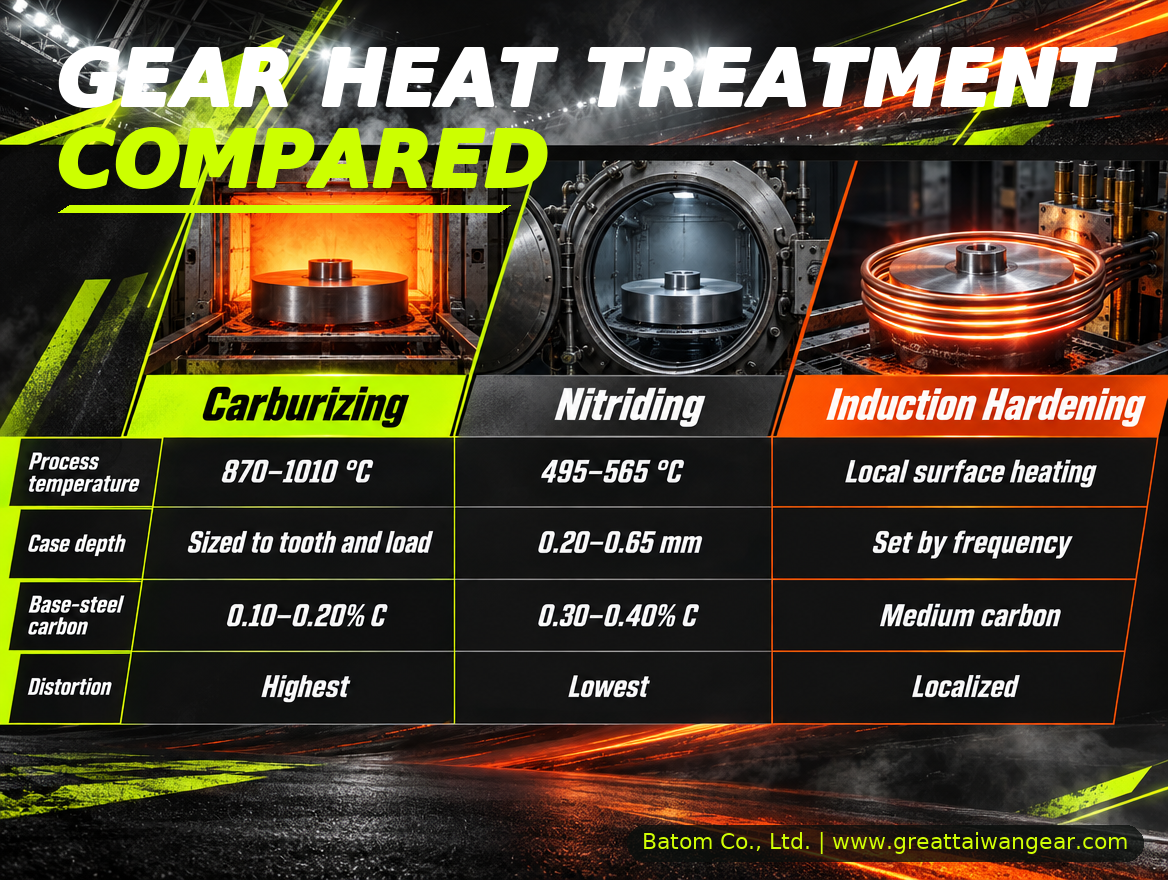
| Parameter | Carburizing | Nitriding | Induction Hardening |
|---|---|---|---|
| Typical process temperature | 870–1010 °C | 495–565 °C | Surface heated locally above the hardening temperature |
| Cycle | Hours, depending on case depth | 10–80 hours | Short; seconds per gear or per tooth |
| Typical case depth | Broad (0.13–8.25 mm across carburized parts); sized to tooth and load | 0.20–0.65 mm | Set by frequency and power; lower frequency, deeper case |
| Base-steel carbon | About 0.10–0.20% | About 0.30–0.40% | Medium carbon (e.g., 1050, 4140, 4150) |
| Core | Tough, about 30–40 HRC recommended | Keeps pre-hardened condition | Keeps prior condition outside hardened zone |
| Quench | Oil, or high-pressure gas after LPC | None | Spray or immersion, typically polymer |
| Distortion | Highest; LPC with gas quench makes it more predictable | Lowest; small, uniform growth | Localized; sensitive to coil-to-tooth gap |
| Finishing after hardening | Usually ground or honed | Often none; finished before nitriding | Depends on accuracy requirement |
| Best fit | Heavily loaded transmission and aerospace gears | Precision gears under moderate load | Large gears, medium-carbon steel, selective hardening |
All specifications customizable per customer requirements & gear specifications.
How to Choose: A Buyer's Checklist
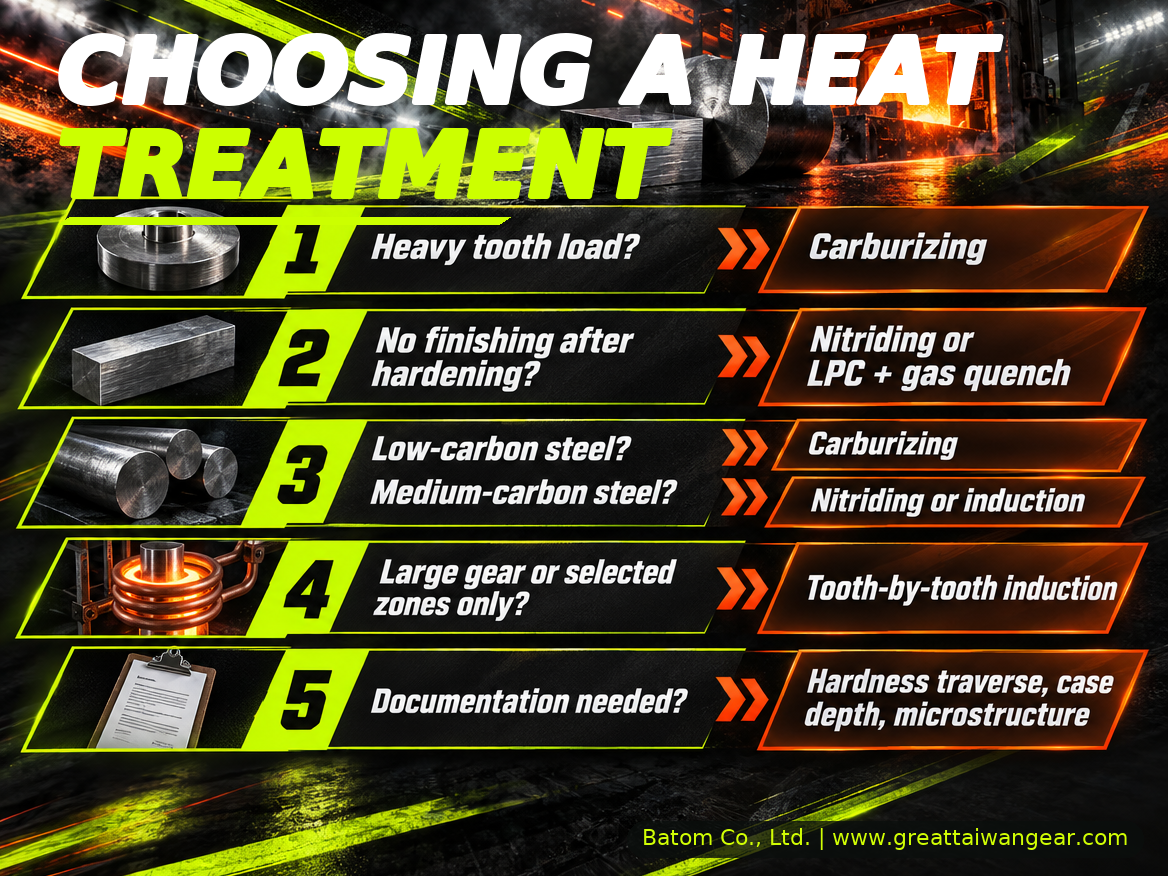
The decision usually comes down to five questions, answered in this order.
- How heavily is the tooth loaded? High contact and bending stress points to carburizing, because it gives the deepest case on a tough core.
- Can the gear be finished after hardening? If finish grinding or honing is budgeted, carburizing is open. If the geometry must hold without post-processing, look at nitriding, or at LPC with gas quenching to cut movement.
- Is the steel already fixed? Low-carbon carburizing grades need carburizing. Medium-carbon alloy steels point to nitriding or induction.
- How big is the gear, and does all of it need hardening? Very large gears and parts that need only the flanks or roots hardened suit tooth-by-tooth induction.
- What does the documentation need to prove? Aerospace and automotive programs usually require hardness traverses, case-depth records and microstructure checks, so agree the inspection plan with the process.
Carburizing remains the usual route for EV reduction gears and other heavily loaded drivetrain gears, where the hardened teeth are then ground or honed to hold the micro-geometry that controls gear noise (NVH). Nitriding suits precision gears whose finished form cannot move, such as timing and auxiliary gears that run under moderate load. Induction hardening makes sense where a furnace cannot take the part, where only selected zones need hardening, or where a medium-carbon steel is already specified. Aerospace programs use both carburizing and nitriding; the controlling material and process specifications come from the customer.
What to Put on the Drawing
A heat treatment callout that two suppliers read the same way saves a round of questions at quote stage, and it belongs with the rest of the data in a precision gear RFQ. State the process and the effective case depth with its definition (50 HRC or 550 HV), where it is measured (pitch line, root or both) and whether it applies before or after grinding. Add surface and core hardness ranges. For nitrided gears, add the compound-layer limit; for induction-hardened gears, show the hardened zone and any areas that must stay soft.
Finishing after carburizing deserves its own line. Batom grinds hardened gears on machines listed on its Manufacturing page, including Liebherr LGG280 Twist and Reishauer RZ400 gear grinders, and power-hones on a Fässler HMX-400. Grinding hardened teeth can cause burn, so the drawing should also call for grinding burn inspection, which Batom performs in-house.
For a closer look at finishing hardened teeth, see the gear grinding vs. honing comparison.
Within its one-stop service, Batom runs its own Nadcap-accredited magnetic particle inspection and shot peening in-house, and completes heat treatment with tightly integrated, certified supply-chain partners. Each step on the manufacturing route, from gear cutting through heat treatment to grinding, leaves its mark on noise and durability. That is why the heat treatment callout is best reviewed together with the finishing plan.
References
- Thermal Processing: Heat Treat 101, A Primer (D. H. Herring, 2014)
- Gear Solutions: Improvements in Dimensional Control of Heat Treated Gears (D. H. Herring and F. J. Otto, 2008)
- Gear Solutions: The Power of Pulsed Plasma (D. Pye, 2008)
- Thermal Processing: Induction Hardening Choices for Gears (F. R. Specht and D. H. Herring, 2013)
- NASA TM-101979: Surface Fatigue Life of Carburized and Hardened M50NiL and AISI 9310 Spur Gears (Townsend and Bamberger, 1989)
- SAE J423: Methods of Measuring Case Depth (SAE International)
- ISO 18203: Steel, Determination of the Thickness of Surface-Hardened Layers (ISO; replaces ISO 2639)
Author's Perspective
Heat treatment is one of the hardest decisions to reverse in a gear program. Once the steel is chosen and the blank is drawn around a target case depth, changing the process means re-qualifying the part, and often the drivetrain around it. A common gap on gear drawings is a case depth with no stated definition or measuring point, paired with a grind stock that was never checked against the expected distortion. Founded in 1981, Batom has spent over 40 years manufacturing precision gears, and the cheapest correction is still the one made before the first blank is cut.
Batom Co., Ltd., Marketing Department
Still deciding between carburizing, nitriding and induction hardening for a new gear? Send the drawing, the accuracy requirement and the expected volume, and Batom's engineering team will review manufacturability, including case depth, distortion allowance and finishing, and quote the gear components. Prototype programs and series production are both welcome, and an early design or 3D model is enough to start the DFM discussion. Request a manufacturability review and quote. Batom builds to your drawing and does not sell standard catalog gears, reducers or motors.
Frequently Asked Questions
Q: Is carburizing, nitriding or induction hardening best for gears? A: It depends on load, steel and how much distortion the gear can tolerate. Carburizing gives the deepest case on a tough core and suits heavily loaded gears that will be ground or honed afterward. Nitriding holds finished geometry best but has a shallower case of about 0.20–0.65 mm. Induction hardening suits medium-carbon steels, large gears and parts that need only selected zones hardened.
Q: Which gear heat treatment causes the least distortion? A: Nitriding. It runs at about 495–565 °C, below the steel's transformation temperature, and needs no quench, so growth is small and uniform. Among carburizing routes, low-pressure vacuum carburizing with high-pressure gas quenching produces more consistent, predictable movement than atmosphere carburizing with a liquid quench.
Q: How is effective case depth defined on a gear drawing? A: U.S. practice (SAE J423) measures effective case depth to 50 HRC, while ISO 2639 measures it to 550 HV, so the drawing should name the definition. It should also state where depth is measured, such as pitch line or root, and whether it applies before or after finish grinding, since grinding removes part of the case.
Q: Can medium-carbon steel like 4140 be carburized? A: Carburizing is meant for low-carbon steels of about 0.10–0.20% carbon, because the process adds carbon to the surface. Medium-carbon alloy steels such as 4140 already contain enough carbon to harden directly, so they are normally nitrided or induction hardened instead.
Q: What heat treatment details should a gear RFQ include? A: Include the process, effective case depth with its definition and measuring location, surface and core hardness, and any compound-layer or hardened-zone limits. Add the finishing route after hardening and the inspections required, such as hardness traverses and grinding burn inspection. Batom quotes from the drawing and can review these callouts during DFM before production.