Gear Design for Humanoid Integrated Actuator Modules: Lightweight, Compact, Quiet
Humanoid robots are converging on the integrated actuator module: one housing at each joint that carries the motor, the reduction, the output bearing, position sensing and often the drive electronics. Tesla's AI Day 2022 presentation of Optimus, a publicly documented industry example, showed the scale involved. As reported by Robotics 24/7, Tesla engineers said Optimus used 28 actuators. They had consolidated them into a small family of shared rotary and linear designs, using an optimization model that compared torque, speed and energy needs. Every humanoid joint module carries gears, and the gears decide much of its mass, length, noise and cost.
This is written for engineers who have settled on a motor or reducer architecture and now have to specify the gears inside it. Batom builds those gear components to the customer's drawing as a one-stop service, from early DFM review through series production; it does not sell standard gears, reducers or motors. Where a module program calls for it, Batom can also purchase the bearings and other parts the customer specifies and handle sub-assembly of the gear train to the customer's design.
What an Integrated Actuator Module Asks of Its Gears
Integration moves the gears out of a separate gearbox and into a shared housing. The reduction now competes for space with the stator, the rotor magnets, the output bearing and the encoder. Every millimeter of face width or ring gear wall is a millimeter the motor cannot use.
Public updates show the direction of travel. When Tesla unveiled Optimus Gen 2 in December 2023, Electrek reported that the robot used all Tesla-designed actuators and sensors, and that Tesla said it walked 30% faster and weighed 10 kg less. In the Robotics 24/7 account of AI Day 2022, Tesla had presented the robot as designed for manufacturing at high volume, low cost and high reliability, with a reduced part count. Experts reviewing that presentation for IEEE Spectrum described the rotary actuators as integrating a strain wave gear reduction and the linear actuators as integrating an inverted roller screw drive.
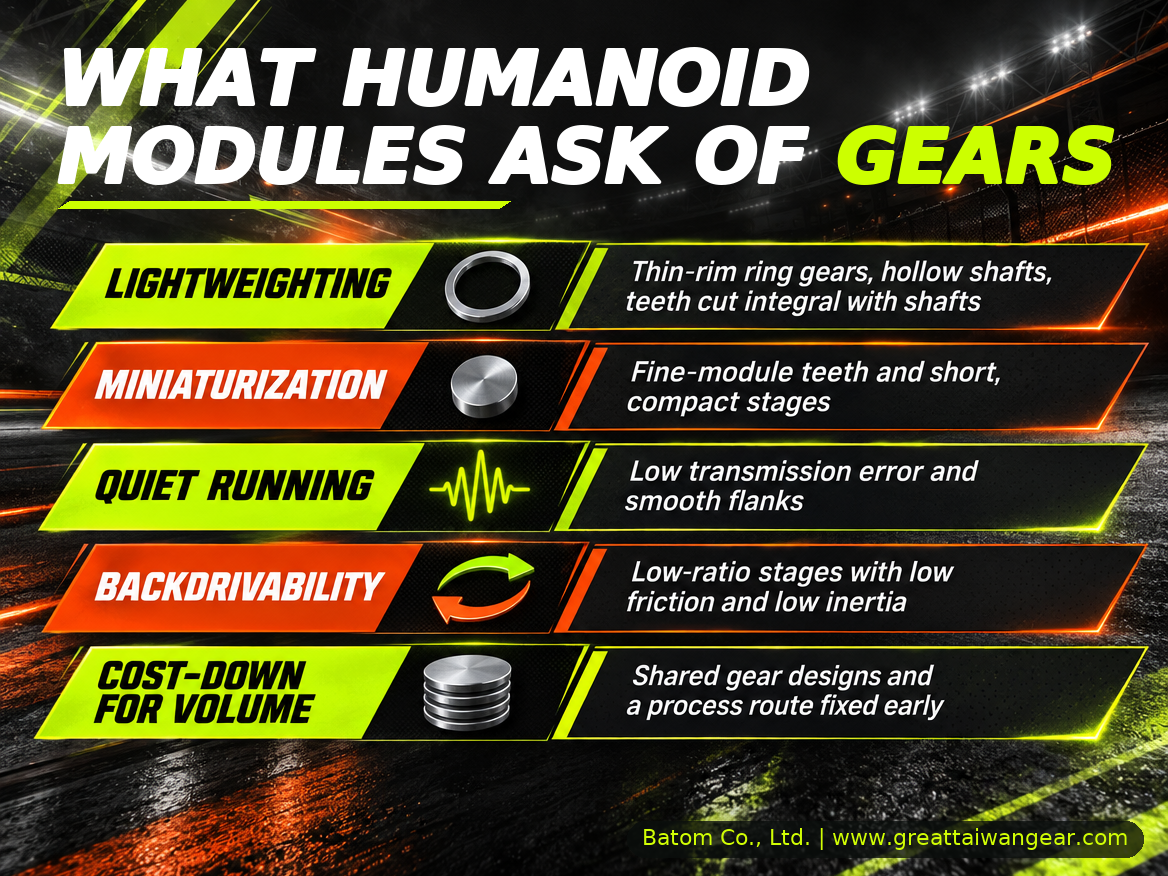
None of these publicly presented statements is a gear specification. Taken with the legged-robot research cited below, they point to five pressures that land on the gear components of any humanoid joint module.
| Trend | What it asks of the gears | Where it lands on the drawing |
|---|---|---|
| Lightweighting | Thin-rim ring gears, hollow shafts, teeth cut integral with shafts | Rim thickness, wall thickness, root-stress verification |
| Miniaturization | Fine-module teeth and short, compact stages | Module, face width, accuracy grade |
| Quiet running near people | Low transmission error and smooth flanks | Flank modifications, roughness, finishing method |
| Backdrivability and impact tolerance | Low-ratio stages with low friction and low inertia | Ratio, tooth counts, backlash budget |
| Cost-down for volume | Shared gear designs across joints and a process route fixed early | Material, heat treatment and inspection plan agreed at DFM |
Collaborative robots met several of these pressures first in their joint gears, and a humanoid adds walking, falling and a far larger number of joints per machine.
Ratio, Reflected Inertia and Backdrivability
Gear ratio is the first gear decision in a joint module, and it sets more than torque. In their study of the MIT Cheetah actuator, Wensing and colleagues note that the reflected rotational inertia of a motor scales with the square of its gear ratio. Doubling the ratio therefore quadruples the motor inertia the leg feels when it strikes the ground.
The Cheetah team chose a one-stage planetary gear train with four planet gears at 5.8:1. They reported that such a low ratio gives a higher impact mitigation factor, their measure of backdrivability at impact. A large, high-torque motor with a short reduction has since become a design family of its own. A 2024 study of cycloidal quasi-direct-drive actuators applies the same idea to legged robots with a cycloidal stage.
A low-ratio stage is unforgiving for the gears. With little reduction between motor and output, the stage's backlash and transmission error reach the joint almost directly, and a sensor on the motor side does not see them. Higher-ratio reducers recover torque density at the cost of reflected inertia and friction, so different joints on one robot often take different answers.
The right ratio, tooth counts and backlash allocation depend on each joint's torque, speed and impact profile, and they are rarely settled in one pass. Batom's development process plans the mass-production route while samples are still being made. Ratio and tooth-count changes between prototype rounds can then be matched by changes to the machining route, without waiting for a frozen design.
Planetary Stages: Thin Rims and Fine Modules
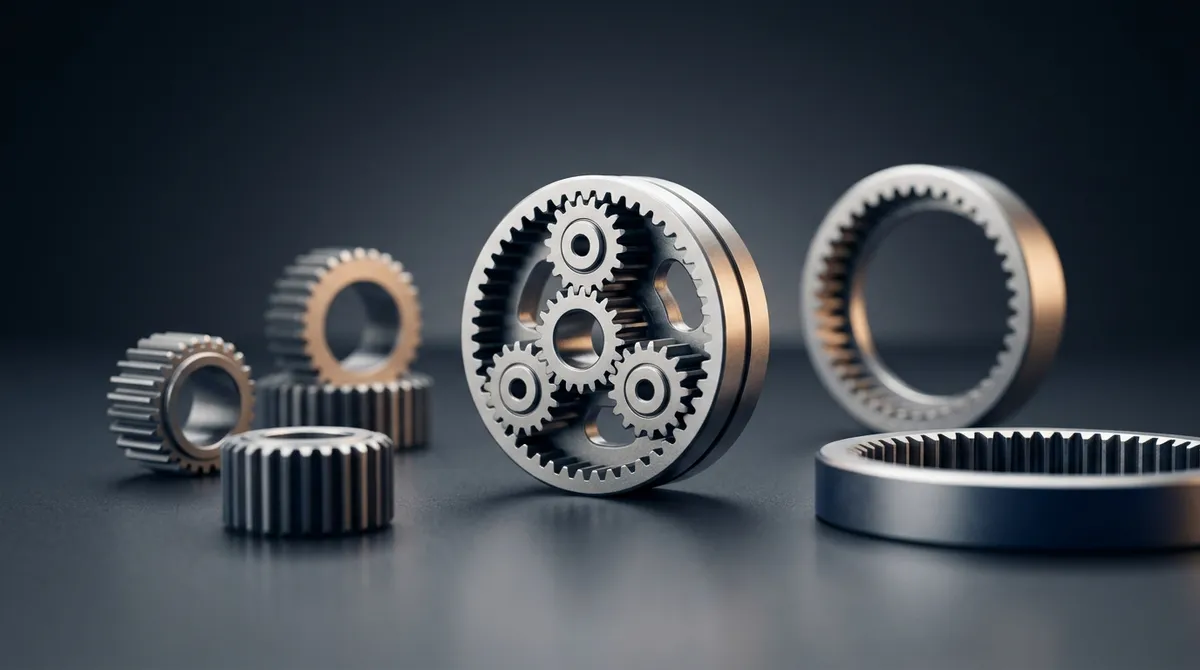
The planetary stage is the workhorse reduction in rotary modules. It keeps motor and output on one axis and splits the load among several planets. Lightweighting usually starts with its ring gear, because the ring sets the module's outside diameter and a large share of its gear mass.
Thinning that rim changes how a cracked tooth fails. A NASA gear crack propagation investigation, written because reduced weight is a major design goal in aircraft power transmissions, defined the backup ratio as rim thickness divided by tooth height. Gears with backup ratios of 3.3 and 1.0 produced tooth fractures. A ratio of 0.3 produced rim fractures, and at 0.5 the experiments also produced rim fractures. The report treats a crack through the rim as the catastrophic case and a tooth crack as probably not catastrophic.
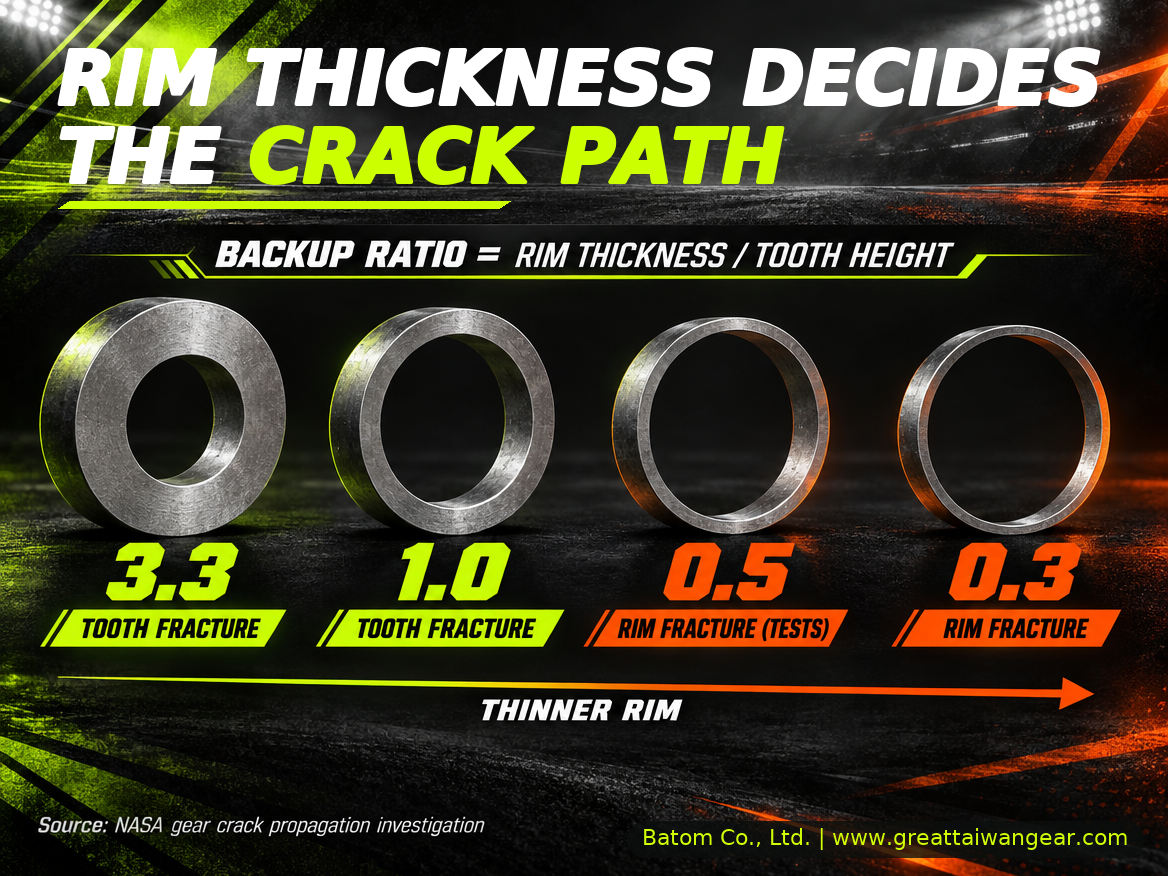
For a module drawing, the rim under the ring gear's tooth root is therefore a controlled dimension, verified by root-stress analysis rather than left to whoever designs the housing. Batom's gear design work uses FEM calculation of tooth root stress, including the effect of grinding notches.
Miniaturization pushes the same stage toward fine modules. Batom's motion control gears and shafts page lists robotics among its industrial applications and fine modules from M0.2, with processing capability customizable per customer material and requirements. At small modules the absolute tolerance on profile and pitch shrinks with the tooth, so the inspection method has to resolve it. Internal ring gears are cut by shaping, and the machine list includes a Liebherr LS120 gear shaper with autoloader and a Mitsubishi SE25A electronic-guide shaper.
Rim, module and finishing route for the ring are best settled together. Batom's planetary gear work treats sun gears, planet gears, internal ring gears and planet carriers as matched components, from prototype development and engineering validation through volume production.
Backlash and Load Sharing: Where Selective Assembly Helps
A planetary stage only shares its load evenly when the planets mesh alike. Tooth thickness differences between planets, carrier pin position error and ring gear runout all push one planet to carry more than its share. The same variations add up to the stage's backlash, which a low-ratio joint passes almost directly to its output.
There is more on building a backlash budget from runout and tooth thickness in the gear tolerance stack-up guide.
Tightening every tolerance is one answer, and usually the most expensive one. Selective assembly is the other. Researchers at Chalmers University of Technology describe it as classifying parts by their measured dimensions and assembling them in matched groups, which makes higher-quality assemblies possible from relatively lower-quality parts. They note that the bearing and engine industries have used it since before 1950 to get tight fits. Its known cost is surplus parts when group sizes do not match.
In a planetary set, the measured value can be tooth thickness, and the matched groups can be planet sets or sun and ring pairings. Batom pairs 100% inspection with selective assembly. Its Quality Guarantee page lists the inspection equipment, including Klingelnberg P-26, P-40 and P-65 gear measuring centers and Frenco double-flank rolling testers. Matching parts by measured size lets a module hold a backlash band that loose tolerances alone would not.
Shafts, Splines and Hollow Bores
Compact modules remove joints wherever they can. Cutting a pinion integral with its shaft removes a press fit or key and shortens the stack. A hollow output shaft lets cables pass through the center of the joint, which keeps the harness from winding up as the joint turns.
Both choices move complexity into one machined part. That part may carry gear teeth, bearing seats, a spline to the next stage and a seal surface at once, and their relationship matters more than any single tolerance. Runout between the teeth and the bearing seats shows up as a once-per-revolution error at the output. Thin walls also move during heat treatment, which the next section covers.
In a strain wave joint, the flexspline and circular spline usually come from the strain wave gear maker. The parts around them are still conventional machined components: the input shaft that carries the wave generator, splined couplings, output shafts and any planetary or spur stage ahead of the strain wave gear. Those are the parts where the module designer's own drawings apply, and a custom circular spline can be one of them.
The Machining Range table on Batom's manufacturing page lists spline shafts hobbed before heat treatment and ground after it. The same machine list includes Nachi PFFM-915XTHNC spline rolling machines, Okamoto SSG spline grinders, ETECH EGM-350 bore grinders and ETECH EGA-3260 OD grinders. The teeth, splines and ground seats of an integrated shaft can therefore be machined on one process route. Batom also machines circular splines, the rigid internal gear of a strain wave set, by gear shaping or skiving and with the bore and OD grinders above. The flexspline is a different case: its very thin wall makes distortion control the main difficulty, so customers are welcome to send the drawing for Batom's DFM evaluation and process-feasibility check.
Quiet Running: Transmission Error, Flank Modifications and Hard Finishing
A humanoid works within arm's reach of people, often indoors, and its electric motors add little noise of their own. A gear mesh tone has nothing to hide behind. The excitation behind that tone is transmission error.
A walking robot's joints reverse constantly, so both flanks carry load. Modifications for the left and right flanks can be set independently of each other, which lets the drive side and the coast side each be optimized. Tip and root relief, end relief and twist are then set against the load the joint actually sees.
A modification only helps if the finishing process can hold it. Gear grinding corrects heat-treatment distortion, and Batom's gear grinding lineup includes Reishauer RZ260, Liebherr LGG280 and KAPP KX260 Twin grinders marked for twist control. Power honing on Fässler HMX-400 machines leaves a surface free from grinding burn, and Batom's page notes that honed gears produce less noise. Batom also performs shot peening and superfinishing in-house: peening for root bending strength in thin, highly loaded teeth, and superfinishing for smoother flanks.
Which modification and finishing route a joint needs depends on its torque, speed and acoustic target, and a prototype round usually confirms it. Batom can run loaded tooth contact and transmission-error analysis in KISSsoft on the customer's design during DFM, then propose modification changes for the customer's approval and adjust the grinding or honing route between rounds.
Heat Treatment, Distortion and Material for Thin Parts
Case hardening gives gear teeth the surface hardness and core toughness a joint needs, but thin rims and hollow shafts move during the quench. The thinner and less symmetric the section, the more it distorts, and the more stock the finishing step must remove to bring the teeth back. A ring designed at its minimum wall may leave no room for that stock.
Process choice is one lever. Nitriding runs cooler than carburizing and generally distorts less, at the price of a shallower case.
The heat treatment comparison covers carburizing, nitriding and induction hardening in more depth than this section allows.
Batom runs its own Nadcap-accredited magnetic particle inspection and shot peening in-house, and completes heat treatment and coatings with tightly integrated, certified supply-chain partners. The steel table on its Manufacturing Spec page lists grades common in gearing, including SCM415, SCM420, SCM440 (SAE 4140), SAE 8620, SAE 4320, 18CrNiMo7-6 and the nitriding steel SACM645. Those are routine grades rather than a limit: if a module program needs another material, Batom can source it. Specify case depth, surface hardness and core hardness as ranges with their measurement locations. All specifications customizable per customer requirements & gear specifications.
Writing the Module's Gear Drawing
A gear maker can only quote what the drawing and the RFQ state. For a humanoid actuator module, these items let a supplier make the trade-offs above with the designer rather than after the fact:
- The joint's torque spectrum, including impact peaks from walking or falls and the load reversals at each step.
- The ratio of each stage and the backlash allocated to it, measured at the joint output.
- The accuracy grade with its standard, for example ISO 1328 class 6 (AGMA A5), set by the joint's positioning and noise targets.
- Rim thickness under the ring gear's tooth root, and the wall thickness of hollow shafts.
- Profile and lead modifications for both flanks, with the load at which they were optimized.
- Finishing method and flank roughness, plus shot peening or superfinishing where the design relies on them.
- Case depth, surface hardness and core hardness as ranges, with measurement locations.
- The inspection method for each tolerance and, if selective assembly is used, the measured value and group width.
- The assembly scope: loose gear components, or a gear train sub-assembled to the customer's design with the bearings the customer specifies.
Sources
- Proprioceptive Actuator Design in the MIT Cheetah: Impact Mitigation and High-Bandwidth Physical Interaction for Dynamic Legged Robots (Wensing et al., IEEE Transactions on Robotics, 2017)
- Gear Crack Propagation Investigation (NASA Technical Reports Server)
- What Robotics Experts Think of Tesla's Optimus Robot (IEEE Spectrum)
- A Multistage Approach to the Selective Assembly of Components without Dimensional Distribution Assumptions (Chalmers University of Technology)
About the Author
Batom Co., Ltd. Marketing Department
Batom Co., Ltd. was founded in 1981 and is headquartered in Dali District, Taichung. With over 40 years in gear manufacture and inspection, it works as a Leading Precision Gear Manufacturer focused on DFM and gear manufacturing. Module drawings tend to arrive with a torque rating and an outside diameter, and the gear train is expected to fit between the two. The ring gear rim, the tooth-thickness band and the finishing route get settled later, often after the first prototype turns out noisy or loose. They cost far less to agree before tooling is cut, while a thinner rim can still be traded against a different module or heat treatment.
Whether you are prototyping a new humanoid joint or scaling up series production, send the drawing and the accuracy requirement, and Batom's engineering team can review manufacturability and quote the gear components. To begin, schedule a consultation. An early design or 3D model is enough to start the DFM discussion. Batom builds to your drawing and does not sell standard gears, reducers or motors.
Frequently Asked Questions
Q: What is an integrated actuator module in a humanoid robot? A: It is a self-contained joint unit that combines the motor, the gear reduction, the output bearing, position sensing and often the drive electronics in one housing. At AI Day 2022, Tesla engineers said Optimus used 28 actuators consolidated into a small family of shared rotary and linear designs. Integration saves space and wiring, but it leaves the gears competing with the motor for every millimeter.
Q: Why do some humanoid robot joints use low gear ratios? A: A motor's reflected inertia scales with the square of the gear ratio, as the MIT Cheetah actuator study notes. A low ratio keeps that inertia small, which improves backdrivability and impact tolerance when a leg strikes the ground. The MIT Cheetah used a one-stage planetary gear train at 5.8:1, and its designers noted that such a low ratio gives a higher impact mitigation factor.
Q: How thin can a robot joint ring gear be? A: It depends on the loads, but rim thickness changes how a gear fails. A NASA investigation found that backup ratios (rim thickness divided by tooth height) of 3.3 and 1.0 produced tooth fractures, while 0.3 produced rim fractures. The rim should be set on the drawing and verified by root-stress analysis.
Q: How do you reduce gear noise in a robot joint? A: Gear noise is excited by transmission error. Profile and lead modifications set for both flanks against the joint's real load reduce it, and grinding or power honing holds those modifications on hardened gears. Power honing also leaves a surface free from grinding burn.
Q: Does Batom sell standard gearboxes, reducers or motors for these applications? A: No. Batom provides a one-stop custom service for core gear components — gears, shafts and related parts — built to the customer's drawing, from early DFM co-development through series production and after-sales support. Where a program calls for it, Batom also sources the specified components and handles sub-assembly to the customer's design. It does not sell standard catalog gears, reducers or motors, and it quotes from a drawing that specifies geometry, material, accuracy grade and inspection requirements.