RV-Type Reducers for Humanoid Hip and Knee Joints: Manufacturing and Machining Pain Points
A humanoid's hip and knee carry the body and absorb the shock of every landing. In a 2025 jumping study on a research humanoid, the knee consistently demanded the highest torque, speed and power of the leg joints across all jumping tasks. RV-type reducers are one of the designs engineers reach for at these joints. "RV" is a trademark of Nabtesco Corporation and names one commercial implementation of the design; this article uses "RV-type reducer" as the generic term. The reducer pairs an involute planetary stage with a cycloidal stage, and much of its precision is decided in the machine shop. This guide follows the parts that make an RV-type reducer hard to build and what the drawing has to control on each.
Batom's work is custom gear components built to a customer's drawing, quoted from that drawing rather than from a catalog. Its engineers join at the design stage for DFM review, and the same team manages the parts through grinding, heat treatment, surface treatment, inspection and series production. Batom does not sell standard gears, reducers or motors, which is why this article concentrates on the gear specifications an engineer controls directly. Where a joint program calls for it, Batom can also source the purchased components and handle sub-assembly to the customer's design.
Why Hip and Knee Joints Push Toward Cycloidal Reduction
Leg joints take loads that wrist joints rarely see. A 2024 actuator paper from a UCLA robotics team, posted on arXiv, notes that conventional gears are less resilient to significant impulse loads, such as those experienced during a fall. The authors chose a cycloidal gearbox because cycloidal mechanisms offer rigidity and a better stress distribution across the teeth. They add that the design stays compact while keeping backlash minimal.
The jumping study, also on arXiv, puts numbers on the knee. During a 0.5 m box jump, the knee of the research humanoid reached 286 Nm. That knee is driven through a ball screw, so the figure describes the load a knee joint has to carry rather than a reducer rating. The authors explain that the robot has to build its take-off energy within 0.15 to 0.5 seconds, which places extreme demands on the leg joints and on the knee in particular.
RV-type reducers answer that kind of duty with multi-tooth contact. A 2019 study in Applied Sciences describes RV-type reducers as having multi-tooth contact, high impact resistance and a small backlash, and notes their wide use in precision transmissions such as robot joints. Industrial robots made the design common, and in robot arms the choice between planetary, strain wave and cycloidal cobot joint gears still varies by joint position.
How an RV-Type Reducer Divides the Work
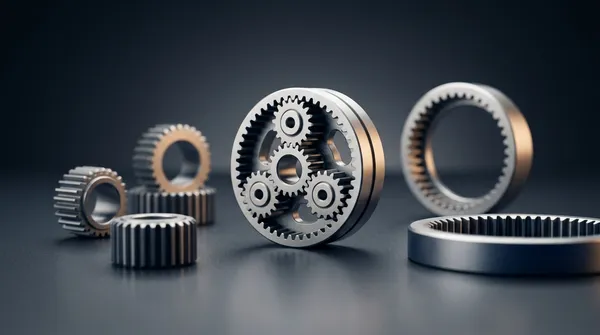
A 2018 analysis in the Chinese Journal of Mechanical Engineering describes the RV-type reducer as a two-stage closed planetary gear train built from involute gears and cycloid gears. The high-speed stage is a planetary set, with a sun gear driven by the motor and planet gears around it. Each planet gear turns a crankshaft. In the low-speed stage, the crankshafts drive the cycloid discs through eccentric journals, the discs roll against a ring of pins in the housing, and a carrier joined to the output collects the motion.
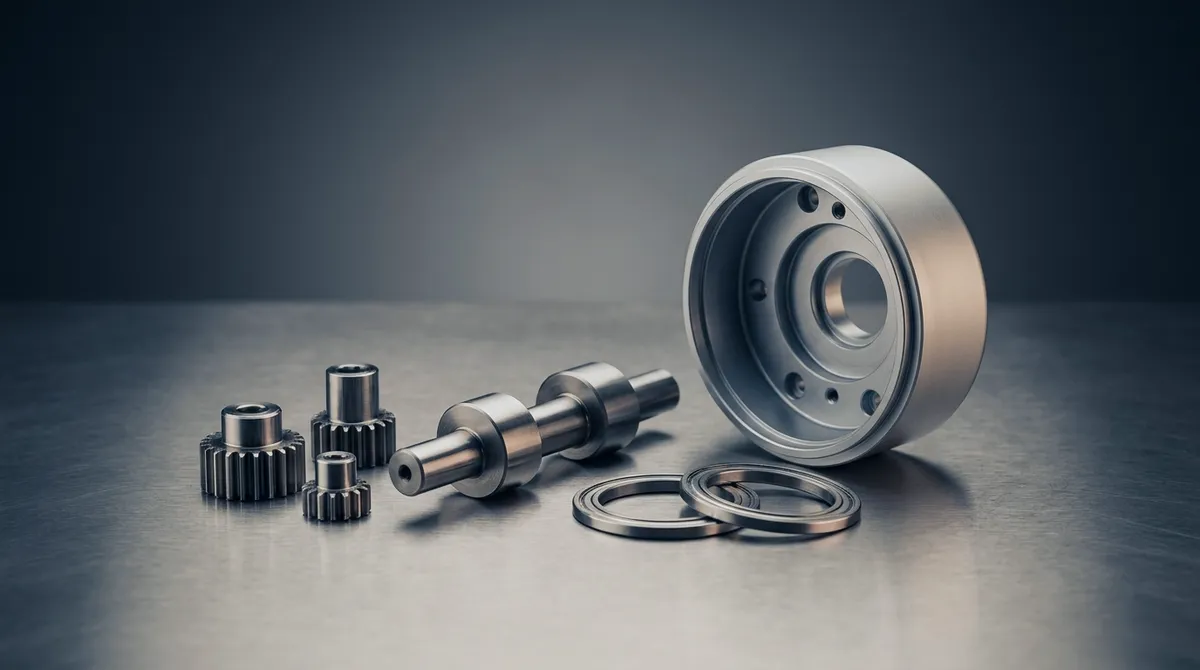
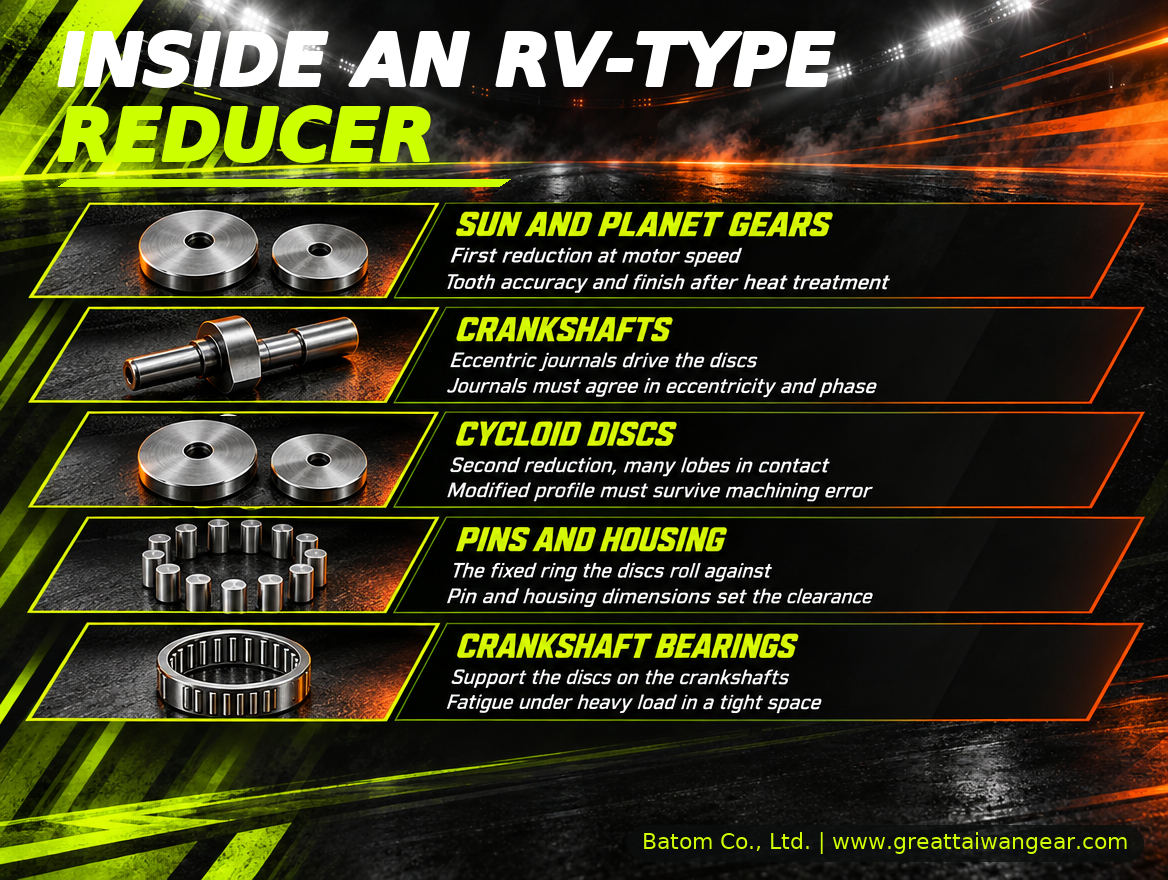
Every one of those parts has its own manufacturing problem:
| Part | What it does | Where manufacturing gets hard |
|---|---|---|
| Sun and planet gears | First reduction, at motor speed | Tooth accuracy, profile modification and finish after heat treatment |
| Crankshafts | Carry the planets; eccentric journals drive the discs | Journals that must agree with each other, and bearing surfaces that set fatigue life |
| Cycloid discs | Second reduction through many lobes in contact | A modified profile that has to survive machining error and heat treatment |
| Pins and pin housing | The fixed ring the discs roll against | Pin and housing dimensions that set the clearance at the cycloid mesh |
| Crankshaft bearings | Support the discs on the crankshafts | Fatigue under heavy load in a tight space |
Pain Point 1: Backlash and Lost Motion Come From a Tolerance Stack
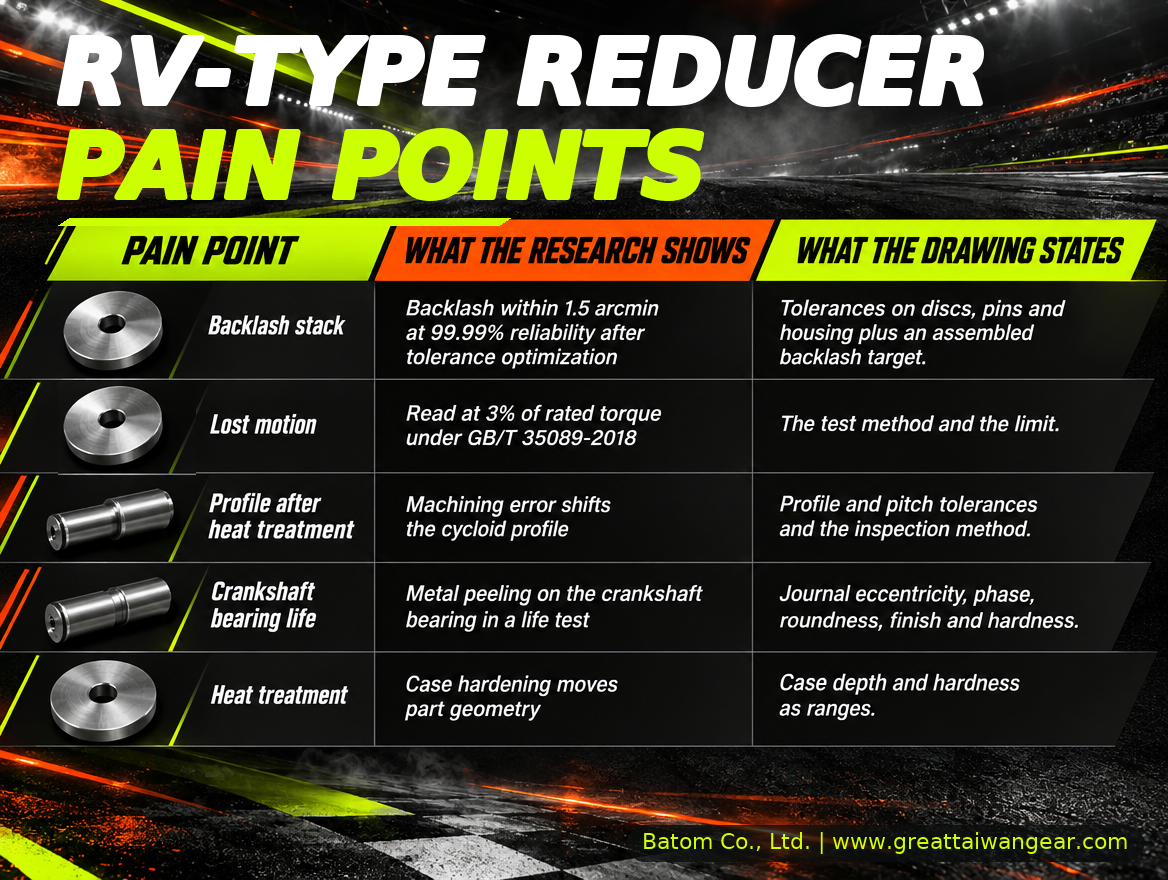
The cycloid stage cannot be built with zero clearance. A 2023 study in Machines explains that a suitable clearance must be left between the cycloid gear and the pin teeth to allow assembly and lubrication, so the cycloid profile has to be modified. That modification then governs accuracy. The 2019 Applied Sciences study found that cycloid profile modification has a significant influence on the transmission accuracy and torsional stiffness of an RV-type reducer.
Tolerances therefore work as design variables. A 2024 study in Energies optimized the geometry, dimensional tolerances and profile modification of the cycloid-pin gear together, judged against backlash, transmission error and torsional stiffness. After optimization, the authors report a 99.99% reliability of keeping backlash within 1.5 arcmin. They report 98.52% reliability for keeping transmission error within 1 arcmin.
Lost motion adds the elastic part of the error. A 2022 paper in Metrology and Measurement Systems describes the test under China's national standard for precision robot gearing, GB/T 35089-2018. Static lost motion is read from the hysteresis curve at 3% of rated torque. On the same paper's test platform, ten repeat runs on one RV-type reducer averaged 0.534 arcmin of dynamic lost motion. These are fractions of an arcminute, built up from clearances in both stages and from elastic deflection under load.
For a closer look at tolerance stack-up in assembled gear pairs, from runout to backlash, see the gear tolerance stack-up guide.
Holding a stack like that in production is partly a measurement problem. Batom can pair 100% inspection with selective assembly on the reducer parts it builds, such as planet gears and the pin housing. Mating parts are measured, sorted by size and matched so the assembled clearance lands inside the drawing's budget. Its quality guarantee page lists the inspection equipment behind that, including Klingelnberg P-26, P-40 and P-65 gear measuring centers and Frenco double-flank gear rolling testers.
Pain Point 2: Profiles Are Finished After Heat Treatment
A cycloid profile is only as good as the process that finishes it. A 2023 study in Applied Sciences analyzed the machining error items that shape the cycloidal gear profile. The authors proposed a compensation and modification model, because the error between the designed and the machined profile cannot be ignored. The modification on the drawing has to be one the finishing process can hold, and the inspection plan has to measure it.
The sun and planet gears follow established involute practice: hard finishing after heat treatment, a stated accuracy class, and profile and lead modifications where the load calls for them. Batom's Manufacturing page notes that gear grinding corrects heat treatment distortion as well as improving gear quality. The choice between gear grinding and power honing then depends on accuracy, surface finish and cost.
Batom machines the sun and planet gears, the crankshafts and the pin housing of an RV-type reducer to the customer's drawing. Involute gears are finished on the generating grinders in its Manufacturing machine list, including Reishauer RZ260 (Twist), Liebherr LGG280 (Twist) and KAPP KX260 Twin (Twist) grinders, next to Fässler HMX-400 power honing machines. The same page lists gear shaping and skiving. Its gear shapers, which cut internal and external gears, include a Liebherr LS120 with autoloader and Lorenz SN4/SN5 machines. Cycloid discs are a different case, because their non-involute profile calls for special grinding. Customers are welcome to send the drawing for Batom's DFM evaluation and process-feasibility check.
Pain Point 3: Crankshafts and Their Bearings Decide Service Life
The weakest point is often not a gear. A 2020 study in Applied Sciences calls the crankshaft bearing the key component of an RV-type reducer. It notes that the bearing often suffers fatigue failure because of its harsh working load and the restricted space available. An accelerated life test published in 2024 in the Strojniški vestnik – Journal of Mechanical Engineering ended the same way. After the test, the reducer was disassembled, and metal peeling was found on the crankshaft bearing while the other parts were relatively intact.
For the shop, the crankshaft is a precision shaft with several jobs at once. Its eccentric journals carry the bearings that drive the cycloid discs. With two or more crankshafts driving the same discs, the journals have to agree in eccentricity and angular phase. Where a journal or a disc bore serves as a bearing raceway, its roundness, surface finish and hardness become part of the bearing design that the studies above found to be the limit.
Shafts are routine work for Batom, listed with gears on its motion control shaft page, and RV-type crankshafts are among the reducer parts it machines to drawing. For the reducer parts Batom machines, the same machine list carries internal and external cylindrical grinding. It includes ETECH EGA-3260, Mitsubishi PD 32 and Goodway GRA-2060 OD grinders, and ETECH EGM-350 bore grinders. Batom also performs superfinishing in-house. A drawing that states the eccentricity and phase tolerance between journals, with journal roundness, surface finish and hardness ranges, gives the DFM review something concrete to check.
Pain Point 4: Heat Treatment, Material and Surface Condition
Case hardening gives gear parts the surface hardness they need for contact loads, and it also moves their geometry. That is why the finishing allowance has to be planned before heat treatment, and why the drawing should state case depth and hardness as ranges with their measurement locations. The same applies to the involute gears, the crankshaft journals and any disc the program makes in steel.
The trade-offs between carburizing, nitriding and induction hardening are set out in the heat treatment comparison.
Batom runs its own Nadcap-accredited magnetic particle inspection and shot peening (AC7117/2) in-house, and completes heat treatment and coatings with tightly integrated, certified supply-chain partners. Its Manufacturing Spec page carries a steel table that maps JIS, AISI/SAE, DIN and GB grades, including carburizing steels such as SCM415, SCM420, SAE 8620, SNCM420 (SAE 4320) and 18CrNiMo7-6, plus SUJ2 bearing steel. If a joint program needs a material outside that table, Batom can source it.
Industry Architectural Trends
Published legged-robot research shows several directions. One keeps a high reduction ratio for torque density and stiffness, which is where RV-type reducers sit. Another uses a low ratio so the joint stays backdrivable. The 2025 jumping study takes a third route, a ball-screw knee with a variable reduction ratio. The UCLA team's quasi-direct-drive actuator uses a single 10:1 cycloidal stage, with measured continuous and peak torque of 37.5 Nm and 89.9 Nm.
The same paper lists the cost of the cycloidal approach. Cycloidal gears introduce nonlinearities in the torque output, including torque ripple and vibration caused by the eccentricity of the rotors. The dynamic imbalance of the cycloid disc also contributes to oscillations. For the parts maker, that turns disc mass balance and the phase between discs into drawing items alongside the profile.
What the Drawing for Hip and Knee Reducer Parts Should State
When an OEM sends drawings for the gear parts of an RV-type joint reducer, a handful of callouts decide whether the parts can be quoted and held in production.
- Gear accuracy class for the sun and planet gears, led by DIN or ISO 1328 with AGMA in parentheses, for example ISO 1328 class 5 (AGMA A4).
- Profile and lead modifications on the involute gears, with their tolerances.
- For cycloid discs: the modified profile, tolerances on profile and pitch, and the inspection method.
- For pins and housing: pin diameter and pin circle radius tolerances, and whether pins are sorted into size groups at assembly.
- For crankshafts: eccentricity and phase tolerance between journals, journal roundness and surface finish, and hardness.
- Material and heat treatment: the gear steel grade, with case depth and surface hardness as ranges and their measurement locations.
- The assembled targets and how they are tested: backlash, lost motion and torsional stiffness, with the test method named.
All specifications customizable per customer requirements & gear specifications.
Many of these values are easier to set together than one at a time. Batom's development page describes the approach: in the stage of sample development, it also starts planning for future mass production, so process and tooling questions are discussed early. For a humanoid joint program, that means bringing the drawing in while the design can still change, then tightening it across prototype rounds.
Sources
- Ma et al., Explosive Output to Enhance Jumping Ability: A Variable Reduction Ratio Design Paradigm for Humanoid Robots Knee Joint, arXiv:2506.12314 (2025)
- Zhu, Tanaka, Rafeedi and Hong, Cycloidal Quasi-Direct Drive Actuator Designs with Learning-based Torque Estimation for Legged Robotics, arXiv:2410.16591 (2024)
- Yang, Chen and Wang, Response Sensitivity to Design Parameters of RV Reducer, Chinese Journal of Mechanical Engineering 31:49 (2018)
- Zhao et al., Multi-Objective Optimization Design of Cycloid-Pin Gears Based on RV Reducer Precision Transmission Performance, Energies 17(3):654 (2024)
- Huang, Li and Chen, Optimization Design of RV Reducer Crankshaft Bearing, Applied Sciences 10(18):6520 (2020)
About the Author
Batom Co., Ltd. Marketing Department
Batom Co., Ltd. was founded in 1981 and is headquartered in Dali District, Taichung. With over 40 years in gear manufacture and inspection, it works as a Leading Precision Gear Manufacturer focused on DFM and gear manufacturing. Humanoid joint programs often reach a gear shop with the reducer architecture fixed and the tolerance budget still implicit. The drawings give each part a tolerance, but not the assembled backlash or lost motion those tolerances are meant to deliver. A drawing that states the assembled target next to each part's tolerance lets the supplier propose where grinding, inspection and size matching carry the budget. That conversation is cheapest before the first prototype is cut.
Ready to move from specification to parts? Send the drawing, the accuracy grade and the expected volume, whether the program is still in development or heading into series production. Batom's team can come back with a manufacturability review and a quote, then stay with the program through production optimization and after-sales support. Start here. Batom builds to your drawing rather than selling standard gears, reducers or motors.
Frequently Asked Questions
Q: What is an RV-type reducer? A: An RV-type reducer is a two-stage reducer that combines an involute planetary stage with a cycloidal stage. The planet gears turn crankshafts, whose eccentric journals drive cycloid discs against a ring of pins, and a carrier collects the output. "RV" is a trademark of Nabtesco Corporation; "RV-type reducer" is used here as the generic term.
Q: Why use cycloidal reducers in humanoid knee joints? A: Knee and hip joints take high torque and impact loads. Published research describes cycloidal mechanisms as rigid and compact, with good stress distribution and minimal backlash, and as more resilient to impulse loads than conventional gears. In one 2025 study, the knee of a research humanoid reached 286 Nm during a 0.5 m box jump. That knee used a ball-screw drive, so the figure shows the load a knee must carry rather than a reducer rating.
Q: What causes lost motion in an RV-type reducer? A: Lost motion builds up from the clearances in both stages plus elastic deformation under load. A clearance must be left between the cycloid gear and the pins for assembly and lubrication, so the cycloid profile is modified, and that modification strongly affects accuracy and torsional stiffness. Under GB/T 35089-2018, static lost motion is read from the hysteresis curve at 3% of rated torque.
Q: What usually fails first in an RV-type reducer? A: Published studies point to the crankshaft bearing. A 2020 study calls it the key component and notes that it often suffers fatigue failure because of heavy load and limited space. In a 2024 accelerated life test, metal peeling appeared on the crankshaft bearing while the other parts were relatively intact.
Q: Does Batom sell standard gearboxes, reducers or motors for these applications? A: No. Batom provides a one-stop custom service for core gear components — gears, shafts and related parts — built to the customer's drawing, from early DFM co-development through series production and after-sales support. For an RV-type reducer, that includes the sun and planet gears, crankshafts and pin housing; for cycloid discs, customers are welcome to send the drawing for Batom's DFM evaluation and process-feasibility check. Where a program calls for it, Batom also sources the other components and handles sub-assembly to the customer's design. It does not sell standard catalog gears, reducers or motors, and it quotes from a drawing that specifies geometry, material, accuracy grade and inspection requirements.