
EV Gear Noise (NVH): Causes, Testing Methods & Reduction Strategies
EV gear noise is mostly gear whine. It is a tonal sound at the gear mesh frequency and its harmonics, and four causes create it: transmission error, grinding waviness, backlash variation and housing resonance. With no combustion engine to mask it, small deviations in tooth geometry can become audible in the cabin. Most programs tackle it in this order: specify microgeometry and accuracy on the drawing, control waviness in grinding, verify with roll testing and order analysis, and tune the gear blank and housing last.
A note on scope before the details. Batom provides a one-stop custom service for core gear components, built to the customer's drawing: DFM input from the early design stage, machining with grinding, heat treatment and surface treatment, then inspection through to series production. Standard catalog gears, reducers and motors are not part of what Batom sells.
Why Electric Drivetrains Expose Gear Noise
In a conventional car, noise from most other sources is masked by the combustion engine. A 2021 review of battery electric vehicle NVH in Science Progress (Hua, Thomas and Shultis) makes the point directly: once the engine is gone, noise that was always there becomes clearly audible and annoying. The same review lists gear whine alongside electromagnetic noise as the harmonic-order noise of an electric powertrain. That is why an EV gear set that would pass unnoticed behind an engine can draw complaints in an electric car.
Speed makes it worse. The mesh frequency of a gear pair equals the number of teeth times the shaft speed in revolutions per second. As a worked example, a 25-tooth pinion at 12,000 rpm (200 revolutions per second) meshes at 5,000 Hz. E-motors spin far faster than engines, so EV mesh tones land in the kilohertz range, where a pure tone stands out more than broadband noise of the same level. The Liebherr customer story on EV gear grinding puts the trend plainly: transmissions are getting smaller, electric drives are much quieter than combustion engines, and the need to reduce gear noise is obvious. The wider shift from internal combustion to EV transmissions is why this problem now sits on so many gear drawings.
Four Root Causes of EV Gear Noise
Transmission Error
Transmission error (TE) is the main excitation behind gear whine. It is the difference between where the driven gear actually is and where a perfect, rigid involute mesh would put it. Profile and pitch deviations cause it, and so does elastic tooth deflection under load. NASA's gear noise research compared TE predictions with sound power measured on eight spur and helical gear designs, and found the predictions generally tracked the measured noise. In practice, a lower and smoother TE curve across the load range gives a quieter gearbox.
TE varies at the mesh frequency, so it drives vibration at that frequency and its harmonics. Shafts and bearings carry the vibration into the housing, which radiates it as sound. The peak-to-peak value matters, and so does how much it changes between light load and full torque.
Surface Waviness and Ghost Orders
Grinding gives a gear its final accuracy, but it can also leave periodic micron-scale undulations on the flanks. When the waviness period does not match the tooth spacing, the noise spectrum shows tones that are not mesh harmonics. Engineers call these "ghost orders." A 2025 review in the MDPI World Electric Vehicle Journal, drawing on more than 80 publications, covers how flank waviness affects NVH in EV drivetrains. Ghost orders are hard to catch because a gear can meet its profile and helix tolerances and still carry them.
For a closer look at how each process step, from cutting to grinding and honing, shapes noise, see the gear process-route guide.
Backlash Variation and Rattle
Every gear pair needs clearance on the non-driving flanks for thermal growth and lubrication. If that clearance changes around the gear, through runout, eccentric mounting or wear, the teeth can lose contact and rattle when torque reverses or the load is light. Regenerative braking reverses torque often, so EVs make backlash control more important than it was in engine drivetrains. Center distance, tooth thickness, runout and bearing clearance all add to the result, which is why gear tolerance stack-up belongs in the NVH review.
Structural Resonance Coupling
Vibration at the mesh does not stay there. It passes through the gear blank, shafts and bearings into the housing. When a housing mode or a blank torsional mode lines up with a mesh harmonic, radiated noise jumps. A 2025 SAE paper on a production electric drive unit showed how much structure matters. A three-slot asymmetric transfer gear blank with re-optimized microgeometry gave up to 10 dB lower gear noise at the system level, and it saved mass too. The authors also noted that changing the blank changed the vibration path, so the microgeometry had to be optimized again.
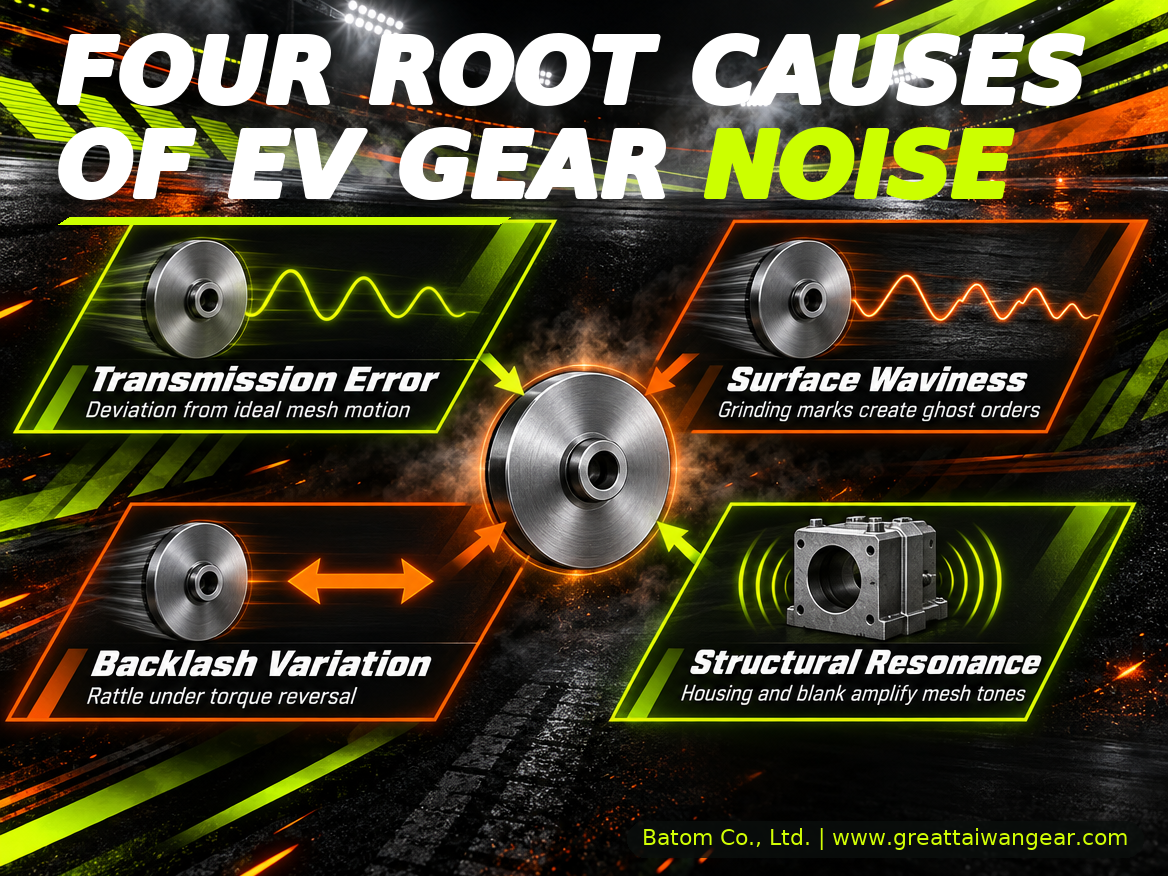
These four causes interact, so the right mix of corrections depends on the drive unit's torque range, speed and housing. Batom works on that mix with customers from the drawing stage through gear design and analysis, setting profile and lead modifications before the first prototype is cut.
NVH Testing Methods Compared
Finding gear noise takes measurements at several scales, from single-tooth geometry to the complete drive unit. No single test finds all four root causes, so most EV programs combine them. The table shows what each method measures and where it fits.
| Method | What it measures | Root cause it finds | Best used for |
|---|---|---|---|
| Gear measuring center (analytical) | Profile, helix and pitch deviations; flank waviness with order analysis software | Geometry behind TE; ghost orders from grinding | Process setup and first-article approval |
| Single-flank roll test | Transmission error of a gear pair under light load | TE level and its harmonics | Pair acceptance and microgeometry validation |
| Double-flank roll test | Total composite deviation, runout and nicks | Runout that drives backlash variation | Fast production checks |
| System acoustic test (order tracking, Campbell diagram) | Radiated noise or vibration by order across the speed sweep | Housing and blank resonance; confirms ghost orders | Drive-unit integration |
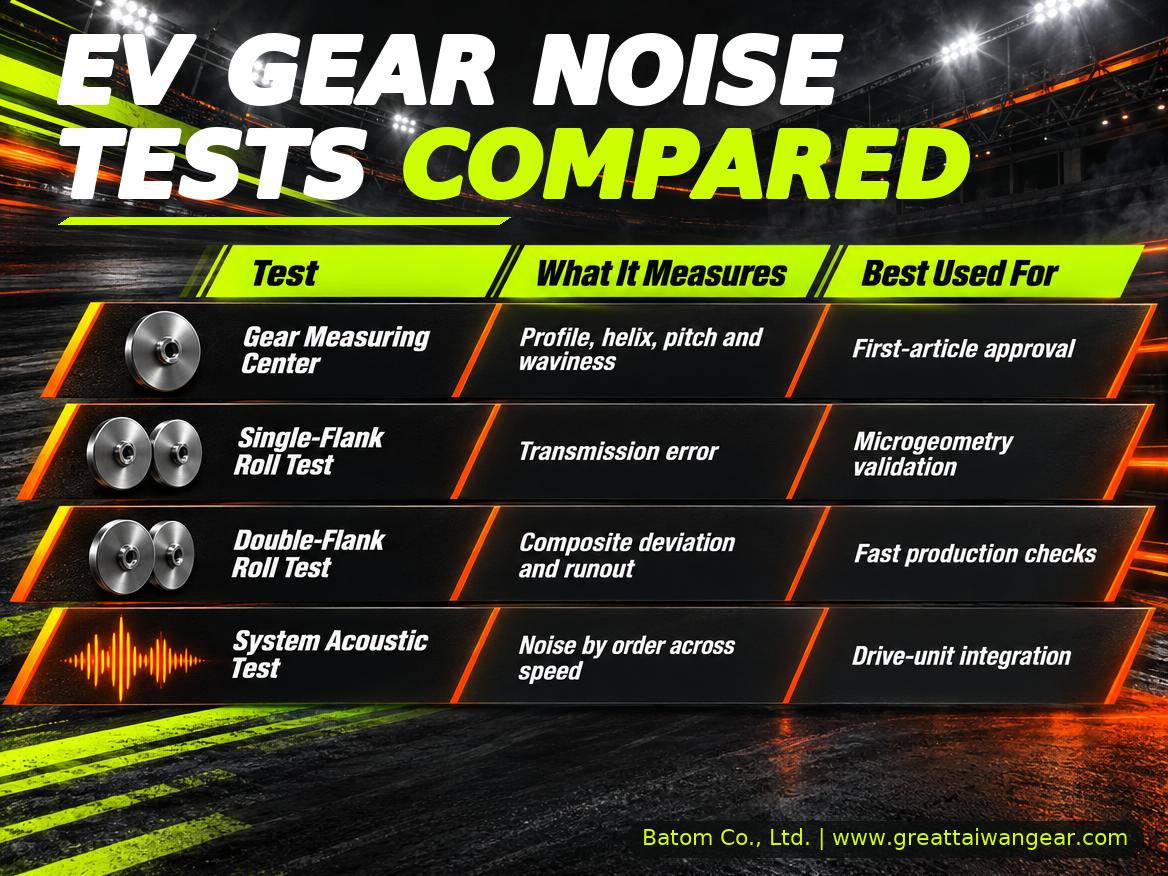
Analytical measurement and roll testing work together. A measuring center tells you why a flank deviates, while a roll test tells you how the pair behaves in mesh. The detail behind measuring centers, roll testing and what a report should show sits in the gear metrology guide. Batom's own inspection uses Klingelnberg P-series gear measuring centers and Frenco double-flank gear rolling testers, with a Zeiss 3-axis CMM kept for dimensional checks. The full equipment list is on the quality guarantee page.
Six Noise Reduction Strategies
Each strategy targets a different root cause. Teams usually work down the list in this order, because the early levers are cheaper to change.
| Root cause | Primary lever | How to verify it worked |
|---|---|---|
| Transmission error | Microgeometry optimization; tighter accuracy grade | Single-flank roll test; measuring center |
| Surface waviness | Grinding process control; power honing or superfinishing | Waviness order analysis |
| Backlash variation | Runout and tooth thickness control; tolerance stack-up | Double-flank roll test |
| Structural resonance | Gear blank and housing redesign; active noise cancellation | System order tracking |
1. Microgeometry Optimization
Microgeometry is the most direct lever on transmission error. Three modifications work together. Tip relief eases each tooth into and out of contact, crowning tolerates misalignment under load, and profile and lead modifications spread the load across the flank. The hard part is robustness. EV torque swings widely, and a modification tuned for one load point can be noisy at another. Good practice optimizes TE across the full operating range and checks that the design still works at the edges of the manufacturing tolerance.
2. Tighter Accuracy Grades
Tighter grades reduce the pitch, profile and helix deviations that feed TE. The Liebherr customer story on EV gear grinding notes that EV gears call for very high accuracy, from DIN 4 to 5 (broadly aligned with AGMA A3–A4). ISO 1328 grades, the older DIN 3962 series and AGMA numbers are roughly comparable rather than 1:1 identical, so name the controlling standard on the drawing. How to specify gear quality walks through that callout. Each step tighter asks more of the whole chain: blank consistency, heat-treatment distortion control and finish grinding.
3. Grinding and Finishing Process Control
Continuous generating grinding usually leaves a more uniform texture than form grinding, with lower periodic waviness. Most EV gears also need bias (twist) control, so the grinder can apply lead crowning without twisting the flank. After grinding, power honing leaves a crossed texture that tends to run quieter. The tradeoffs between the two finishes are laid out in gear grinding vs. gear honing. On Batom's manufacturing floor, twist-controlled grinding runs on Liebherr LGG280 Twist, Reishauer RZ260 Twist and KAPP KX260 Twin Twist machines, and power honing on Fässler HMX-400 machines.
4. Gear Blank and Housing Structural Optimization
Structure is the amplifier that turns micro-level tooth vibration into cabin noise. Typical targets are moving housing modes away from mesh harmonics by redistributing wall thickness, changing blank geometry (slots, web thickness) to alter the torsional path, and stiffening bearing seats. The SAE drive-unit study above shows that blank changes and microgeometry have to be optimized together.
5. Active Noise Cancellation
When passive measures reach their limit, active noise cancellation (ANC) gives extra headroom. Cabin microphones pick up the tone, and the audio system plays an anti-phase signal to cancel it. ANC works best on narrow-band tones like gear whine. It treats the symptom in the cabin, so it supports good gear quality and cannot replace it.
6. Material, Heat Treatment and Surface Finish
Carburizing steels with controlled heat treatment give a more uniform case and less distortion, so there is less stock to grind off and less variation left on the flank. Batom's reference list is the steel table on its manufacturing spec page, including SCM420, SNCM420 / 4320 and 18CrNiMo7-6, and Batom can source other grades when a program needs them. Batom runs its own Nadcap-accredited magnetic particle inspection and shot peening in-house, and completes heat treatment and coatings with tightly integrated, certified supply-chain partners. Superfinishing is done in-house and lowers flank roughness after grinding.
What to Specify and Ask a Gear Supplier for NVH
Buyers and SQE teams can turn the sections above into a short checklist for the drawing and the RFQ:
- Accuracy grade with the controlling standard named, for example DIN 4–5 or the ISO 1328 equivalent your program requires.
- Microgeometry targets: tip relief, crowning and lead modification, with tolerances, plus the load points they were optimized for.
- Waviness requirement: whether order analysis is required on the measuring center, and the acceptance method.
- Roll test requirement: double-flank for production checks, and single-flank or TE data where your program calls for it.
- Process capability: Cpk ≥ 1.67 for automotive production release on the characteristics that drive noise.
- Selective assembly: whether mating parts should be 100% measured and matched to hold backlash and TE inside a tighter band.
The precision gear RFQ checklist covers the rest of the package, from the gear data block to volumes and inspection documents. The noise characteristics depend on the application, so they are best settled in a DFM review before tooling is ordered.
References
- Houser, D. R., et al. (1994). Comparison of Transmission Error Predictions with Noise Measurements. NASA TM-106647 / AIAA-94-3366. NASA Technical Reports Server.
- Hua, X., Thomas, A., & Shultis, K. (2021). Recent Progress in Battery Electric Vehicle Noise, Vibration, and Harshness. Science Progress, 104(1). PMC10358619.
- Horváth, K., et al. (2025). Surface Waviness of EV Gears and NVH Effects: A Comprehensive Review. World Electric Vehicle Journal, 16(9), 540. MDPI.
- He, S., Bahk, C., Li, B., Du, I., et al. (2025). Asymmetric Gear Blank Optimization to Reduce Gear Noise for Electric Drive Units. SAE Technical Paper 2025-01-0079. SAE Mobilus.
- Liebherr. (2019). Liebherr customer story, customer magazine.
About the Author
This article was written by the Batom Co., Ltd. Marketing Department. Batom is a leading precision gear manufacturer founded in 1981, with over 40 years in gear manufacturing. Its certifications include IATF 16949, ISO 14001, ISO 14064-1 (carbon inventory) and ISO 14067 (carbon footprint). Batom's engineers work with EV and automotive programs on DFM and gear manufacturing, from profile and lead modification through series production.
Author's perspective: EV noise targets have changed what "high precision" means on a gear drawing. A grade that once satisfied most transmissions is now the entry point, and the gears that cause trouble are often in tolerance on every listed characteristic. The programs that reach quiet drive units early treat microgeometry, waviness control and roll testing as one specification, agreed before the first prototype rather than after the first noise complaint.
Whether you are prototyping a new EV drive unit or scaling up series production, send the drawing and the accuracy requirement, and Batom's engineering team can review manufacturability and quote the gear components — schedule a consultation. An early design or 3D model is enough to start the DFM discussion on noise-critical features such as microgeometry and finishing route. Batom builds to your drawing and does not sell standard gears, reducers or motors.
Frequently Asked Questions
Q: What causes gear whine in electric vehicles? A: Gear whine comes mainly from transmission error, the small deviation between actual and ideal gear motion caused by tooth geometry errors and deflection under load. Grinding waviness adds "ghost order" tones, backlash variation adds rattle, and housing or gear blank resonance amplifies all of them. EVs make whine audible because there is no engine noise to mask it.
Q: How do you reduce EV gear noise? A: Start with microgeometry (tip relief, crowning, lead modification) and a tighter accuracy grade to lower transmission error. Then control grinding waviness, with power honing or superfinishing where needed. Last, tune the gear blank and housing structure, and use active noise cancellation for any remaining tones.
Q: What are ghost orders in gear noise? A: Ghost orders are tones in the noise spectrum that are not harmonics of the gear mesh frequency. They usually come from periodic waviness left on the flanks by grinding. A gear can meet its profile and helix tolerances and still produce them, so waviness order analysis is needed to find them.
Q: What accuracy grade do EV gears need? A: EV gears commonly call for very high accuracy, around DIN 4 to 5, which is broadly aligned with AGMA A3–A4. The grades in ISO 1328, DIN 3962 and AGMA are roughly comparable but not identical, so the drawing should name the controlling standard.
Q: Does Batom sell standard EV gearboxes, reducers or motors? A: No. Batom provides a one-stop custom service for core gear components, including gears, shafts and related parts, built to the customer's drawing from early DFM co-development through series production and after-sales support. Where a program calls for it, Batom also sources the other components and handles sub-assembly to the customer's design. It does not sell standard catalog gears, reducers or motors, and it quotes from a drawing that specifies geometry, material, accuracy grade and inspection requirements.